
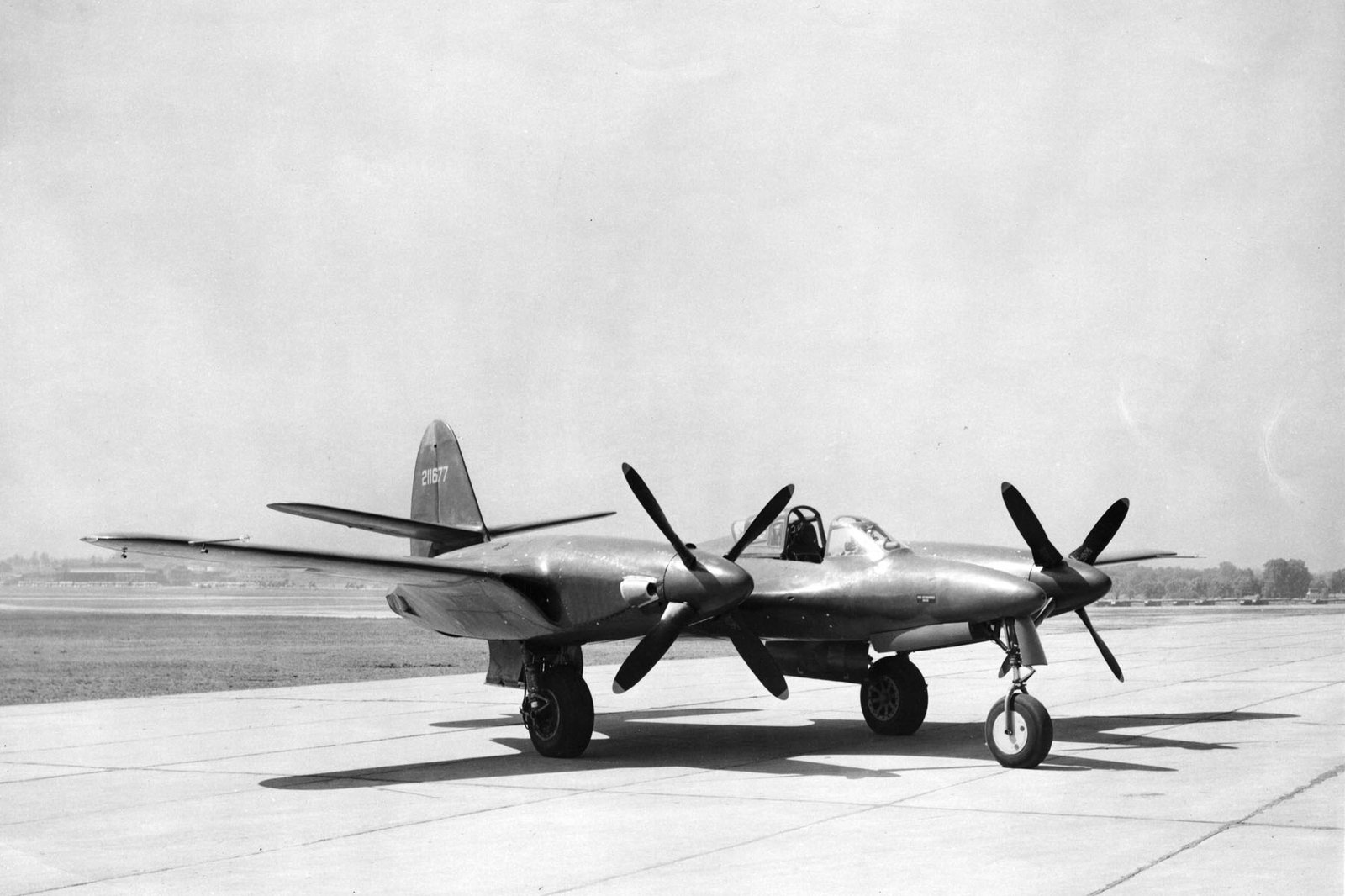
The McDonnell XP-67, also known as the "Bat" or "Moonbat," was the first aircraft designed and built by the McDonnell Aircraft Corporation, founded by James Smith McDonnell in 1939. The project began in response to the U.S. Army Air Corps Request for Data R40-C issued on February 20, 1940, which sought new fighters capable of reaching 450 mph, with a desired goal of 525 mph. McDonnell proposed the Model 2A interceptor, and on September 30, 1941, the U.S. Army Air Forces (USAAF) ordered two prototypes under the designation XP-67 and Materiel Experimental code MX-127. The contract was valued at $1,508,596 plus an $86,315 fee.
Designed as a single-seat, twin-engine long-range interceptor, the XP-67 featured a highly unconventional blended wing-fuselage and nacelle configuration. This design created a continuous airfoil cross-section, leading USAAF test pilots to nickname the aircraft the "Flying Fillet." The aircraft was intended to be a "bomber destroyer" equipped with six 37 mm M4 cannons in the nose, though these weapons were never actually installed in the prototype. The aircraft utilized tricycle landing gear and was powered by two Continental XI-1430-17/19 inverted V-12 liquid-cooled piston engines, each driving a four-bladed, constant-speed, fully feathering propeller. While early expectations placed engine output at 1,350 hp, tests indicated the engines could deliver 1,600 hp at 3,200 rpm.
Construction took place at McDonnell's facility at Lambert Field in St. Louis, Missouri. The first prototype (serial 42-11677) was rolled out in November 1943 and made its maiden flight on January 6, 1944, piloted by McDonnell's chief test pilot, Edward "Ed" Elliott. Performance measurements showed a maximum speed of 357 mph at 10,000 feet and 393 mph at 20,000 feet, with McDonnell estimating a top speed of 405 mph at 25,000 feet. Other performance specifications included a cruise speed of 270 mph, a service ceiling between 37,000 and 38,000 feet, and a maximum internal fuel range of approximately 2,380 miles.
The program was plagued by cooling and handling issues, and the aircraft never reached its anticipated performance levels. On September 6, 1944, the first prototype suffered a starboard engine fire during flight; although the pilot landed safely, the aircraft was severely burned. Consequently, the program was suspended on September 13, 1944, and formally cancelled between October 24 and 27, 1944. Only one aircraft was completed; a second prototype (serial 42-11678) was approximately 15% complete at the time of cancellation. Both the burned first prototype and the unfinished second airframe were scrapped. No examples of the XP-67 survive today.