
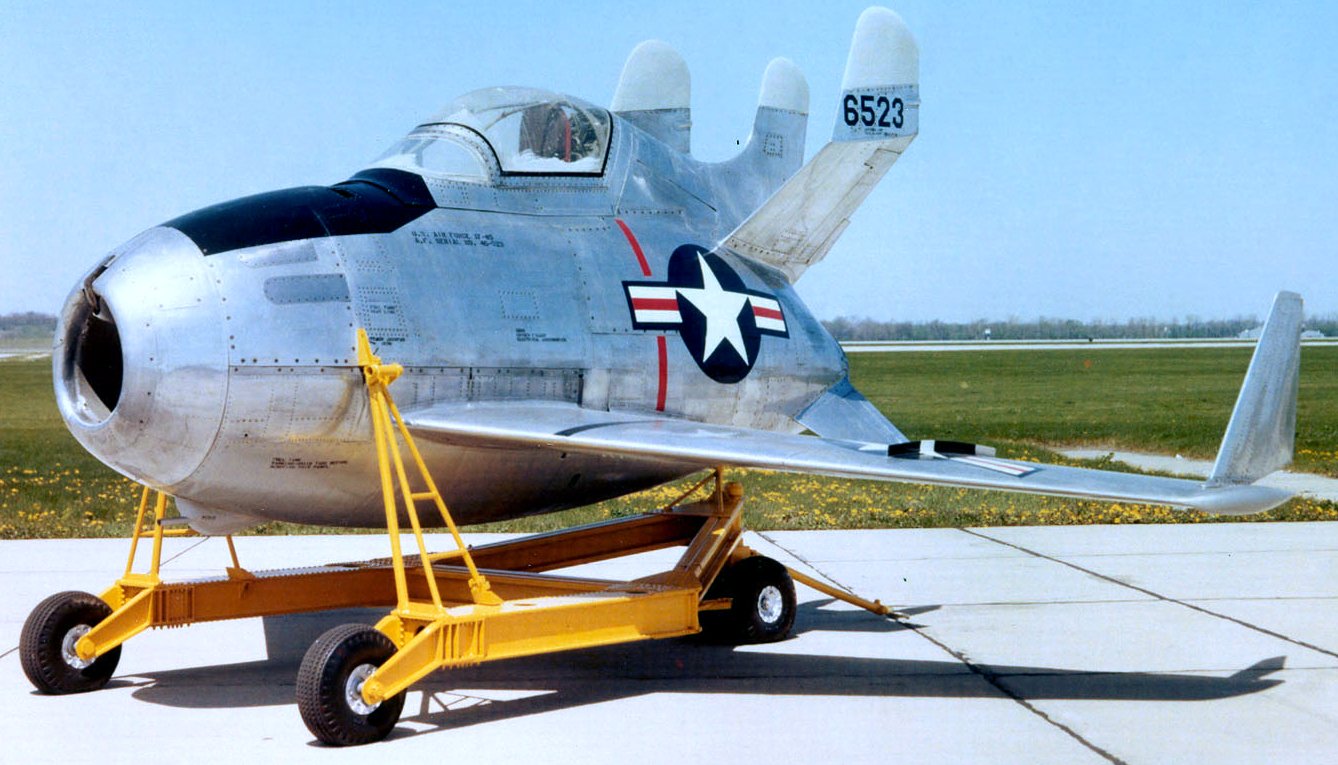
The McDonnell XF-85 Goblin was an experimental jet-powered parasite fighter developed in the immediate aftermath of World War II. Conceived as 'Model 27' by the McDonnell Aircraft Corporation, the aircraft was designed to meet a United States Army Air Forces (USAAF) requirement for a fighter capable of being carried inside the bomb bays of massive bombers, specifically the Convair B-36 and Northrop XB-35. This concept aimed to solve the strategic problem of escorting very-long-range nuclear-capable bombers beyond the reach of conventional fighter aircraft.
Designed under the leadership of company founder James S. McDonnell, the XF-85 featured a highly specialized, compact configuration to fit within a bomber's internal bay. The aircraft was characterized by an egg-shaped fuselage, a mid-mounted straight wing, and a distinctive forked vertical tail. To facilitate recovery, the Goblin lacked traditional landing gear, instead utilizing a retractable hook to engage a trapeze mechanism lowered from the mother ship. For emergency landings, it was equipped with a retractable steel belly skid and small wingtip skids.
The USAAF ordered two prototypes in October 1945, with construction taking place between 1947 and 1948. The XF-85 was powered by a single Westinghouse XJ34-WE-7 axial-flow turbojet engine, producing approximately 3,000 lbf of thrust. This powerplant enabled a maximum speed of 650 mph and a service ceiling of 48,000 feet. The aircraft's planned armament consisted of four 0.50 inch M3 Browning machine guns located in the nose.
Flight testing occurred at Muroc Air Test Center (now Edwards AFB) in California. The first free flight took place on August 23, 1948, piloted by McDonnell test pilot Edwin F. "Ed" Schoch, who remained the only pilot to fly the aircraft. Because a B-36 was unavailable for the tests, a modified Boeing B-29 Superfortress, designated the EB-29B "Monstro," served as the mother ship. Over the course of the program, Schoch completed seven free-flight missions totaling 2 hours and 19 minutes of flight time. Many of these sorties ended in emergency ground landings due to severe turbulence under the EB-29B, which made docking with the trapeze exceptionally difficult.
The program was officially canceled by the USAF on October 24, 1949. The decision was driven by the persistent difficulties in mid-air recovery, the XF-85's inferior performance compared to emerging Soviet MiG-series fighters, and the rapid development of aerial refueling, which provided a more practical solution for long-range escort. Both prototypes survive today as static exhibits: serial 46-0523 is held by the National Museum of the United States Air Force in Ohio, and serial 46-0524 is located at the Strategic Air Command & Aerospace Museum in Nebraska.