
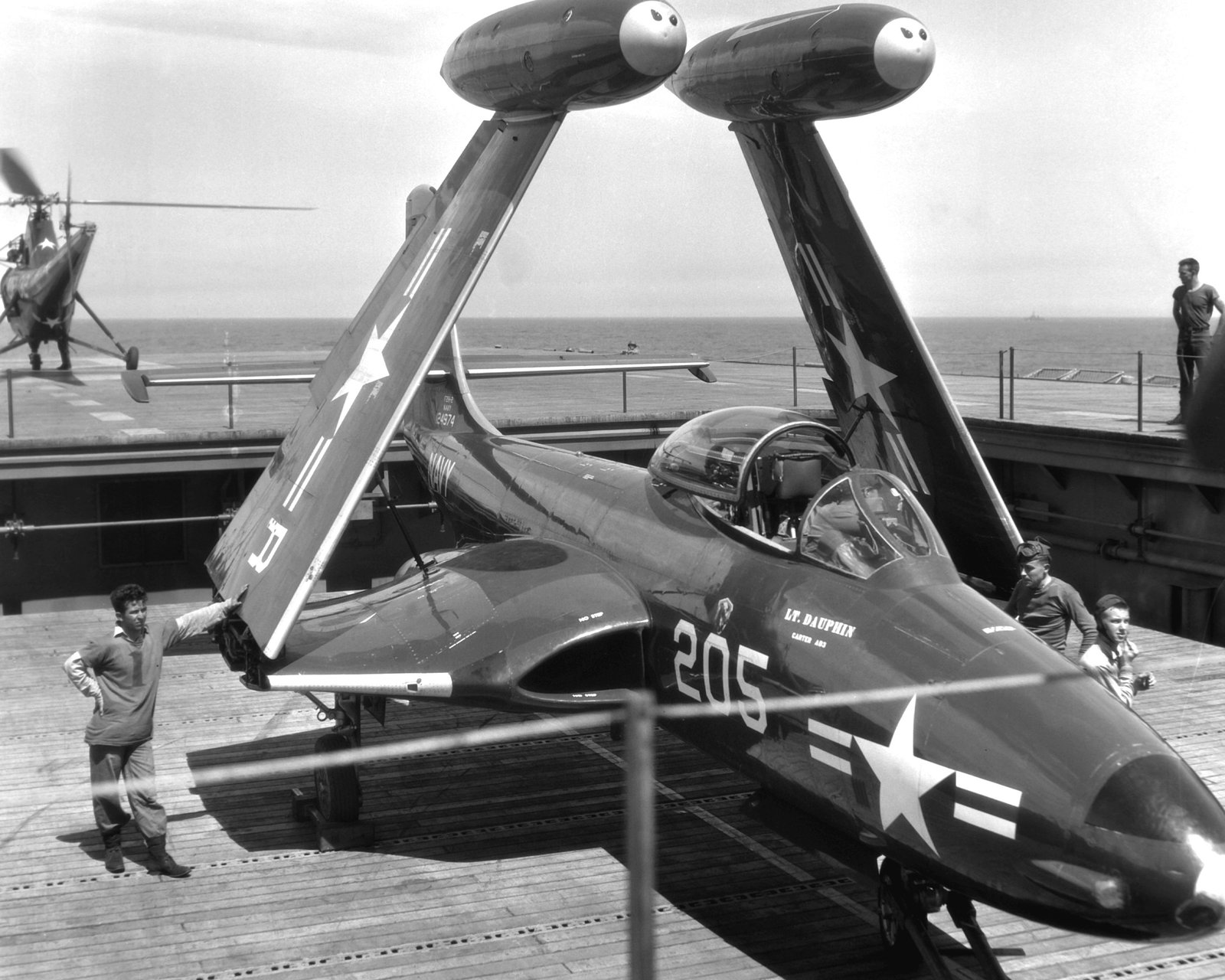
Production and Manufacturer History
The McDonnell F2H Banshee was developed by the McDonnell Aircraft Corporation at its manufacturing plant in St. Louis, Missouri. Production ran from 1947 to 1953, resulting in a total of 895 aircraft. The company, founded in 1939 by James S. McDonnell, later merged with Douglas Aircraft Company in 1967 to form McDonnell Douglas, which subsequently merged with The Boeing Company in 1997. Today, the legacy of the Banshee is maintained through Boeing's archival records.
Design and Technical Specifications
Designed as an enlarged and more powerful successor to the FH-1 Phantom, the F2H featured an expanded airframe, increased armament, and more potent engines. To facilitate carrier operations, the aircraft was equipped with "kneeling" nose landing gear, an ejection seat, and a pressurized cockpit. The prototype F2H-1 first flew on January 11, 1947.
Technical performance was notable for the era; the aircraft could climb at approximately 9,000 feet per minute and set a jet altitude record of 52,000 feet in 1949. The F2H-4 variant, for example, had a length of 48 feet 2 inches and an empty weight of 13,183 lb. Powerplants varied by model, with the F2H-3 utilizing two Westinghouse J34-WE-34 turbojets producing 3,250 lbf each, while the F2H-4 used J34-WE-38 turbojets providing 3,600 lb of static thrust each. Maximum speeds ranged between 524 mph and 580 mph depending on the variant.
Military Service
The U.S. Navy began acquiring the Banshee in August 1948, and the aircraft entered squadron service by March 1949. It saw extensive action during the Korean War (1950–1953), where it served as a fighter-bomber and reconnaissance aircraft. Specifically, it was the preferred choice for providing top-cover escort for USAF B-29 raids over North Korea, though it was generally kept out of "MiG Alley." Additionally, USMC Banshees conducted 27 overflights during the 1955 Taiwan Strait Crisis.
Beyond the United States, the Royal Canadian Navy operated the F2H-3 from 1955 to 1962, marking the only jet-powered fighter ever deployed by the RCN. The U.S. Navy utilized advanced Banshee variants as its primary all-weather carrier fighters until 1959, with the final aircraft leaving the inventory in 1965.
Legacy and Preservation
Armed with four 20 mm cannons and capable of carrying bombs, rockets, and Sidewinder missiles, the Banshee bridged the gap to later swept-wing designs like the F-4 Phantom II. Currently, ten aircraft are known to survive, including an F2H-4 at the National Naval Aviation Museum and an F2H-2P at the Pima Air & Space Museum.