
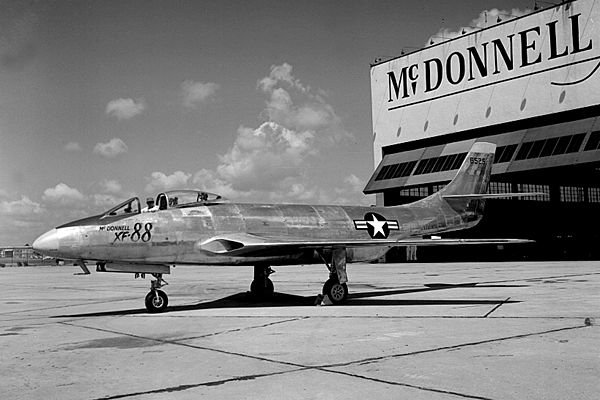
The McDonnell XF-88 Voodoo was conceived during the immediate postwar era as the United States transitioned from piston-powered aircraft to jet propulsion. Developed by the McDonnell Aircraft Corporation, the XF-88 was designed to fulfill the role of a long-range penetration fighter and bomber escort for the U.S. Air Force. The aircraft first took to the skies on 20 October 1948, marking the beginning of a prototype program intended to push the boundaries of escort fighter capabilities.
Production of the XF-88 took place at McDonnell's facilities in St. Louis, Missouri. The program remained limited in scope, with only two XF-88 prototypes ever built. While the aircraft showed promise, the program was officially canceled in August 1950, preventing the XF-88 from ever entering series production or operational military service. Despite the cancellation, the design lineage established by the XF-88 was instrumental to the company's future, feeding directly into the development of the supersonic F-101 Voodoo.
Technically, the XF-88 was powered by two Westinghouse J34 turbojet engines. While the prototype program ended prematurely, the airframes continued to serve as valuable test platforms. One such example was converted into the XF-88B, a turboprop-powered experimental aircraft. The XF-88B first flew on 14 April 1953 and achieved a significant milestone in aviation history by becoming the first turboprop-powered aircraft to exceed Mach 1 in a dive.
The legacy of the XF-88 is tied closely to the evolution of the McDonnell Aircraft Corporation. Founded in 1939 by James S. McDonnell in St. Louis, the company later merged with Douglas Aircraft in 1967 to form McDonnell Douglas. In 1997, McDonnell Douglas merged with Boeing, and the corporate lineage survives today as part of The Boeing Company. Although the XF-88 never saw combat or commercial use, it remains a vital stepping stone in the history of American jet fighter development.