
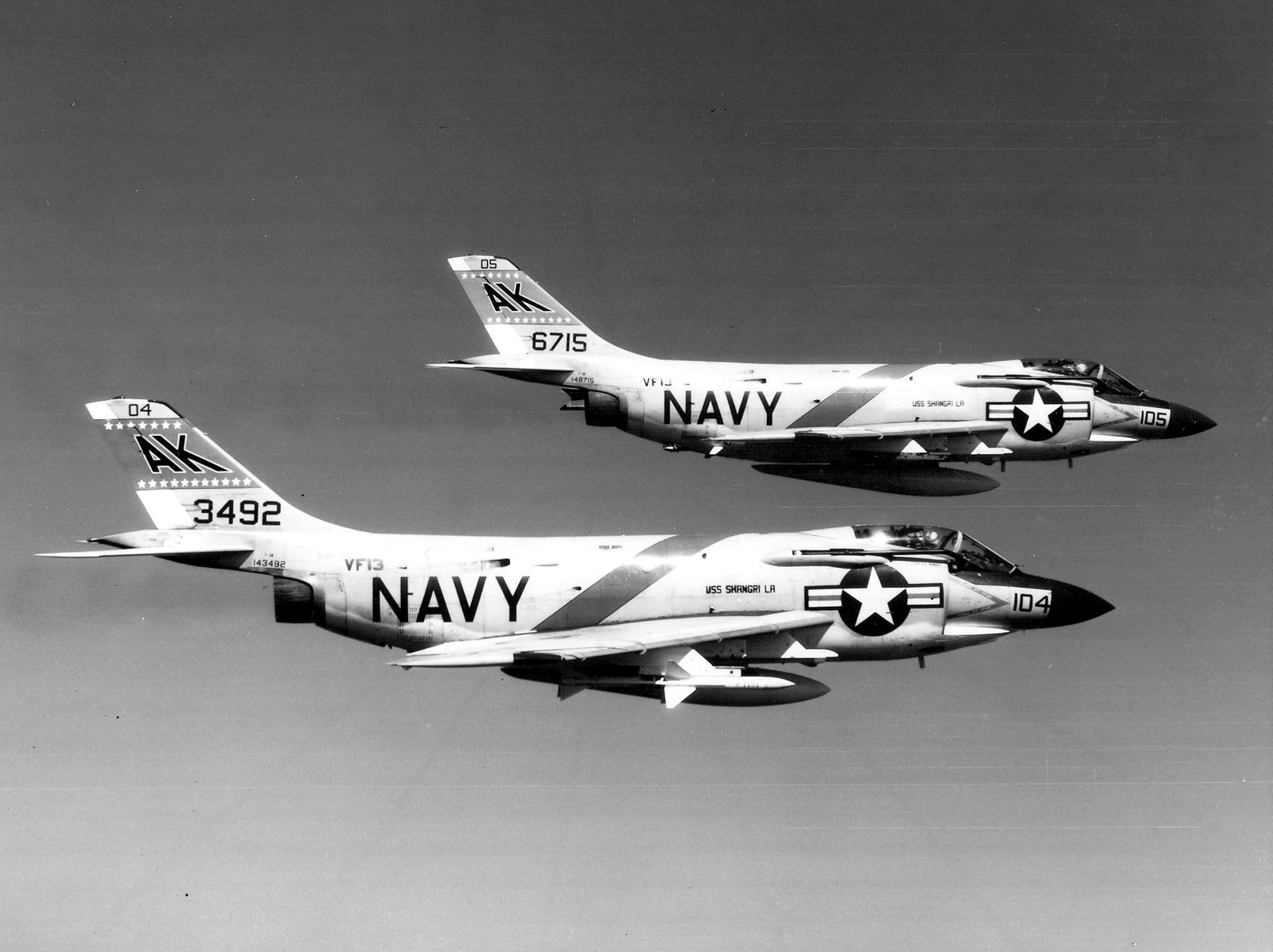
The McDonnell F3H Demon was developed in the 1940s to fulfill a United States Navy requirement for a high-performance, all-weather, swept-wing carrier fighter. Design work commenced in 1949, leading to the first flight of the XF3H-1 prototype on August 7, 1951. While the aircraft was fully qualified as a first-line fighter by 1956, production aircraft did not fly until 1953 due to significant delays in engine development. The F3H was the first swept-wing aircraft produced by McDonnell and remained the only single-engine carrier-based fighter the company ever manufactured.
The aircraft's early history was marred by the unreliability of the Westinghouse J40 axial-flow turbojet engine. These failures resulted in several crashes and pilot fatalities between 1952 and 1955. The issues were eventually resolved by re-engining the aircraft with the Allison J71 afterburning turbojet. The J71-A-2 variant provided approximately 9,700 to 10,000 pounds of dry static thrust, increasing to roughly 14,750 pounds with the afterburner. This change substantially improved performance and cured most of the Demon's operational problems.
Operational service began on March 7, 1956, with 23 Navy fighter squadrons utilizing the aircraft before its retirement in 1964. The F3H served in various roles; early versions acted as interceptors, while the F3H-2 added air-to-ground strike capabilities. Notably, the F3H-2M was one of the first fighters designed to be armed exclusively with guided missiles, specifically the AIM-7 Sparrow, omitting internal guns. Other armament options included four 20 mm Colt Mk 12 cannons, AIM-9 Sidewinder missiles, and up to 6,000 pounds of bombs.
During the Cold War, the Demon participated in critical operational deployments, including fleet defense over Lebanon in the Mediterranean and off Quemoy Island near China in 1958. Although it served during the era of the Vietnam War, it was withdrawn from service before it could see combat in that conflict. Performance figures varied by variant, with maximum speeds reported between 647 mph at altitude and 727 mph at sea level, and a range estimated between 1,180 and 1,370 miles.
Production took place at the McDonnell Aircraft Corporation facility in St. Louis, Missouri. While some sources cite 519 airframes built, Boeing corporate records indicate that 522 units were delivered by 1959. The Demon's legacy is defined by its role as a stepping stone for the McDonnell F-4 Phantom II, which was conceived as an advanced development of the Demon. Today, examples are preserved at the National Naval Aviation Museum and the Pima Air & Space Museum.