
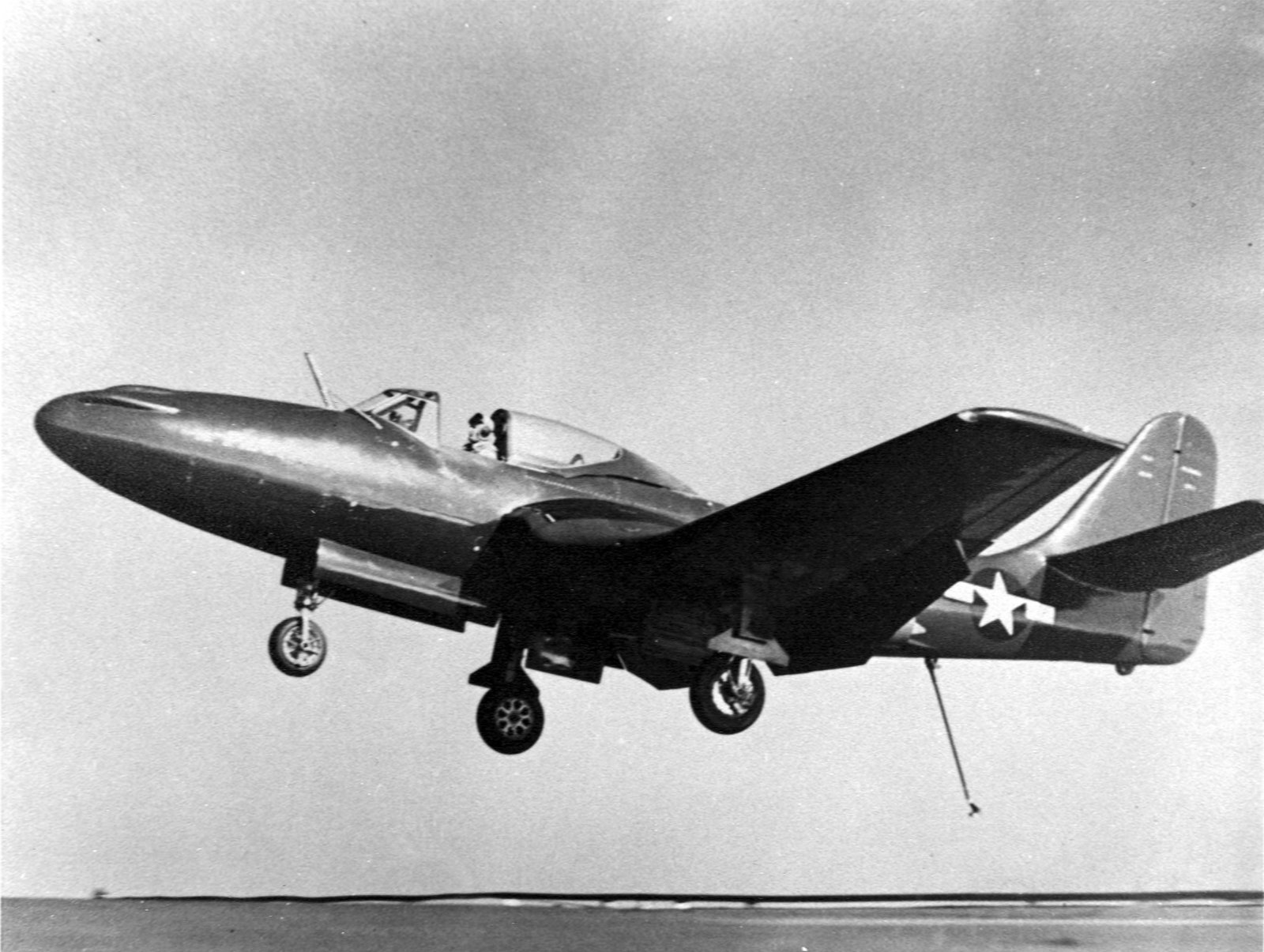
Production and Manufacturer History
The McDonnell FH-1 Phantom was designed and produced by the McDonnell Aircraft Corporation in St. Louis, Missouri. Founded in 1939 by James S. McDonnell, the company focused on military aircraft. Between 1945 and 1947, McDonnell built a total of 62 Phantoms, consisting of two prototypes and 60 production aircraft. Deliveries to the U.S. Navy began in January 1947. The original manufacturer eventually merged with the Douglas Aircraft Company in 1967 to form McDonnell Douglas, which was subsequently acquired by The Boeing Company on August 1, 1997.
Design and Development
In 1943, the U.S. Navy contracted McDonnell to develop a carrier-based jet fighter. The prototype, initially designated as the XFD-1 (and later the FD-1), evolved from an early three-engine-per-wing concept into a twin-engine configuration. The prototype first flew on January 26, 1945. A pivotal milestone occurred on July 21, 1946, when an XFD-1 completed the first carrier qualification of a pure jet in U.S. Naval Aviation aboard the USS Franklin D. Roosevelt (CVB-42), marking the first time a jet-propelled combat aircraft operated from an American aircraft carrier.
Technical Specifications and Performance
The FH-1 was powered by two Westinghouse J30-WE-20 (or J30-P20) centrifugal-flow turbojet engines, each producing 1,600 lb of static thrust for a total of 3,200 lbf. The aircraft had a length of 38 ft 9 in and an empty weight of 6,683 lb. Performance varied by source, with maximum speeds cited between 479 mph and 505 mph, a cruise speed of 248 mph, and a landing speed of 80 mph. It possessed a service ceiling of 41,100 ft, a rate of climb of 4,230 ft/min, and a combat range of 600 nautical miles. For armament, the fighter featured four .50-caliber machine guns in the nose and eight 5-inch HVAR rockets under the wings.
Military Service
The FH-1 served as a carrier-based day fighter for the U.S. Navy and Marine Corps. In 1947, Navy Fighter Squadron VF-17A (later VF-171) became one of the first all-jet Navy squadrons, and by May 1948, they formed the first all-jet squadron aboard a carrier while operating from the USS Saipan (CVL-48). In October 1947, Marine Fighter Squadron VMF-122 received the Phantom at MCAS Cherry Point, North Carolina, under the command of Lt. Col. Marion Carl. This unit formed the "Marine Phantoms" demonstration team. While the aircraft did not see combat in World War II or the Korean War, it served as a critical transition trainer for pilots moving from piston engines to jets. Front-line service ended around 1949–1950, and the aircraft were retired from reserve service between 1953 and 1954.
Legacy
As the first all-jet aircraft ordered into production by the Navy, the FH-1 established the operational doctrine for naval jet aviation. Its success led directly to the development of the more capable F2H Banshee and cemented McDonnell's role as a primary supplier of Navy fighters. Today, several static examples are preserved, including airframes at the Smithsonian National Air and Space Museum, the Pima Air & Space Museum, and the National Naval Aviation Museum.