
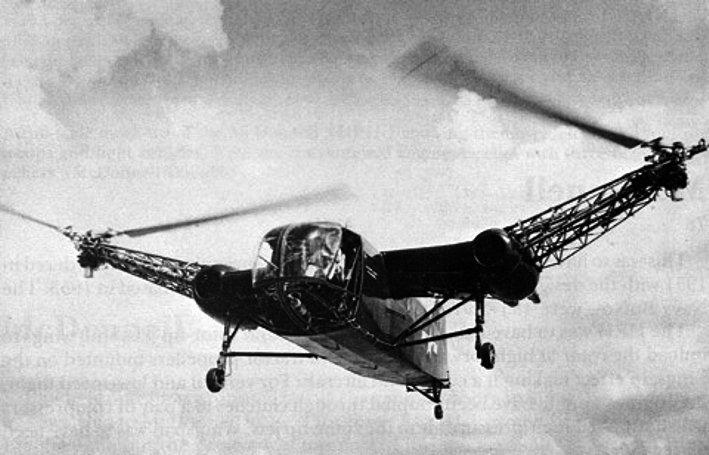
The McDonnell XHJH Whirlaway, originally designated as the XHJD-1, was a pioneering experimental helicopter developed by the McDonnell Aircraft Corporation in the mid-1940s. The project began on May 15, 1944, when the U.S. Navy Bureau of Aeronautics issued a Letter of Intent for a large antisubmarine helicopter. McDonnell responded with the XHJD-1 concept, leading to a formal contract awarded on March 23, 1945. The aircraft was designed by Constantine M. Zakhartchenko and strongly supported by company founder James S. McDonnell, who sought to expand the firm's capabilities into rotary-wing aviation.
Technically, the Whirlaway was a landmark achievement as the first successful transverse twin-rotor helicopter. It featured two three-bladed main rotors mounted on short wing-like pylons that rotated in opposite directions to cancel torque. To ensure reliability, the design incorporated a complex cross-shafted transmission, allowing either engine to power both rotors in the event of a mechanical failure. The aircraft was powered by two air-cooled, 9-cylinder Pratt & Whitney R-985-AN-14B "Wasp Junior" radial piston engines, each producing approximately 450 horsepower. These engines were installed in outboard nacelles at the wing tips.
On April 27, 1946, test pilot Charles R. Wood conducted the first flight at Lambert Field in St. Louis, Missouri. At the time, the Whirlaway was the largest helicopter ever flown in the United States. While originally intended for antisubmarine warfare (ASW) and search-and-rescue missions—with a design capacity for up to ten occupants—it never entered operational service. Instead, it served as a flying laboratory from 1946 until June 1951, logging approximately 250 flight hours. During this period, the U.S. Navy used the aircraft to study rotor-fuselage interactions, transmission behavior, and lateral rotor aerodynamics. The aircraft underwent various modifications to its rotor blades and horizontal tail surfaces during these tests.
Following its retirement in June 1951, James McDonnell donated the sole prototype to the Smithsonian Institution. Today, the aircraft is preserved in the collection of the National Air and Space Museum. The Whirlaway remains historically significant as the last major attempt by a primary American aircraft manufacturer to utilize a conventional laterally spaced rotor configuration before the industry shifted toward tandem or single-rotor designs.