
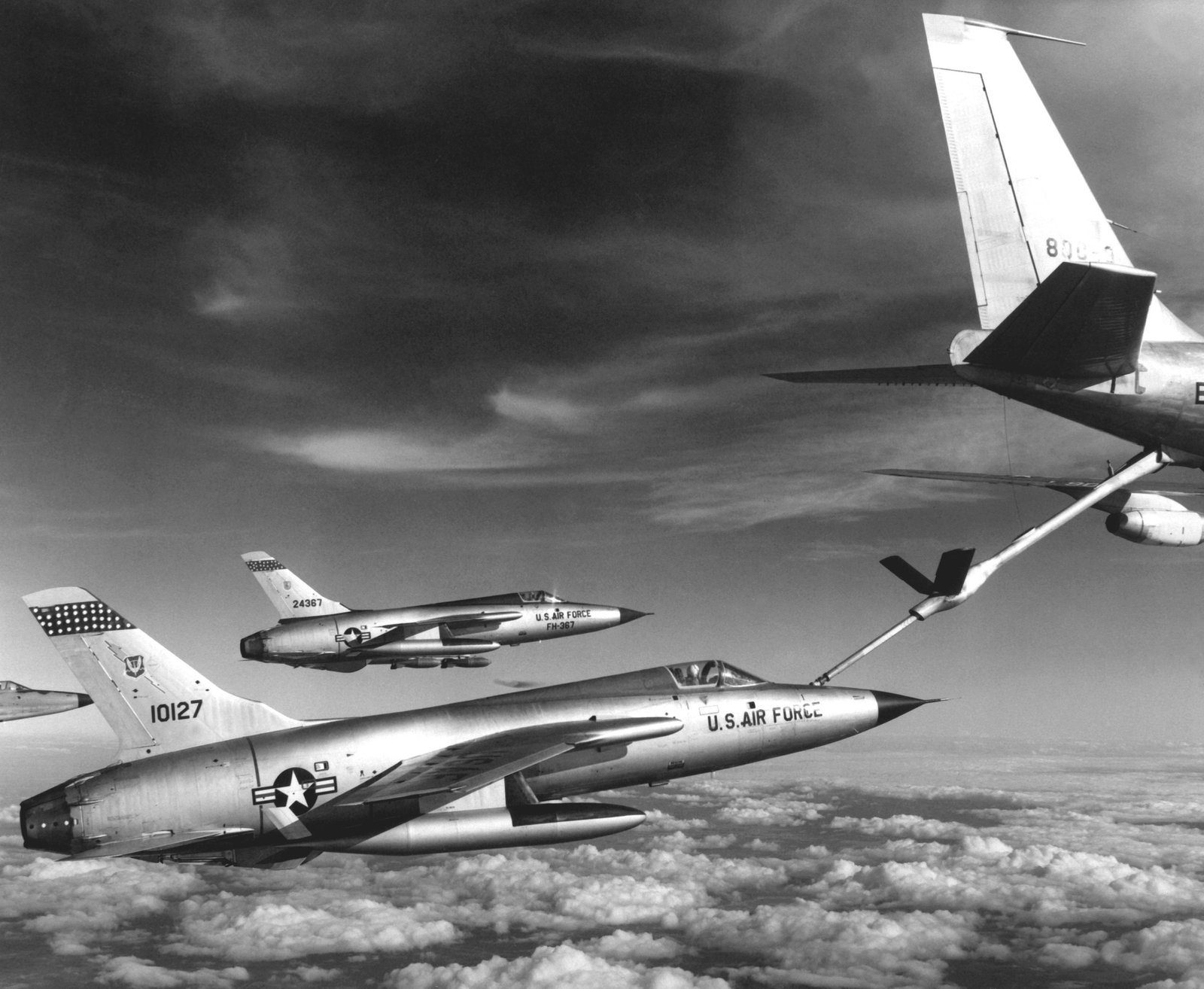
Design and Development
Conceived by chief designer Alexander Kartveli, who previously led the development of the P-47 and F-84 series, the Republic F-105 Thunderchief was designed as a Mach 2-class fighter-bomber. Unlike air superiority fighters, the F-105 was optimized for high-speed, low-altitude penetration. It was one of the largest and heaviest single-engine combat aircraft of its era, featuring an internal bomb bay specifically designed to carry a single tactical nuclear weapon, supplemented by five external pylons. This configuration allowed it to carry a conventional bomb load exceeding that of a WWII B-17 Flying Fortress.
Production and Technical Specifications
Production took place between 1955 and 1964 at Republic Aviation's facility in Farmingdale, Long Island, New York. A total of 833 airframes were built, including 75 F-105B, 610 F-105D, and 143 F-105F two-seat aircraft. Of the F-105F airframes, 61 were later modified into the F-105G Wild Weasel configuration. The aircraft was powered by a single Pratt & Whitney J75 afterburning turbojet; the F-105D standard utilized the J75-P-19W, capable of producing 26,500 lbf of thrust with afterburner. Performance figures for the F-105D included a maximum speed of approximately Mach 2 at altitude, a service ceiling of up to 50,000 feet, and a rate of climb of roughly 23,000 ft/min.
Military Service
The F-105 entered USAF operational service on May 27, 1958. During the Vietnam War, specifically during Operation Rolling Thunder (1965–1968), the F-105D served as the primary strike bomber for deep interdiction. The two-seat F-105F/G variants became the first dedicated Suppression of Enemy Air Defenses (SEAD) platforms, tasked with hunting SA-2 Guideline SAM sites. While the F-105 flew over 20,000 sorties in Vietnam, it suffered extreme attrition; between 382 and 400 aircraft were lost, nearly half of the total production run. Despite these losses, crews were credited with destroying approximately 27 to 29 enemy aircraft, primarily MiG-17s and MiG-21s.
Retirement and Legacy
Following its frontline service, the F-105 was operated by various Air National Guard and Reserve units, including the Georgia, New Jersey, and Virginia ANG. The final ANG flight occurred on May 25, 1983, with the Georgia ANG, while the final Reserve flights took place at Hill AFB, Utah, in 1985. Republic Aviation was acquired by Fairchild in September 1965, becoming Fairchild-Republic, before eventually ceasing aircraft production in the 1980s. Today, approximately 90 to 100 airframes survive as static displays in museums, such as the National Air and Space Museum and the American Airpower Museum, though none remain in flying condition.