
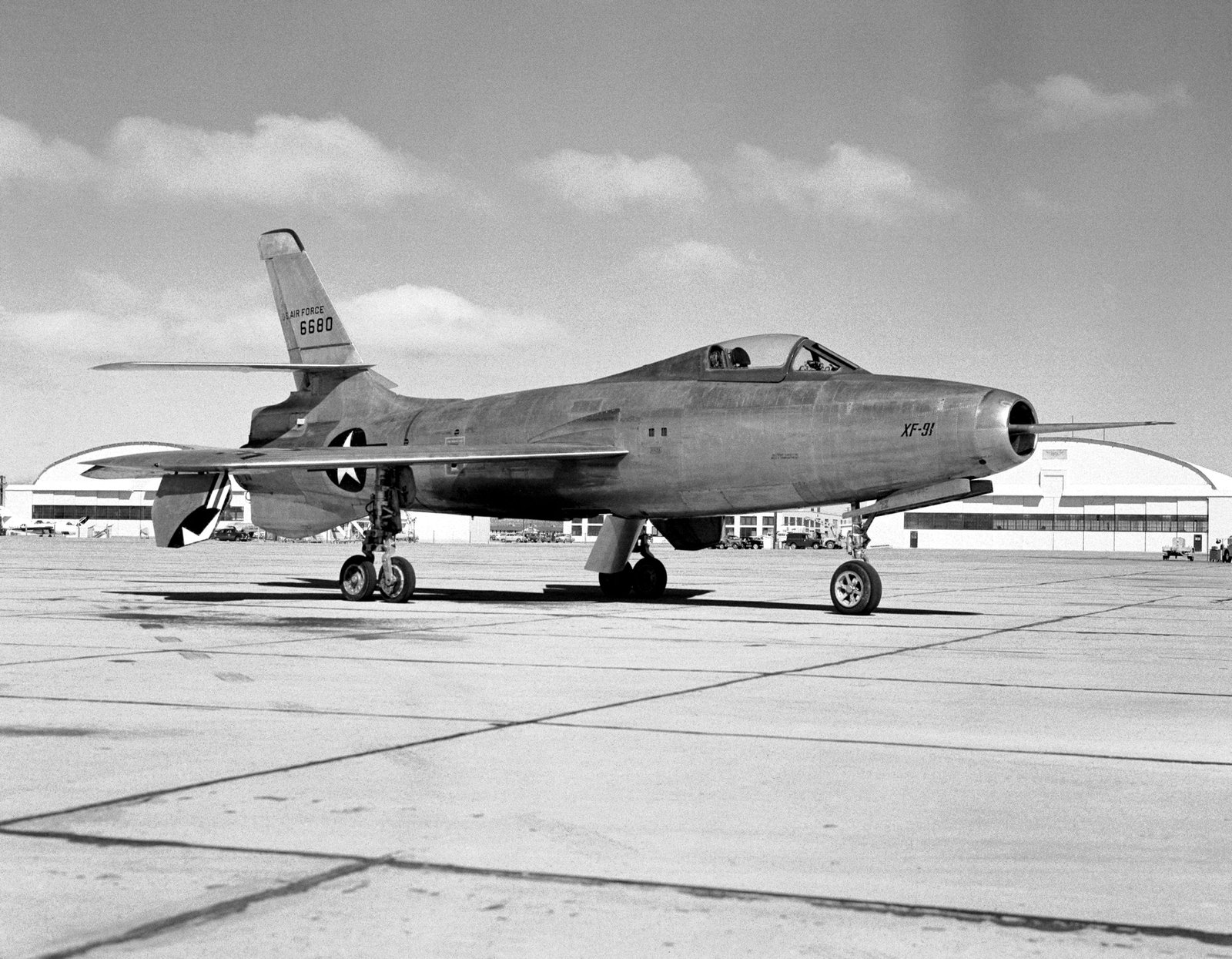
The Republic Aviation XF-91 Thunderceptor was an experimental mixed-propulsion interceptor developed in the late 1940s. Designed by Alexander Kartveli, who was also responsible for the P-47 Thunderbolt and F-105 Thunderchief, the project began in 1946. Kartveli's design was heavily influenced by research from the German Messerschmitt Me 163 Komet, aiming to create a point-defense interceptor capable of rapidly engaging high-altitude bombers.
Two prototypes were constructed at Republic Aviation's plant in Farmingdale, Long Island, New York, with U.S. serial numbers 46-0680 and 46-0681. The aircraft rolled out on February 24, 1949, and made its maiden flight on May 9, 1949, from Edwards Air Force Base, California, piloted by Carl Bellinger. The XF-91 is most notable for becoming the first American fighter to exceed Mach 1 in level flight in December 1951. Official performance data recorded speeds of Mach 1.49, while other accounts citing combined propulsion suggest a maximum speed of Mach 1.71 (approximately 1,126 mph).
Technically, the Thunderceptor featured a unique inverse-taper wing, where the chord was larger at the tip than at the root. This design was implemented to reduce pitch-up tendencies and improve low-speed handling and stall characteristics. Its propulsion system combined a General Electric J47 turbojet (producing up to 6,900 lbf with afterburner) and a Reaction Motors XLR11-RM-9 four-chamber liquid-fuel rocket engine, which provided an additional 6,000 lbf of thrust using liquid oxygen and a water-alcohol mixture. This allowed the aircraft to reach 50,000 feet in just 5.5 minutes.
Although the U.S. Air Force operated the prototypes for evaluation, the XF-91 never entered series production. Proposed variants included the F-91, which would have featured various cannon configurations (M3, T-110, or M24), the F-91-2 equipped with Hughes AIM-4 Falcon missiles, and the F-91B carrying HVAR or "Mighty Mouse" rockets. The program was ultimately cancelled as more powerful turbojets rendered mixed propulsion obsolete. One prototype was lost during testing, while the second is preserved at the National Museum of the United States Air Force in Ohio.