
Production and Manufacturer History
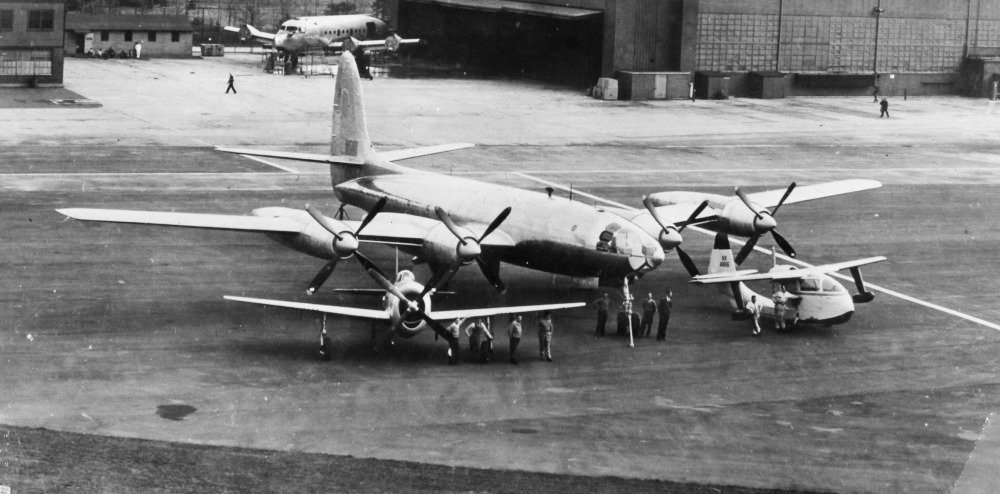
Developed by the Republic Aviation Corporation in Farmingdale, Long Island, New York, the XF-12 Rainbow originated from a 1943 US Army Air Forces (USAAF) requirement for a purpose-built long-range reconnaissance aircraft. Republic Aviation, which had evolved from the Seversky Aircraft Corporation founded in 1931, was a prominent World War II fighter producer. While the company was later acquired by Fairchild Aircraft in 1965, the Rainbow program remained a limited prototype effort. Only two aircraft were built, assigned serial numbers 44-91002 and 44-91003. Although a production order was initially planned, it was cancelled following the end of World War II.
Design and Technical Specifications
The XF-12 was an all-metal, four-engine, low-wing monoplane optimized for maximum aerodynamic efficiency. The design featured a slim fuselage, carefully filleted wing roots, and engine nacelles designed to minimize drag. To maintain performance at high altitudes, the aircraft utilized sliding cowl flaps and dual-purpose pressurization and cooling systems. A defining feature of the Rainbow was its integrated photographic suite, which included day and night cameras and an on-board darkroom for developing and printing film during flight.
Power was provided by four Pratt & Whitney R-4360 "Wasp Major" 28-cylinder, four-row radial piston engines. In the reconnaissance configuration, these engines produced approximately 3,250 to 3,500 hp each, with some arrangements increasing altitude capability by 250 hp. This propulsion system allowed the aircraft to reach a maximum speed of approximately 470 mph at altitude and a service ceiling of 45,000 feet, making it one of the fastest four-engine piston aircraft ever constructed.
Service History and Legacy
The first prototype flew on 4 February 1946. After the creation of the United States Air Force (USAF) in 1947, the aircraft was redesignated as the XR-12. The most notable achievement of the program was "Operation Bird's Eye" on 1 September 1948, during which the second prototype completed a transcontinental photographic mission. In a flight lasting 6 hours and 55 minutes at an average speed of 361 mph, the aircraft captured 390 photographs that formed a continuous 325-foot strip of the continental United States.
Despite its performance, the program was plagued by accidents and shifting priorities. The first prototype suffered a landing-gear failure on 10 July 1947, and the second was destroyed on 7 November 1948 following a No. 2 engine explosion that killed two crew members. The arrival of jet-powered platforms like the Boeing RB-47 Stratojet and the availability of cheaper B-29 and B-50 conversions led to the program's cancellation. Republic also proposed a civil airliner derivative, the RC-2, which attracted provisional orders from American Airlines and Pan American World Airways, but these were cancelled in favor of surplus Douglas C-54/DC-4 transports. The final surviving prototype was destroyed as a target at Aberdeen Proving Ground around June 1952; no examples of the XF-12 survive today.