
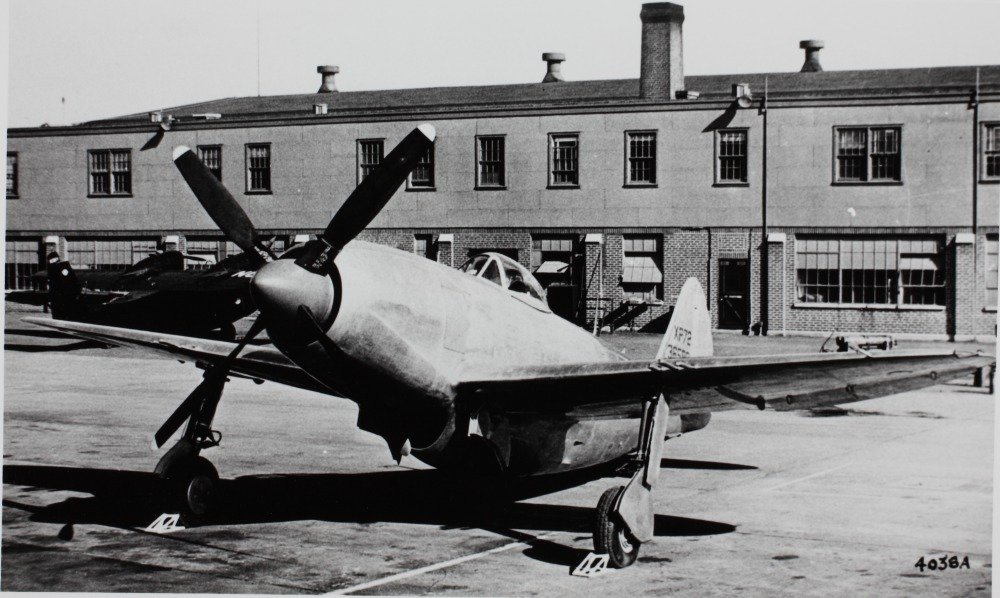
The Republic XP-72 was developed as a high-speed fighter-interceptor designed to push the limits of piston-engine performance. Often referred to as the "Super Thunderbolt," "Superbolt," or "Ultrabolt," the aircraft was an in-house Republic Aviation design derived from the P-47 Thunderbolt. The United States Army Air Forces (USAAF) ordered two prototypes on June 18, 1943, to explore the potential of a heavily armed, high-climb interceptor.
The aircraft was built around the Pratt & Whitney R-4360-13 "Wasp Major," a 28-cylinder, four-row air-cooled radial engine producing approximately 3,500 horsepower. To manage the engine's power, the XP-72 featured a unique supercharging layout with a mechanically driven supercharger mounted behind the pilot and connected via an extension shaft. The first prototype flew on February 2, 1944, while a second prototype, completed on June 26, 1944, utilized an advanced Aero Products contra-rotating propeller to better handle the engine's immense torque.
Technical performance was exceptional for the era. The XP-72 reached a maximum speed of 490 mph (789 km/h) at 25,000 feet and approximately 387 mph at sea level. Its climb rate was equally impressive, reaching 5,280 ft/min at low altitudes and allowing the aircraft to ascend to 20,000 feet in under five minutes. The design offered a service ceiling of 42,000 feet and a range of roughly 1,200 miles when equipped with two 150-gallon drop tanks.
Proposed armament for the production P-72 was unusually heavy for a single-engine fighter, with configurations including six .50 caliber Browning AN/M2 machine guns, or a mix of four machine guns and two 37 mm M4 autocannons. A specialized interceptor version was even contemplated with four 37 mm M4 cannons. While the USAAF initially ordered 100 production aircraft, the order was canceled on January 4, 1945. This decision reflected a strategic shift toward jet-powered interceptors and long-range escorts, prompting Republic to focus on the P-84 Thunderjet. Although test pilot Carl Bellinger is associated with high-speed test reports, the XP-72 never entered operational service. Both prototypes were eventually scrapped, and no examples survive today.