
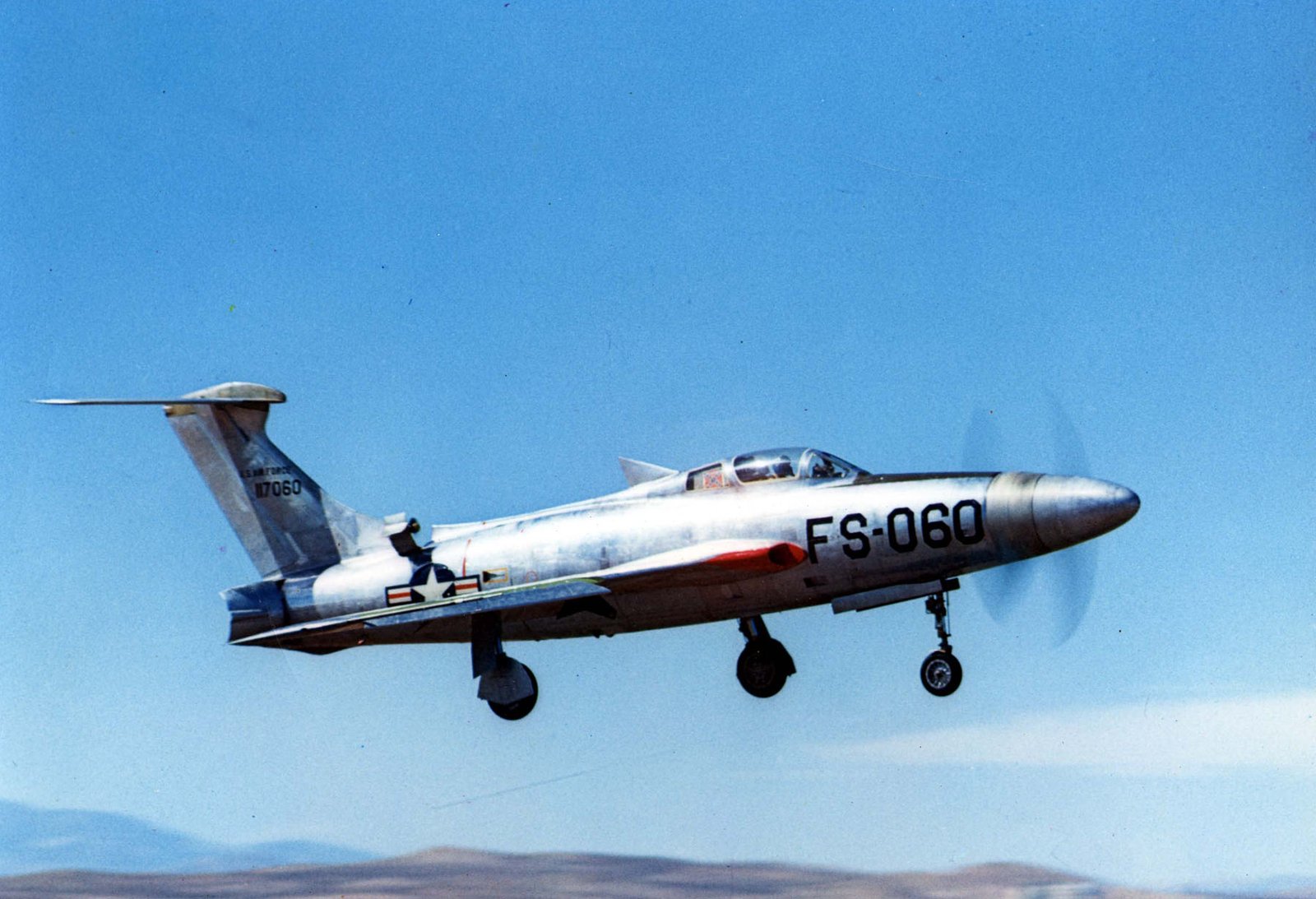
The Republic Aviation XF-84H, known as the "Thunderscreech," was an American experimental turboprop fighter-bomber developed in the mid-1950s. Designed as a derivative of the F-84F Thunderstreak, the aircraft was the result of a joint project between the U.S. Air Force and U.S. Navy, managed by the Wright Air Development Center in Dayton, Ohio. The goal was to create a platform capable of jet-level speeds and the fuel efficiency of a turboprop, making it suitable for long-range bomber escort duties or short-deck carrier operations that did not require catapults.
Republic Aviation Corporation produced two prototypes at its facility in Farmingdale, Long Island, New York, with serial numbers 51-17059 and 51-17060. The XF-84H first took flight on July 22, 1955, at Edwards Air Force Base, California, piloted by Republic test pilot Hank Baird. The aircraft was powered by an Allison XT40-A-1 turboprop engine producing approximately 5,850 shp. This engine was mounted mid-fuselage and utilized an extension shaft to drive a three-bladed Aeroproducts constant-speed propeller at the nose. The propeller was designed for supersonic tip speeds, reaching approximately Mach 1.18 at maximum rpm. This configuration created continuous lateral shock waves, leading to extreme noise and vibration that could be heard on the ground from up to 25 miles away.
Technical challenges plagued the program, including severe vibration in the power shaft, engine reliability issues such as flameouts, and intense torque that caused strong yaw during takeoff. The noise and shock waves also had physiological effects on personnel, including reports of nausea and headaches. Consequently, the aircraft completed only 12 test flights totaling just over 6.5 hours of flight time. The program was cancelled in September 1956, and the final flight occurred on October 9, 1956.
Despite its failures, the XF-84H achieved a recorded top speed of approximately 520 mph (Mach 0.70), making it the fastest single-engine propeller-driven aircraft until 1989. Only one aircraft, serial 51-17059, survives today. After serving as a gate guard at Meadows Field in Bakersfield, California, it was transferred to the National Museum of the United States Air Force at Wright-Patterson AFB, where it remains on display in the Research & Development Gallery.