
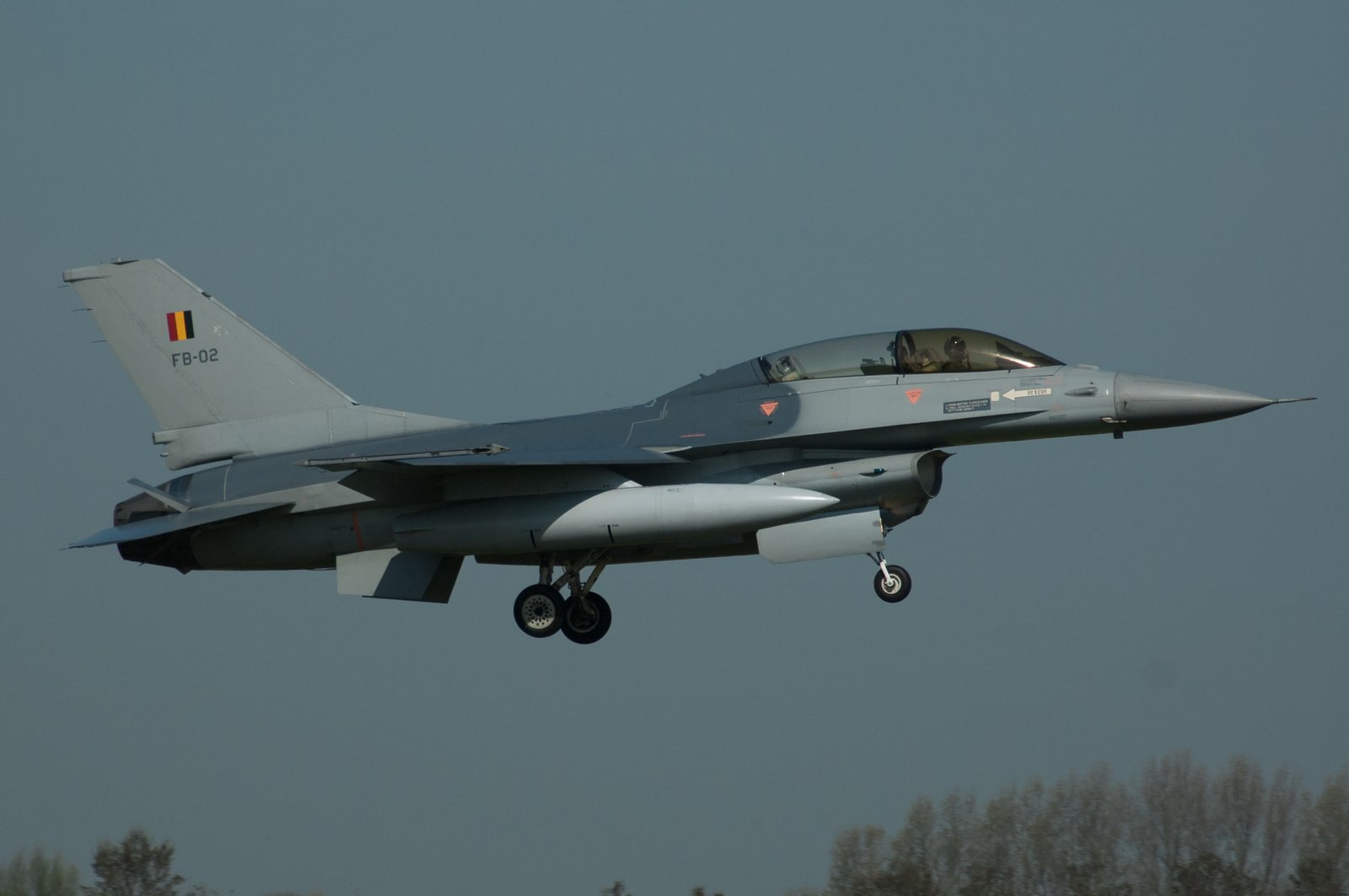
The F-16 Block 20 is not a distinct airframe family but rather an upgraded configuration of the F-16A/B standard, produced as part of later export and Mid-Life Update (MLU) style production. The broader F-16 program was initiated by General Dynamics to meet a United States Air Force requirement for a low-cost, high-performance, and compact lightweight fighter. Depending on the source, the F-16A first flew either on January 20, 1974, or in December 1976.
Production of the F-16 family spanned from 1973 to 2017, with some records citing a start date of 1974. The manufacturing lineage began with General Dynamics, which produced the aircraft until 1993. In 1993, General Dynamics sold its aircraft manufacturing business to the Lockheed Corporation, which handled production until 1995. Since 1995, the program has been managed by Lockheed Martin. Today, the F-16 production line is based at Lockheed Martin's facility in Greenville, South Carolina, where the company continues to support the fleet and produce the modern Block 70/72 variants.
Technically, the aircraft is powered by a single turbofan engine. While specific Block 20 engine models are not detailed in the research, the platform is designed as a multirole fighter capable of carrying up to six air-to-air missiles, as well as various ECM pods and air-to-surface munitions. In terms of crew, the F-16C is a single-seat aircraft, while the F-16D can accommodate one or two personnel. Fiscal 1998 constant dollar costs for the F-16A/B variants were approximately $14.6 million.
In military service, the F-16 has been utilized by the U.S. Air Force and numerous allied nations. It played a pivotal role in Operation Desert Storm in 1991, where it flew more sorties than any other aircraft in the Persian Gulf. It also served during Operation Allied Force in roles including close air support, offensive counter air, and the suppression of enemy air defenses. Following the events of September 11, 2001, the F-16 became a primary component of Operation Noble Eagle, Operation Enduring Freedom, and Operation Iraqi Freedom. Across all blocks, total production is estimated between 4,604 and nearly 5,000 aircraft.