
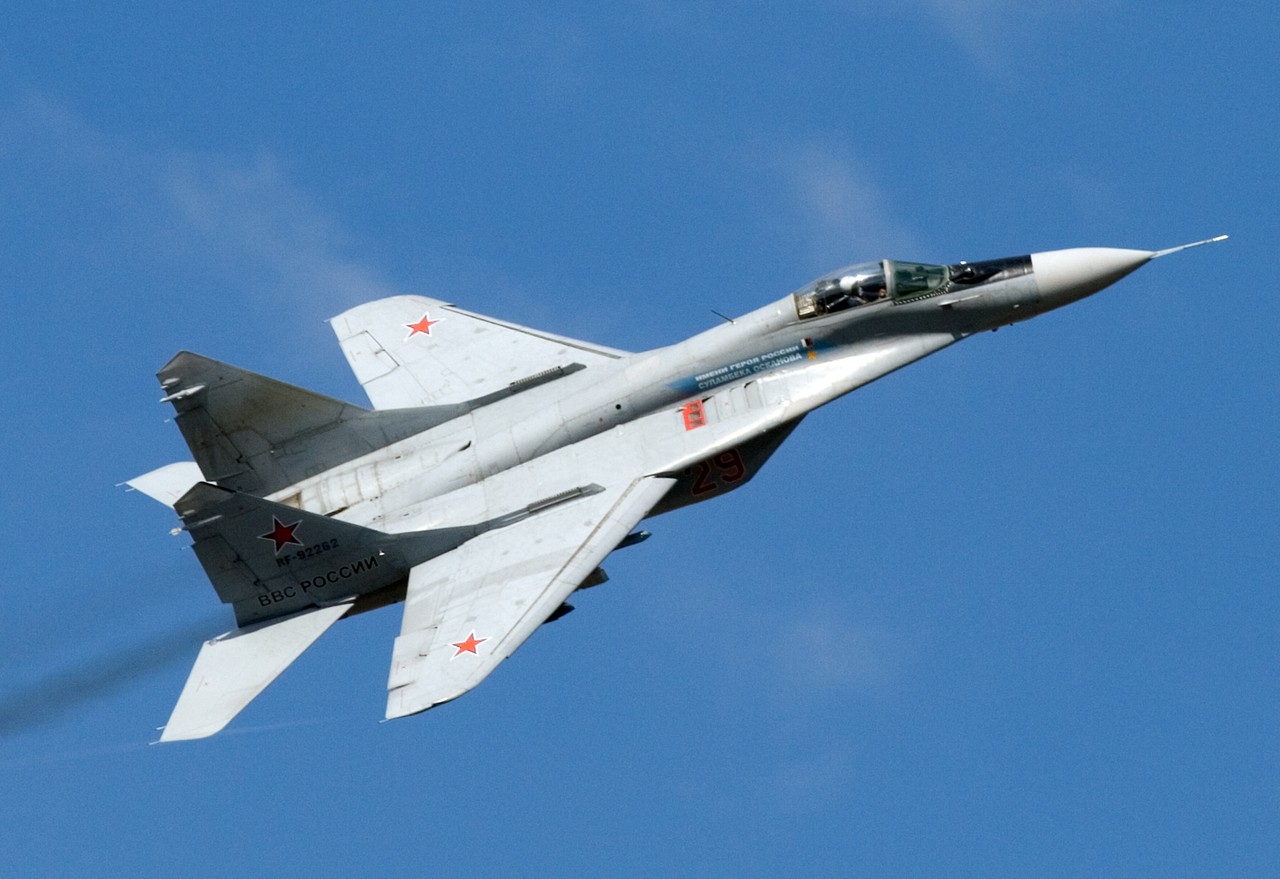
Development and First Flight
The MiG-29 program began in the late 1960s when the Soviet Union recognized the need for a modern tactical fighter to replace the aging MiG-21. Detailed design work commenced in 1974 under the internal designation Product 9, with scale drawings formally approved on July 15, 1974. The Mikoyan design bureau, led by chief designer Rostislav Belyakov, deliberately chose a twin-engine configuration over a single-engine design, drawing from harsh lessons learned with earlier MiG-21 and MiG-23 operations.
Chief test pilot Alexander Fedotov lifted the first prototype, numbered "901," into the air on October 6, 1977, from the flight test center at Zhukovsky. U.S. reconnaissance satellites detected the new fighter within weeks, and NATO intelligence assigned it the codename "Fulcrum." The development program utilized four initial prototypes numbered 901 through 904, though prototype 903 was lost on June 15, 1978, when its engine caught fire during flight testing. Pilot Valeriy Menitskiy successfully ejected without injury.
Production and Service Entry
Production MiG-29s rolled off assembly lines at the Znamya Truda factory in Moscow beginning in 1982, though the first pre-production aircraft had been completed as early as 1979. The Soviet Air Force officially inducted the type into service on June 11, 1987, although Frontal Aviation units had been receiving operational aircraft since June 1983. By the time final stage trials concluded on October 27, 1983, test pilots had completed approximately 2,500 flights across all development aircraft.
Soviet production reached 1,345 aircraft before the collapse of the USSR effectively ended manufacturing in 1991. The production run included 779 MiG-29A single-seat fighters, 197 MiG-29UB two-seat trainers, and 528 improved MiG-29S variants. The MiG-29S, which first flew in 1984 and entered service in 1986, featured enhanced avionics and defensive systems but was restricted from export due to security concerns over its countermeasures suite.
Combat Capabilities and Design
The MiG-29 featured a sophisticated six-pylon weapons system optimized for air-to-air combat, with four stations dedicated to short-range missiles and two for beyond-visual-range engagements. Its twin Tumansky RD-33 turbojets, completed in 1974 after six years of development, provided the thrust necessary to achieve the design goal of a 1.0 thrust-to-weight ratio. This powerplant configuration gave the Fulcrum exceptional climb performance and maneuverability in air-to-air combat scenarios.
The aircraft's design incorporated lessons learned from studying captured Western technology and intelligence on American fighter development. Soviet engineers created a fighter specifically intended to match the capabilities of the McDonnell Douglas F-15 Eagle and General Dynamics F-16 Fighting Falcon, though the MiG-29 entered operational service seven years after the F-15A and four years after the F-16A.
International Service and Modern Variants
Export versions of the MiG-29A formed the backbone of Warsaw Pact air forces and were sold to numerous allied nations including Iraq, India, and North Korea. The basic MiG-29A served primarily as an export platform, while Soviet units transitioned to the more capable MiG-29S standard. Many early production MiG-29As were subsequently upgraded to MiG-29S specifications during overhaul periods.
The carrier-capable MiG-29K variant entered service with both the Russian Navy aboard the Admiral Kuznetsov and the Indian Navy on INS Vikramaditya. Ukraine developed its own modernization program, with the Lviv State Aircraft Repair Plant creating the multirole MiG-29MU2 variant beginning in 2018. The first upgraded Ukrainian aircraft was delivered to operational units in July 2020.
Legacy and Current Operations
Total production exceeded 1,600 aircraft between 1981 and 2019, making the MiG-29 one of the most numerous fighter aircraft of the late Cold War era. Today, significant numbers remain operational with air forces in Russia, India, Ukraine, Poland, and numerous other nations. In an unusual twist, American defense contractor RAVN Aerospace operates MiG-29s for adversary training missions supporting U.S. military units.
The first prototype, MiG-29A 9-01, survives as a museum exhibit at the Central Air Force Museum in Monino, Russia. Additional examples are preserved at the National Museum of the United States Air Force in Ohio and the Pima Air & Space Museum in Arizona, serving as testaments to this significant Cold War-era fighter design.