
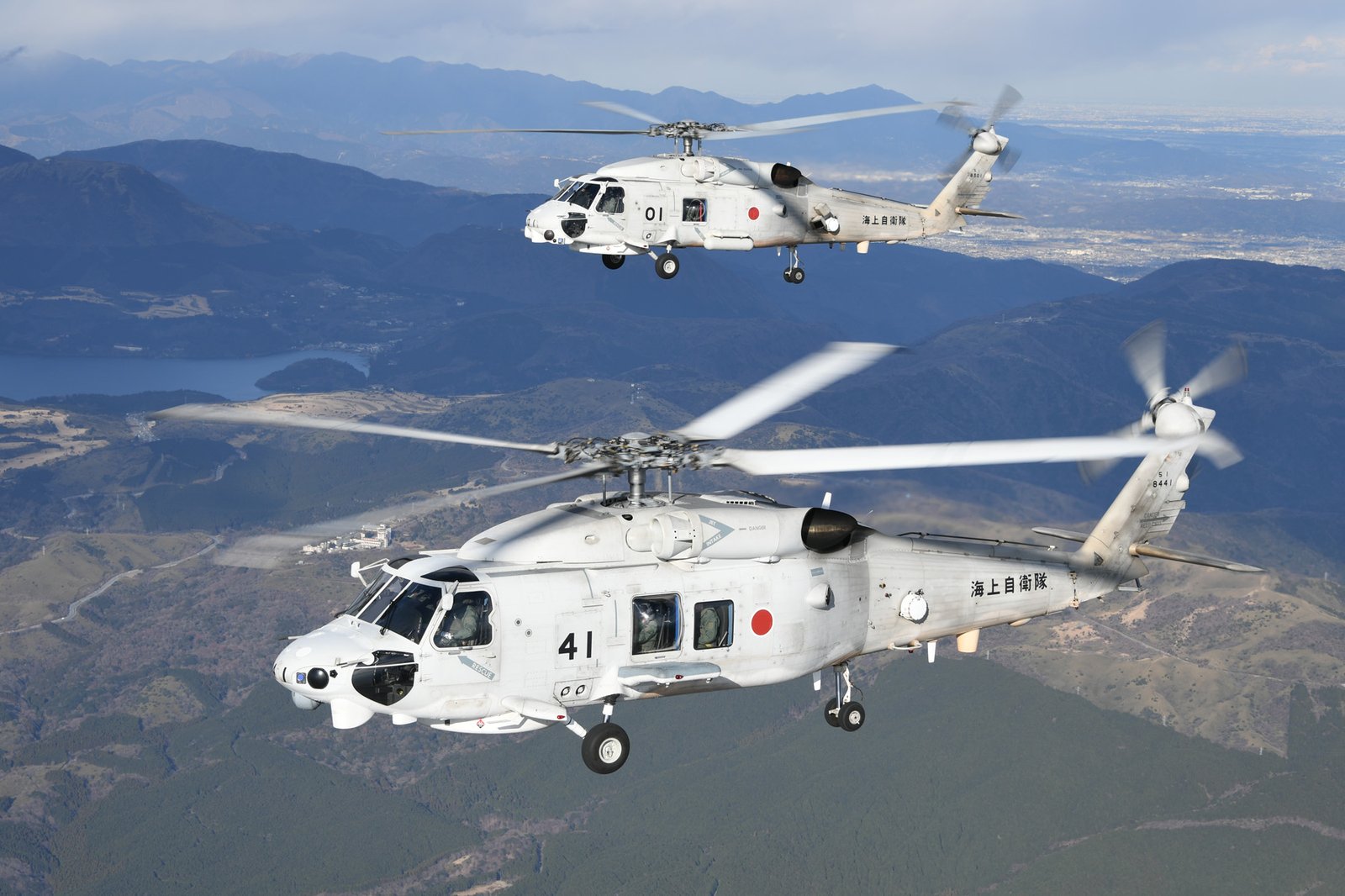
The Mitsubishi SH-60J is a Japanese-optimized maritime helicopter designed specifically to meet the operational requirements of the Japan Maritime Self-Defense Force (JMSDF). Derived from the Sikorsky SH-60B Seahawk family and the broader S-70 lineage, the aircraft was developed as a license-built solution to enhance Japan's naval patrol and anti-submarine warfare (ASW) capabilities. The design process was guided by concepts provided by the JMSDF to ensure the aircraft was tailored for the specific needs of the Japanese fleet.
Development progressed to the prototype stage in the late 1980s, with the first of two XSH-60J prototypes completing its maiden flight in August 1987. Following successful testing, Mitsubishi Heavy Industries (MHI) began delivering the production aircraft in August 1991. Production continued for several years, with reports indicating that 102 examples were built, while other sources state that over 100 units had been produced by 2007. These aircraft were manufactured in Japan under license from the American firm Sikorsky.
Technically, the SH-60J is powered by two IHI Corporation–General Electric T700-IHI-401C turboshaft engines, each capable of producing 1,342 kW (1,800 hp). The aircraft features a main rotor diameter of 16.4 meters and a total length of 19.8 meters. It is designed to carry a crew consisting of two flight crew members and additional mission crew. In terms of performance, the SH-60J reaches a maximum speed of 265 km/h and has a service ceiling of 5,790 meters. Its maximum takeoff weight is rated at 9,750 kg, and it possesses an operational range of 584 km.
In service with the JMSDF, the SH-60J primarily functioned as an anti-submarine warfare patrol helicopter. Beyond ASW, the aircraft and its subsequent variants, such as the SH-60K and SH-60L, have been utilized for anti-surface warfare (ASuW) and search-and-rescue (SAR) operations. The SH-60J established the foundation for Japan's modern shipborne helicopter fleet, eventually being superseded by the improved SH-60K and SH-60L variants.