
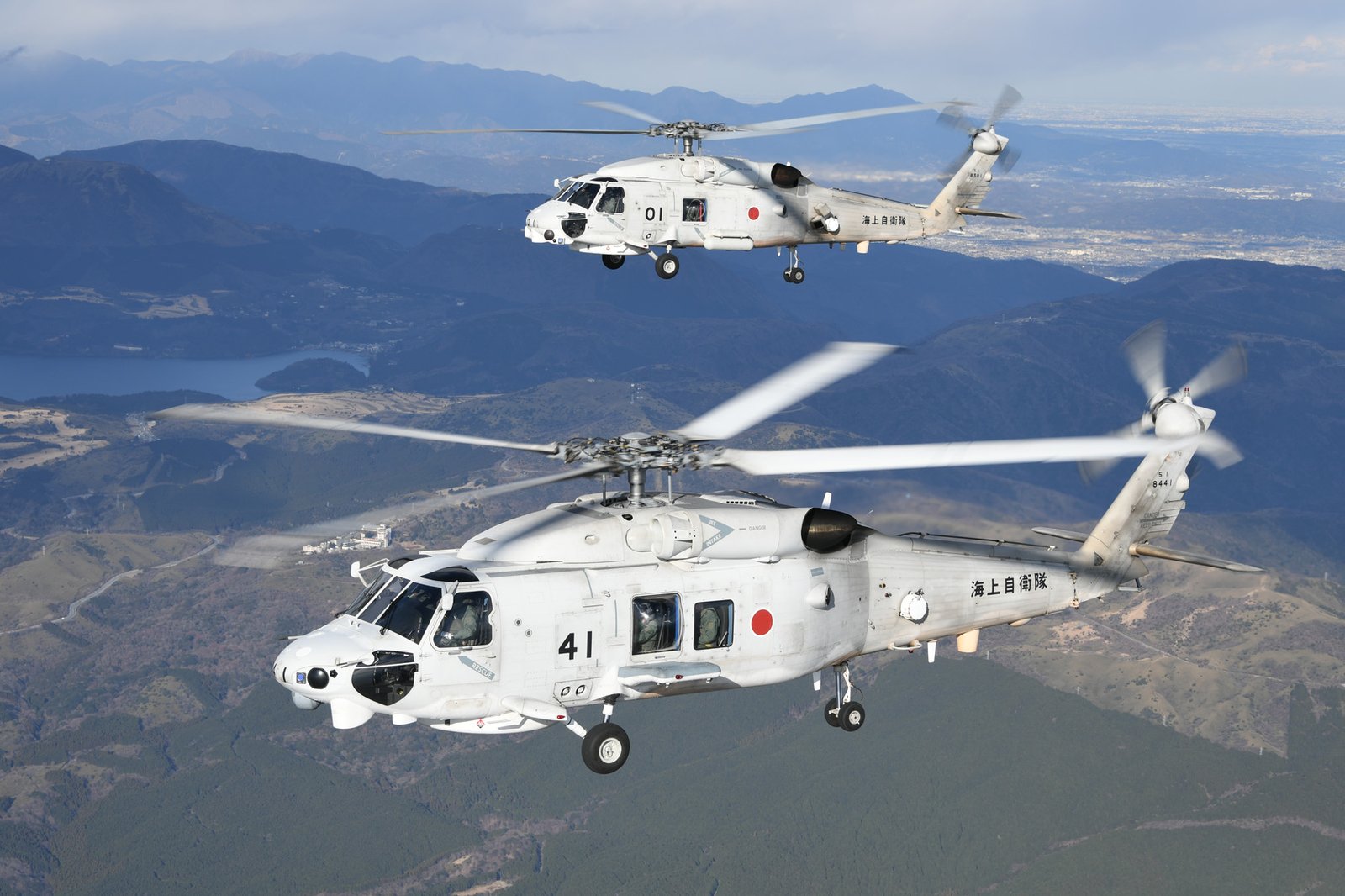
The Mitsubishi Heavy Industries SH-60K is a second-generation Japanese derivative of the Sikorsky Seahawk family, specifically developed to meet the evolving requirements of the Japan Maritime Self-Defense Force (JMSDF). Designed to counter faster and quieter submarines while expanding the SDF's capabilities in disaster response, the SH-60K serves as a multi-role platform capable of anti-submarine warfare (ASW), anti-surface warfare (ASuW), maritime surveillance, transport, and rescue operations.
Development of the aircraft began in 1997 and continued through 2002. A prototype first flew during Japanese Fiscal Year 13 (2001), and two prototype aircraft were delivered to the Defense Agency by June 2002. Following technical and operational validation, the Japanese Ministry of Defense officially approved the SH-60K for operation in March 2005. The first production aircraft was delivered to the JMSDF on 10 August 2005. While an exact end date for production is not documented, the aircraft remained in active production through the 2010s. Production orders totaled 21 aircraft between 2002 and 2004, though total production is estimated to be between 70 and 75 airframes.
Technically, the SH-60K introduced several critical upgrades over its predecessor, the SH-60J. These include a newly developed main rotor blade for improved handling and a specialized Ship Landing Assist System (SLAS) to enhance safety during deck landings in rough seas. The aircraft is powered by two IHI–GE T700-IHI-401C2 turboshaft engines, produced under license by IHI Corporation in cooperation with General Electric, each delivering 2,055 shp. The airframe features a main rotor diameter of 16.4 m and a maximum takeoff weight of 10,650 kg. Its performance includes a maximum speed of between 139 and 143 knots and an operational range of approximately 315 to 900 nautical miles, depending on the mission profile.
In service, the SH-60K operates primarily from JMSDF destroyers. Its armament includes Mk.46, Type 74, or Type 12 torpedoes, Type 67 depth charges, and up to four AGM-114 Hellfire missiles. It can also be equipped with a Type 74 7.62 mm machine gun. As of 2023, the SDF operated 73 SH-60K units, though this number was estimated to be approximately 67 by 2024 following losses, including a mid-air collision on 20 April 2024 near Torishima Island. The SH-60K remains a cornerstone of Japanese naval aviation, bridging the gap between the SH-60J and the recently approved SH-60L.