
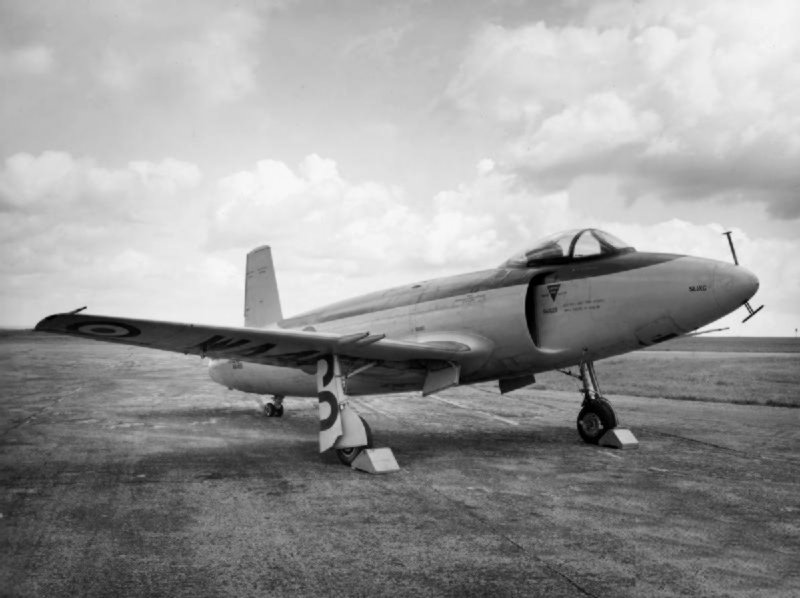
The Supermarine Attacker was a pioneering British single-seat jet fighter designed for the Royal Navy’s Fleet Air Arm (FAA). It holds the distinction of being the first jet aircraft to enter FAA service and the first British carrier-based jet fighter. The aircraft was developed to meet Air Ministry Specification E.10/44, which called for a jet fighter that utilized the laminar-flow wing developed for the Supermarine Spiteful. The prototype, designated Type 398, first flew on July 27, 1946, followed by the first production Attacker F.1 on May 5, 1950.
Designed by a team at Supermarine—a division of Vickers-Armstrongs—the Attacker was a transitional design. It merged late-WWII piston-fighter characteristics with early jet propulsion, most notably by retaining a tailwheel undercarriage. This "tail-dragger" configuration caused the aircraft to sit nose-high on the ground, which complicated carrier operations. The aircraft was powered by a single Rolls-Royce Nene centrifugal-flow turbojet producing approximately 5,000 lbf of thrust. While the F.1 and FB.1 variants used the baseline Nene, the later FB.2 fighter-bomber variant featured a more powerful version of the engine and structural reinforcements to support heavier external stores.
Production totaled 185 aircraft, consisting of three prototypes and 182 production models. The Attacker entered operational service in August 1951 with the 800 Naval Air Squadron based at RNAS Ford. The Royal Navy utilized the aircraft in fighter and fighter-bomber roles, though it was withdrawn from frontline service by 1954 and fully retired by 1957. Beyond the UK, the Pakistan Air Force (PAF) operated 36 Attackers starting in the early 1950s, maintaining them in service until approximately 1964.
Technically, the Attacker F.1 reached a maximum speed of 590 mph with a service ceiling of 44,000 to 45,000 feet. Its armament consisted of four 20 mm Hispano Mk V cannons in the wings, with the ability to carry two 1,000 lb bombs or four 3-inch rockets. Today, the aircraft's legacy is preserved through a static exhibit at the Fleet Air Arm Museum in Yeovilton, Somerset.