
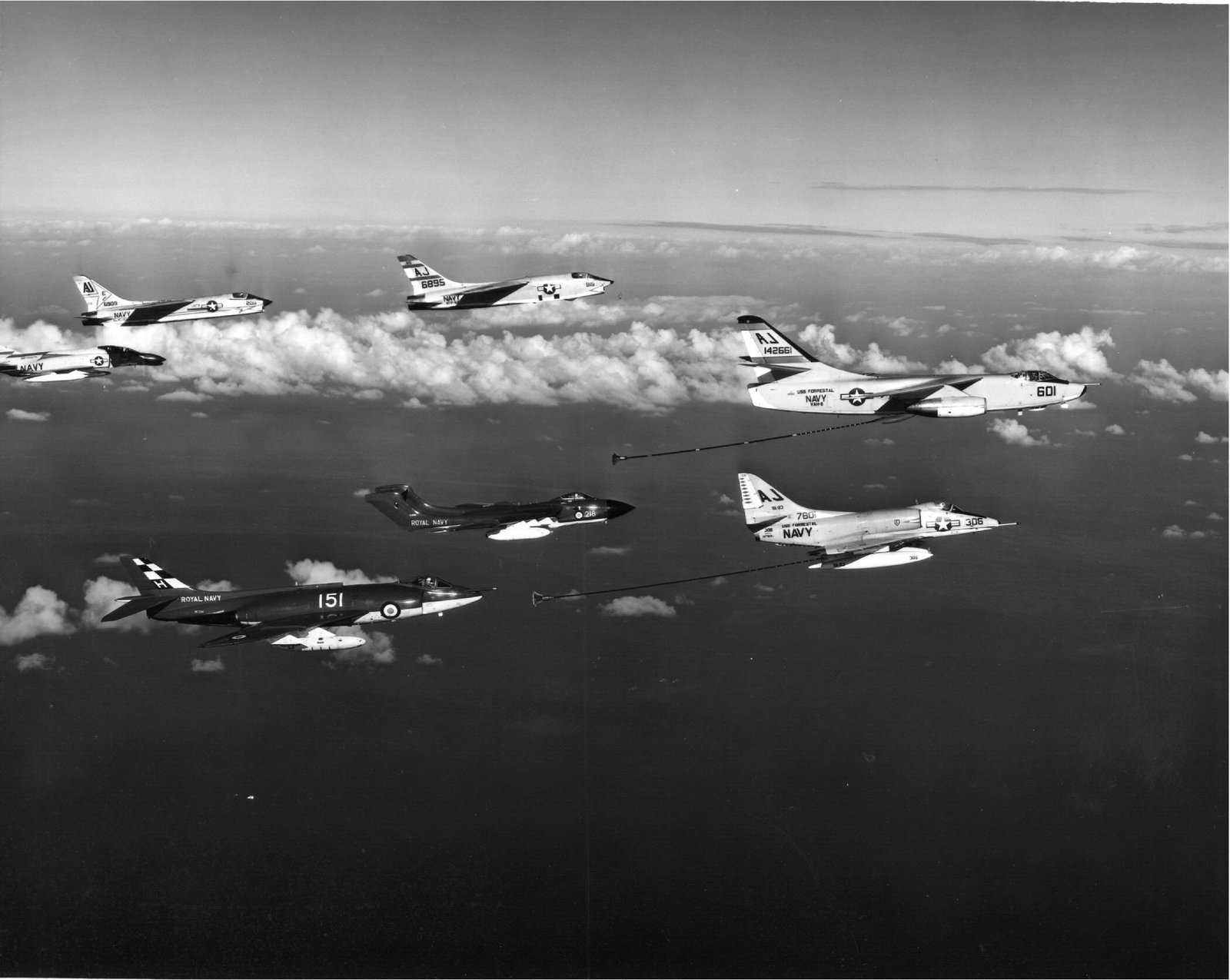
The Supermarine Scimitar was a carrier-borne naval strike fighter developed by Supermarine for the Royal Navy's Fleet Air Arm. It represented the culmination of a post-war design lineage that began with the Type 505 "flexible deck" fighter and progressed through the Type 508, 529, 525, and 544. The Type 544 prototype first flew on January 19, 1956, and the first production aircraft, serial XD212, followed on January 11, 1957. The Scimitar was the final aircraft entirely designed and manufactured by Supermarine as a distinct entity before the company was absorbed into the British Aircraft Corporation (BAC) in 1960.
Production took place at Supermarine's South Marston plant near Swindon, Wiltshire. A total of 76 aircraft were built, though an original order for 100 saw the final 24 units cancelled. The aircraft was powered by two Rolls-Royce Avon 202 single-spool axial-flow turbojets, each providing 11,250 lbf of static thrust. This powerplant enabled a maximum speed of 710 mph at sea level and made the Scimitar the first Fleet Air Arm aircraft capable of supersonic flight in a dive.
Entering service in 1958, the Scimitar was operated exclusively by the Royal Navy. Its primary roles included low-level strike and attack, as well as fighter duties. It was notably the first Royal Navy aircraft equipped to carry the Red Beard free-fall nuclear weapon. Operational service began with 803 Naval Air Squadron on June 3, 1958, which later deployed the aircraft on HMS Victorious, HMS Hermes, and HMS Ark Royal. Additionally, 800B Squadron utilized the aircraft as buddy-tankers to refuel Blackburn Buccaneer S.1s on HMS Eagle between 1964 and 1966. On June 17, 1958, Lt-Cdr D.F. Robbins set a London–Malta speed record in a Scimitar, averaging 588.05 mph.
Despite its performance, the Scimitar suffered from a notoriously high accident rate, with 39 of the 76 produced aircraft lost—an attrition rate exceeding 51%. These losses, which claimed at least nine pilots, were often attributed to demanding landing characteristics on smaller carriers. Front-line service ended in October 1966 with the disbandment of 803 NAS, though the type remained in support roles until 1969. Today, only three static airframes survive: two in the United Kingdom (including the Fleet Air Arm Museum) and one in the United States.