
The Convair B-58 Hustler was a pioneering supersonic strategic bomber developed for the United States Air Force. Designed as a high-speed nuclear deterrent, it was the first operational bomber capable of sustaining speeds of Mach 2. Design studies for the aircraft began in 1949, leading to the first flight of the XB-58 prototype on November 11, 1956. The B-58 officially entered operational service with the Strategic Air Command (SAC) on March 15, 1960.
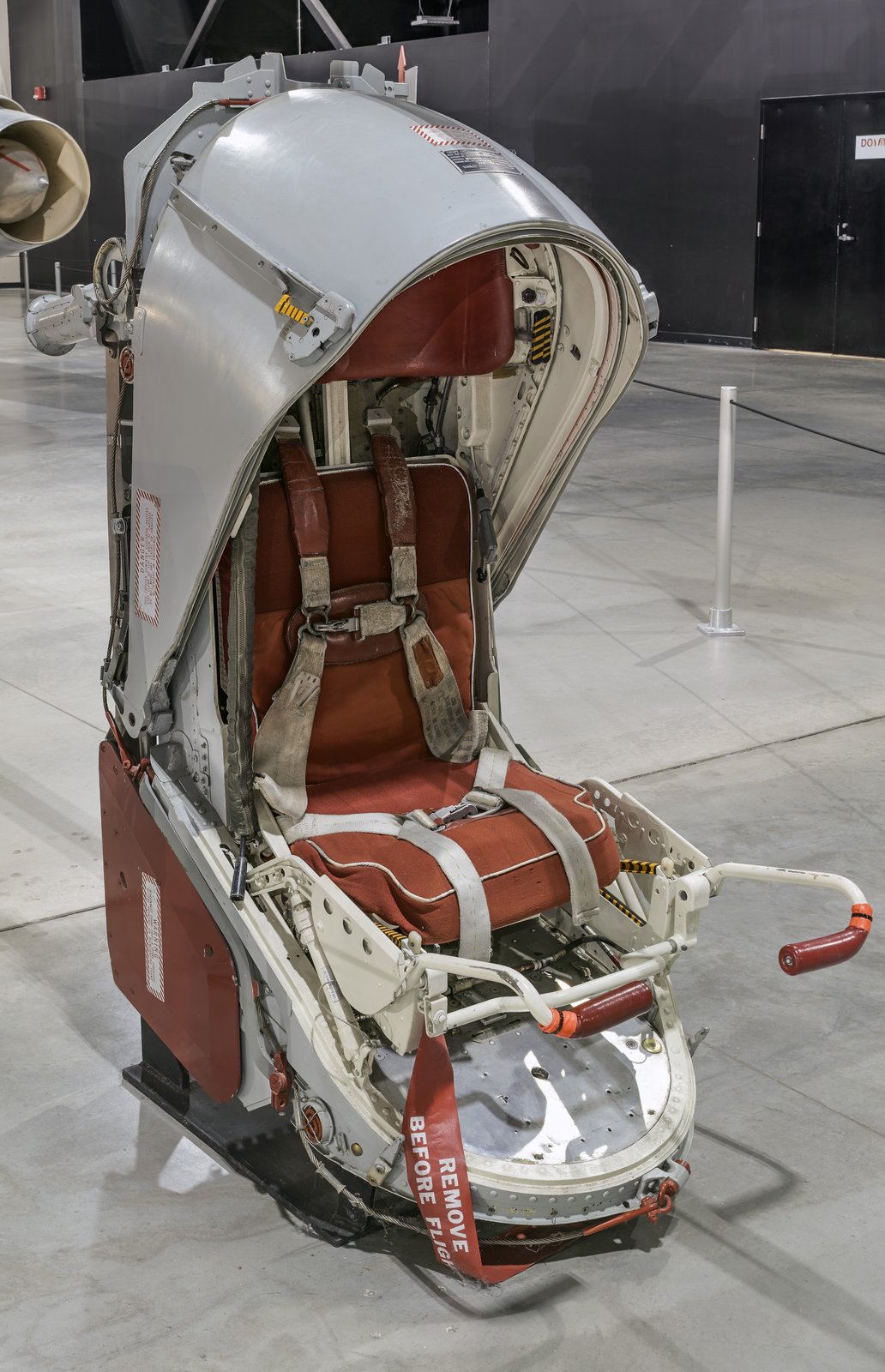
Built by Convair (a division of General Dynamics), the B-58 featured several advanced engineering solutions for its era. To handle the intense heat of supersonic flight, the aircraft utilized stainless-steel honeycomb sandwich skin panels. Its aerodynamic profile was defined by a delta-wing planform and a slender "wasp-waist" fuselage, an application of area-rule shaping. Due to the narrow fuselage, the B-58 lacked an internal bomb bay; instead, it carried a droppable two-component pod under the fuselage that housed a nuclear weapon and additional fuel or reconnaissance equipment. For crew safety at extreme altitudes and speeds, the aircraft was the first to employ encapsulated ejection seats for its three-man crew, consisting of a pilot, navigator/bombardier, and defense systems operator.
Power was provided by four General Electric J79-GE-5A afterburning turbojets, each producing 15,000 pounds of thrust. This propulsion system enabled a maximum speed of approximately 1,325 mph and a service ceiling reaching up to 64,800 feet. The B-58 also introduced the stellar-inertial navigation system, which combined inertial guidance with stellar fixes for precise bombing. In terms of armament, the aircraft was equipped with a remotely controlled 20 mm T171 cannon in the tail and could carry additional nuclear bombs, such as the B43 or B61, on under-wing pylons.
Throughout its service from 1960 to 1970, the B-58 never saw combat, serving instead as a strategic deterrent during the Cold War. Despite its operational role, the aircraft was highly successful in setting records, achieving 19 world speed, altitude, and payload marks. Notably, a B-58A set three speed records on March 5, 1962, during a round-trip flight between Los Angeles and New York, earning the crew the Bendix and Mackay Trophies. However, high operating costs and a high accident rate led to a limited production run of 116 aircraft (30 test/pre-production and 86 operational) and a relatively short service life. Today, only eight B-58s survive in museums, including examples at the National Museum of the U.S. Air Force, the Pima Air & Space Museum, and the SAC Aerospace Museum.