
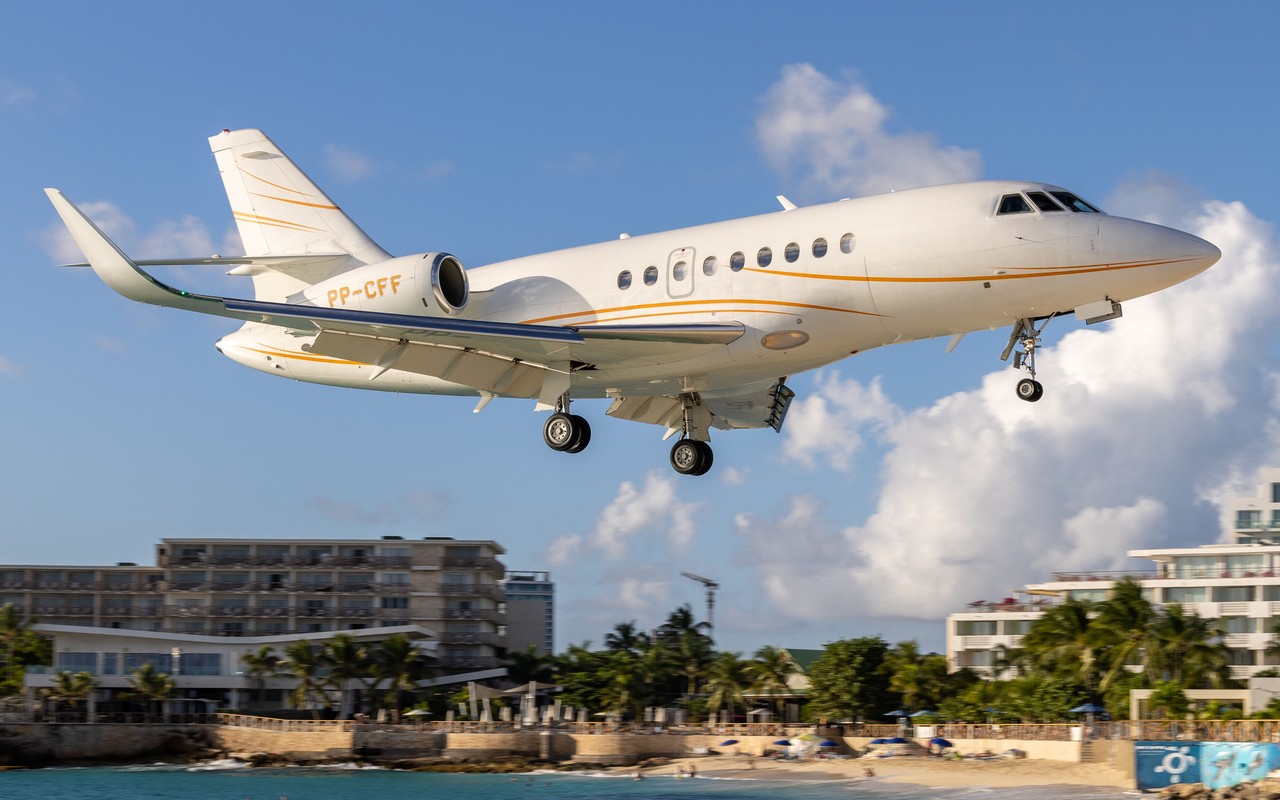
Revolutionary Digital Design
The Falcon 2000 emerged from Dassault Aviation's ambitious goal to create a next-generation business jet by reimagining their successful Falcon 900 trijet. Engineers Jean Pus and Guy Mitaux-Maurouard piloted the prototype on its maiden flight from Bordeaux-Mérignac on March 4, 1993, marking the debut of an aircraft that would transform executive aviation through its groundbreaking use of entirely digital design technology.
Market Dominance and Production Success
Entering service in 1995 at an initial price of $17.85 million, the Falcon 2000 quickly established itself as a dominant force in the super-midsize business jet market. By the early 2000s, Dassault had delivered 231 original variant aircraft, with total sales exceeding 300 units before production transitioned. The broader Falcon 2000 family has achieved remarkable success, with approximately 700 aircraft built across all variants, demonstrating sustained market appeal over three decades.
Dassault Aviation Legacy
Dassault Aviation's heritage traces back to 1938 when Marcel Bloch established an engine factory that would evolve into the company's headquarters. The Falcon family lineage began in 1963 with the Falcon 20, establishing Dassault as a premier business jet manufacturer. The company developed the Falcon 2000 in partnership with Alenia, leveraging decades of aviation expertise to create an aircraft that would carry the Falcon name into the digital age.
Engineering Excellence and Powerplant
The original Falcon 2000 utilized twin General Electric/Honeywell CFE738-1-1B turbofan engines, each producing 5,918 pounds of thrust while consuming 245 gallons per hour. This powerplant configuration enabled the aircraft to achieve a maximum range of 3,052 nautical miles under NBAA IFR conditions with four passengers, allowing nonstop flights from New York to Los Angeles and London to Istanbul.
Evolutionary Variants
The 2003 introduction of the Falcon 2000EX marked a significant advancement, featuring Pratt & Whitney Canada PW308C turbofans generating 7,000 pounds of thrust each. This enhanced powerplant extended the aircraft's range to 3,878 nautical miles, broadening its operational envelope. The 2007 Falcon 2000DX continued this evolution, incorporating the EASy flight deck system while maintaining the proven PW308C engines. Current variants like the Falcon 2000LXS command $36 million, reflecting decades of continuous refinement.
Operational Excellence
Pilots praise the Falcon 2000 for its sophisticated Collins Pro Line 4 flight deck in original variants, later upgraded to advanced glass cockpit configurations. The aircraft's digital design heritage translated into simplified systems and improved aerodynamics, creating an airplane that balanced performance with operational efficiency. Its ability to access shorter runways while maintaining transcontinental range made it particularly attractive to corporate flight departments.
Global Manufacturing Evolution
Dassault's 2017 partnership with Reliance Infrastructure created Dassault Reliance Aerospace Ltd (DRAL) at Nagpur airport in Maharashtra, India. This facility has supplied over 100 major components since delivering its first front section in 2019, with complete aircraft production scheduled to begin by 2028. This manufacturing shift represents a strategic expansion of Falcon 2000 production capabilities while maintaining Dassault's exacting quality standards.
Enduring Legacy
The Falcon 2000's significance extends beyond its individual success to its role in the broader Falcon family achievement. In 2009, Dassault delivered the 2,000th Falcon aircraft across all variants since 1963, with the Falcon 2000 series contributing substantially to this milestone. The aircraft's digital design methodology influenced subsequent business jet development industry-wide, establishing new standards for computer-aided aircraft development.
Today, hundreds of Falcon 2000 aircraft continue operating worldwide, serving corporate flight departments, charter operators, and private owners. The type's combination of transcontinental range, operational flexibility, and technological sophistication ensures its continued relevance in the competitive business aviation market, cementing its position as one of the most successful executive aircraft ever produced.