
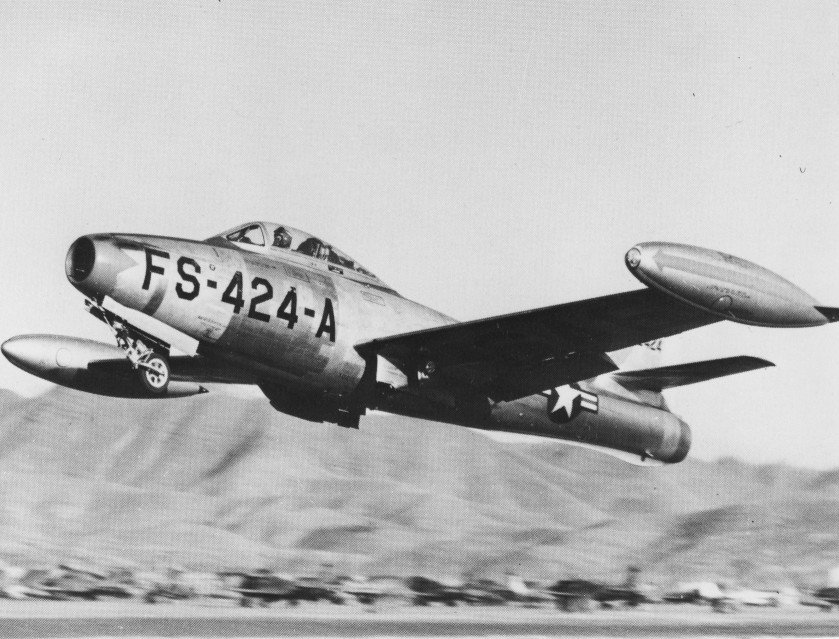
Design and Development
Designed by the renowned Republic Aviation Corporation engineer Alexander Kartveli, the F-84 was conceived in 1944 as a jet-powered successor to the Republic P-47 Thunderbolt. The project evolved into the XP-84 prototype, a straight-wing fighter-bomber that first took to the skies on February 28, 1946. This design represented a critical transition in aviation, bridging the gap between the piston-engine fighters of World War II and the supersonic jets of the later Cold War era.
Production and Technical Specifications
Republic Aviation produced the F-84 in large quantities, with the U.S. Air Force ordering a total of 7,524 aircraft across the entire F-84 family, which included both straight-wing and swept-wing variants. By 1953, 4,457 of the straight-wing Thunderjets had been manufactured. The aircraft utilized various turbojet powerplants; the straight-wing models (B through G) were powered by the Allison J35, with the F-84G specifically using the J35-A-29 to produce 5,600 lb of thrust. In contrast, the swept-wing F-84F and RF-84F variants employed the Wright J65 turbojet, which provided between 6,000 and 7,800 lb of thrust.
Using the F-84G as a benchmark, the aircraft featured a length of 36 ft 1 in, a wingspan of 36 ft 6 in, and a gross weight of 23,525 lb. It achieved a maximum speed of 622 mph and a service ceiling of 40,500 ft. Its typical armament consisted of six .50-caliber machine guns, supplemented by the ability to carry two 1,000 lb bombs or up to 32 5-inch HVAR rockets.
Military Service and Combat
The F-84 entered USAF service in November 1947 and became a cornerstone of early Cold War airpower. During the Korean War, while it struggled in air-superiority roles against the Soviet MiG-15, it excelled as a fighter-bomber. The Thunderjet became the primary strike aircraft of the conflict, flying 86,408 missions and destroying 60% of all ground targets targeted by the USAF. These operations involved dropping 61,000 tons of ordnance, though the effort cost the loss of 335 aircraft to ground fire, flak, and aerial combat.
Beyond Korea, the F-84 achieved several historic milestones: it was the first fighter capable of in-flight refueling and the first capable of delivering nuclear weapons, specifically the Mk 7. The F-84G is recognized as the USAF's first operational nuclear strike fighter. The aircraft was also the first mount for the USAF Thunderbirds demonstration team (1953–1956) and the USAFE Skyblazers (1950–1955).
Global Operations and Legacy
Through the Mutual Defense Assistance Program, more than half of the 7,524 aircraft produced were operated by NATO and allied nations, including Belgium, France, Denmark, Germany, Greece, Italy, the Netherlands, Norway, Portugal, Turkey, and Yugoslavia, as well as Iran, Taiwan, and Thailand. Service continued for decades; the RF-84F remained with the Air National Guard until 1972, and Portugal did not phase out its F-84Gs until 1976. Today, the aircraft is preserved in various collections, including the American Airpower Museum, the Warhawk Air Museum, and the Smithsonian's National Air and Space Museum.