
Production and Manufacturer History
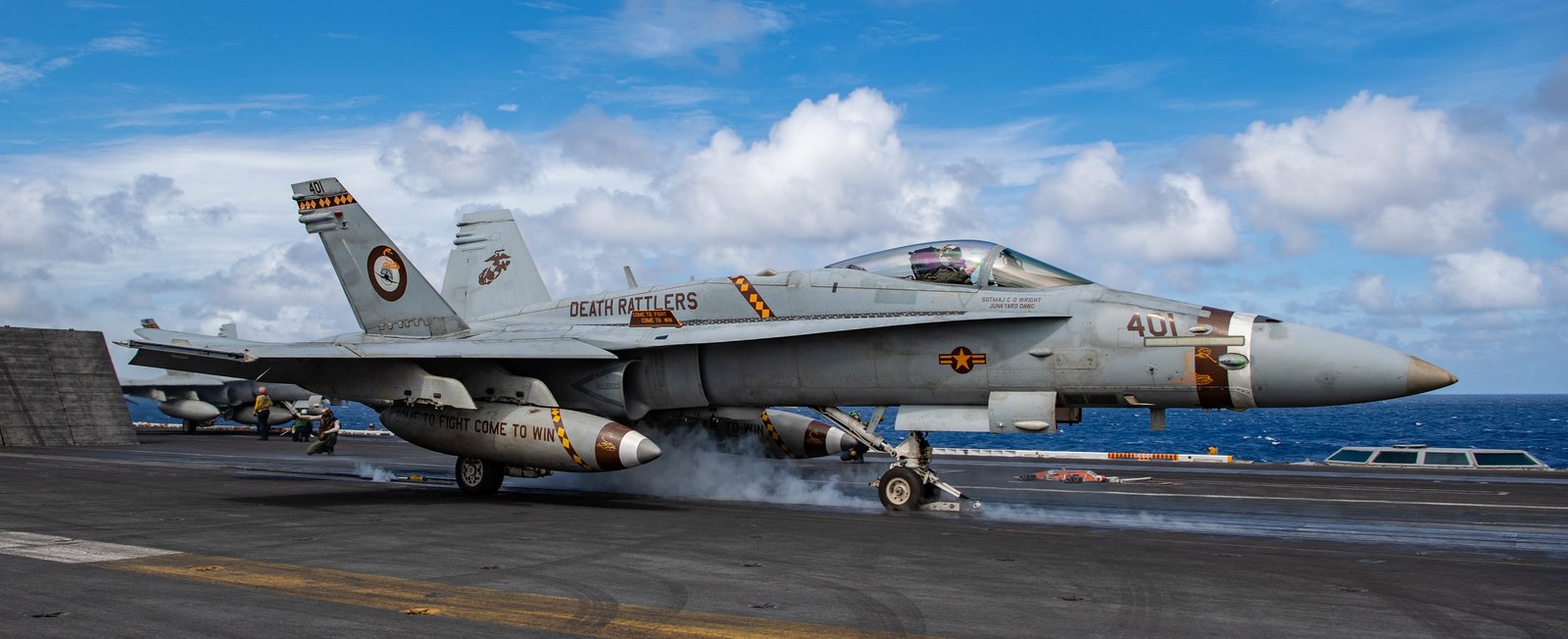
The F/A-18 Hornet was developed in the 1970s as a partnership between McDonnell Douglas, the prime contractor, and Northrop. Production began following the first flight in 1978 and continued for the "classic" Hornet line (F/A-18A/B/C/D) until 2000. Approximately 1,480 airframes were produced for various operators, including the U.S. Navy, U.S. Marine Corps, Australia, Canada, Spain, and Kuwait. Final assembly took place at the McDonnell Douglas plant in St. Louis, Missouri, while Northrop manufactured the vertical tails and center/aft fuselage in Hawthorne, California. Additional structural work was performed by Canadair in Montreal and ASTA in Australia.
McDonnell Douglas was formed on April 28, 1967, through the merger of the McDonnell Aircraft Corporation and the Douglas Aircraft Company. On August 1, 1997, McDonnell Douglas merged with Boeing. Today, the aircraft's legacy is managed by Boeing Defense, Space & Security (BDS), based in St. Louis.
Design and Technical Specifications
Derived from the Northrop YF-17 "Cobra," the F/A-18 was designed to replace both the F-4 Phantom II and the A-7 Corsair II. The design team, led by executives such as David S. Lewis and John K. "Jack" McDonnell, incorporated several advanced features, including a digital fly-by-wire flight control system and leading-edge extensions (LEX) to improve maneuverability at high angles of attack. To enable carrier operations, the airframe was reinforced with strengthened landing gear, folding wings, and an arrestor hook. The prototype YF-18A first flew on November 18, 1978, piloted by Jack Krings.
The aircraft is powered by two General Electric F404-GE-400 afterburning turbofans, each producing 10,800 lbf of dry thrust and 17,700 lbf with afterburner. The F/A-18C variant reaches a maximum speed of Mach 1.8 and has a service ceiling of 50,000 feet. It is armed with an internal M61A1/A2 Vulcan 20 mm rotary cannon and can carry up to 13,700 lb of ordnance across nine external hardpoints.
Military Service and Legacy
As a multirole platform, the Hornet has performed air superiority, fleet defense, strike interdiction, and close air support. It saw extensive combat in Operation El Dorado Canyon (1986), the Gulf War (1991), and NATO operations in the Balkans. During Operation Desert Storm, F/A-18C Hornets scored air-to-air victories against Iraqi MiG-21s using AIM-7 Sparrow missiles. The aircraft also played critical roles in Operation Enduring Freedom and Operation Iraqi Freedom. Beyond combat, the U.S. Navy "Blue Angels" flight demonstration squadron has utilized the Hornet since 1986.
While the U.S. Navy has largely transitioned to the Super Hornet, the legacy Hornet remains in service with the USMC and several allied nations. Preserved examples are displayed at the National Naval Aviation Museum in Florida, the Smithsonian National Air and Space Museum, and the RAAF Museum in Australia.