
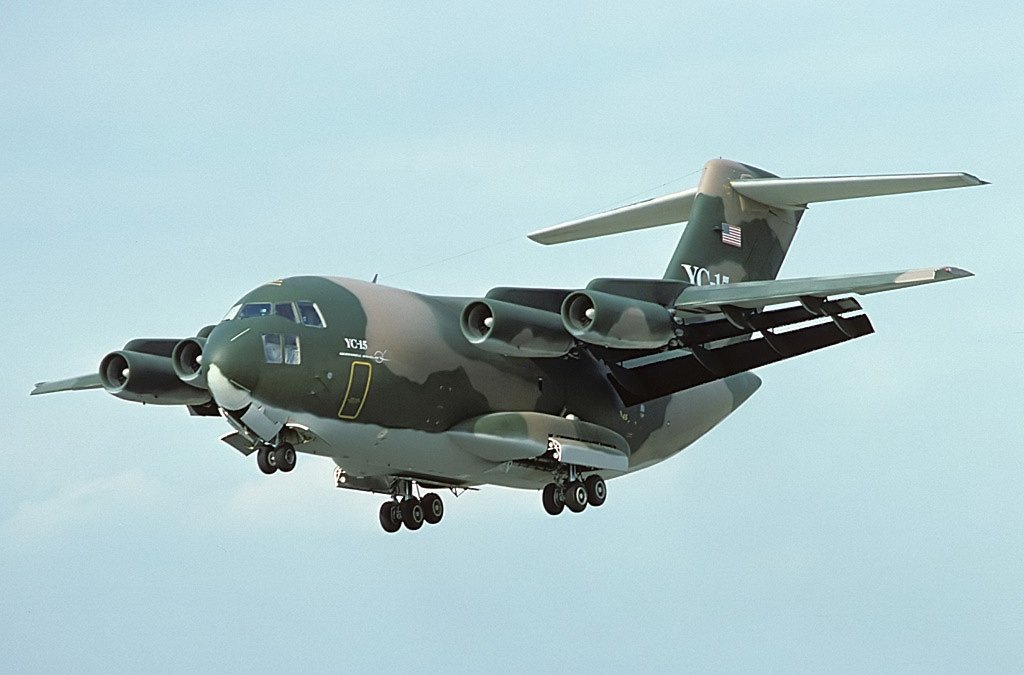
Development and Competition
The YC-15 emerged from the U.S. Air Force's ambitious 1972 requirement to replace the aging Lockheed C-130 Hercules with an aircraft capable of unprecedented short-field performance. The Advanced Medium STOL Transport program demanded an aircraft that could operate from a 2,000-foot semi-prepared runway while carrying a 27,000-pound payload over 400 nautical miles—a dramatic improvement over the C-130's 4,000-foot requirement for the same load. McDonnell Douglas competed directly against Boeing's YC-14 design, with both companies receiving contracts for two prototypes each.
McDonnell Douglas delivered their first prototype, serial number 72-1876, which achieved first flight on August 26, 1975. The second aircraft, 72-1875, followed in December 1975. Over the next four years, both YC-15 prototypes accumulated approximately 600 hours of flight testing, demonstrating the viability of advanced STOL transport concepts.
Revolutionary Design Features
The YC-15 incorporated several groundbreaking technologies that would influence transport aircraft design for decades. The aircraft featured supercritical wing technology applied to a large transport for the first time, combined with massive double-slotted, externally-blown flaps that dramatically enhanced STOL performance. These flaps worked in conjunction with engine exhaust to create extraordinary lift at low speeds, enabling the aircraft to meet its challenging runway requirements.
The high-wing configuration provided excellent ground clearance for cargo operations while housing four Pratt & Whitney JT8D-17 turbofan engines, each producing 15,500 to 16,000 pounds of thrust. McDonnell Douglas chose these proven commercial engines, already serving successfully on Boeing 727 and Douglas DC-9 airliners, to reduce development risk and leverage existing maintenance infrastructure.
Engine and Performance Specifications
The four JT8D-17 engines enabled the YC-15 to achieve impressive performance figures. The aircraft reached a maximum speed of 590 mph and cruised at 543 mph, with a service ceiling of 30,000 feet. Range varied significantly based on mission profile: 2,995 miles with a 38,000-pound payload in conventional operations, or 460 miles when operating in STOL mode with 27,000 pounds of cargo.
The spacious cargo compartment could accommodate 69,000 pounds in conventional operations or transform into a troop transport for 150 soldiers. A crew of three operated the aircraft, managing its advanced systems and challenging short-field operations that demanded precise pilot technique.
Program Termination and Aftermath
Despite successful flight testing that validated the STOL transport concept, the Air Force cancelled the entire AMST program in December 1979. Budget constraints and changing strategic priorities led to the decision that neither the YC-15 nor Boeing's competing YC-14 would enter production. The two YC-15 prototypes were retired to the Aerospace Maintenance and Regeneration Center at Davis-Monthan Air Force Base in Arizona.
McDonnell Douglas Legacy
McDonnell Douglas, the YC-15's manufacturer, represented one of America's premier aerospace companies throughout the 20th century. The company's military transport division possessed extensive experience developing cargo aircraft, making them natural competitors for the AMST program. In 1997, McDonnell Douglas merged into Boeing Aircraft, with Boeing becoming the successor company and continuing as one of the world's largest aerospace manufacturers.
Second Life as Technology Demonstrator
In 1996, after more than 15 years in desert storage, YC-15 serial number 72-1875 emerged from retirement for an unexpected second career. McDonnell Douglas Military Transport Aircraft, by then a Boeing division, operated the aircraft under an eight-year no-cost lease from the Air Force as an Advanced Technology Demonstrator. This arrangement marked the first time the Air Force leased a developmental aircraft back to its contractor under a Cooperative Research and Development Agreement.
The C-17 Connection
The YC-15's most significant legacy lies in its direct influence on the C-17 Globemaster III. Following the AMST cancellation, the Air Force's C-X Task Force formed in 1979 to develop a strategic transport with tactical capability. Impressed by the YC-15's demonstrated technologies, the C-X program selected an enlarged and upgraded version of the YC-15 design. McDonnell Douglas received the C-17 contract in 1981.
The C-17 became one of military aviation's greatest success stories. Declared operational in 1995, the Air Force ultimately purchased over 200 aircraft from a total production run of 279 aircraft completed by 2015. The C-17 remains in active service today, validating the advanced concepts first demonstrated by the experimental YC-15.
Preservation and Historical Impact
One YC-15 prototype survives today at the Flight Test Museum, serving as a testament to this crucial developmental program. Though the YC-15 never achieved operational service, its technological contributions fundamentally shaped modern strategic airlift capabilities. The aircraft represents a vital link in the evolution from 1970s experimental concepts to the proven strategic transport systems that serve military forces worldwide today.