
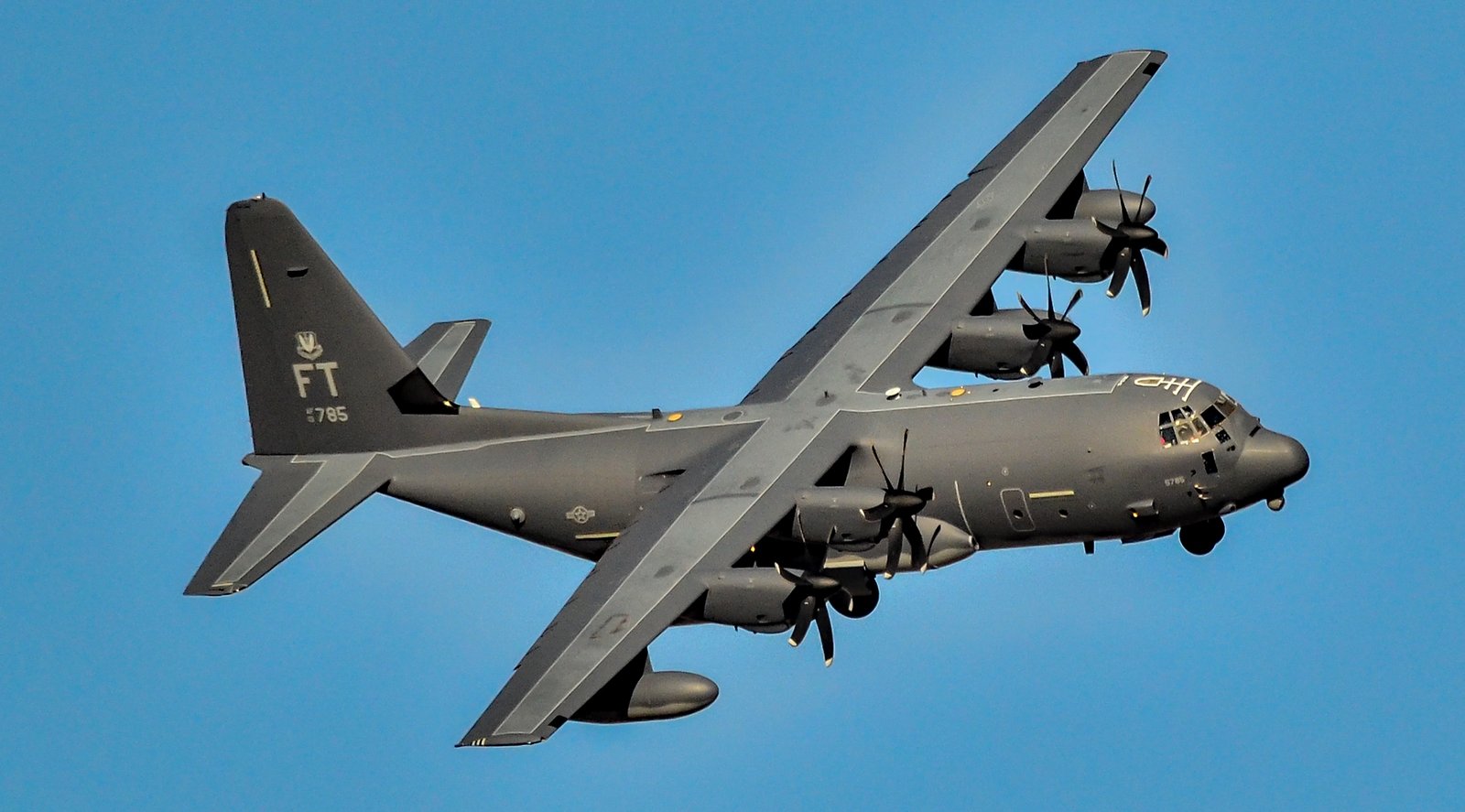
The HC-130 Hercules is not a standalone airframe but a series of specialized search-and-rescue (SAR) and combat search-and-rescue (CSAR) variants adapted from several base C-130 models, including the B, E, H, and J. Developed to extend the reach of rescue operations, the HC-130 family has been in active service since 1959, with the HC-130B being introduced for the U.S. Coast Guard in that year. The aircraft are produced by Lockheed Martin (originally Lockheed Aircraft Corporation), with primary manufacturing occurring at the company's facility in Marietta, Georgia.
Design-wise, the HC-130 inherits the rugged characteristics of the C-130, which was originally conceived to meet a U.S. Air Force requirement during the Korean War for a tactical transport capable of operating from short, unimproved runways. The aircraft features a high-wing configuration and a large rear loading ramp, allowing for the efficient airdrop of equipment and personnel. To fulfill its rescue mission, the HC-130 is equipped with extended-range fuel capacity, specialized sensors, radar, and communications gear. A critical capability of the USAF variants, such as the HC-130H and HC-130P, is the ability to provide aerial refueling to helicopters from the U.S. Air Force, Army, Navy, Marine Corps, and NATO/allied forces.
Powerplants vary by generation. Legacy variants (B, E, H, and P) utilize the Allison T56 turboprop engine, with the HC-130H featuring more powerful T56-A-15 engines. The modern HC-130J Super Hercules / Combat King II is powered by Rolls-Royce AE 2100D3 turboprops driving six-blade propellers. While the base C-130 Hercules made its first flight on August 23, 1954, the HC-130 variants have been produced or converted from 1959 to the present. Due to this nature as a variant series, total production numbers for the HC-130 are not publicly documented in a precise figure, though it is noted that 30 HC-130H aircraft were built as of July 1977.