
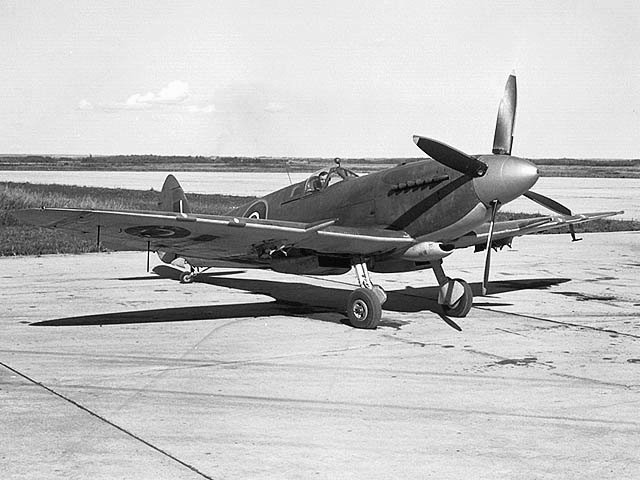
The Supermarine Seafire was developed as a navalized version of the Supermarine Spitfire to provide the Fleet Air Arm with a high-performance carrier fighter and fighter-bomber. While the original Spitfire was designed by R. J. Mitchell, the Seafire represented a specific adaptation of that airframe for maritime environments. To facilitate carrier operations, Supermarine integrated essential naval equipment, including folding wingtips and an arrestor hook. Despite these modifications, the aircraft remained challenging to operate from carriers due to its long nose and narrow undercarriage, which contributed to a higher rate of landing accidents.
Production of the Seafire spanned from 1942 to 1949, with a total of 2,646 aircraft built. The first Seafire took flight on January 7, 1942. The production line concluded on January 28, 1949, when the final aircraft, designated VR971, left the Supermarine factory. Powerplants for the Seafire were primarily piston-driven Rolls-Royce Merlin engines. For example, the Seafire F Mk III utilized the liquid-cooled V-12 Rolls-Royce Merlin 55M, which produced 1,585 horsepower. Other sources cite the Merlin 55 variant providing approximately 1,600 horsepower.
In military service, the Seafire replaced the Sea Hurricane in Fleet Air Arm squadrons between 1942 and 1943. It played a critical role in several major Allied campaigns, including Operation Torch in November 1942, the invasion of Sicily in July 1943, and the invasion of Italy in September 1943. The aircraft also supported the Normandy landings in June 1944 and Operation Dragoon in August 1944. Later in World War II, the Seafire served with the British Pacific Fleet, where it was employed to intercept kamikaze attacks. Beyond World War II, the Seafire saw operational service during the Korean War.
Performance specifications varied by mark. The Seafire F Mk III reached a maximum speed of 359 mph with a service ceiling of 36,000 feet and a range of 404 nautical miles. Other recorded performance data indicates a maximum cruise speed of 312 knots and a travel range of 481 nautical miles. Today, the legacy of the Seafire continues with four airworthy examples remaining: two located in the United Kingdom and two in the United States.