
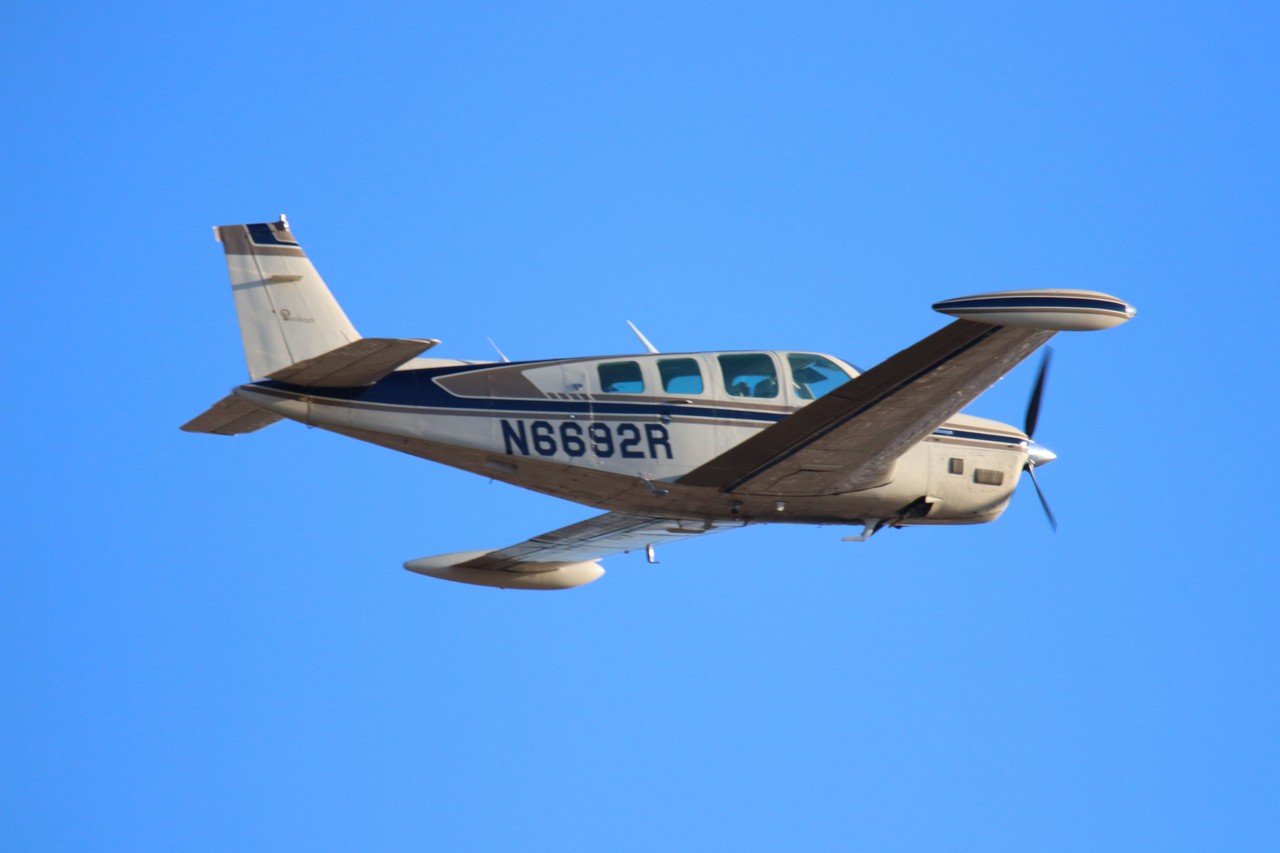
Overview
The Beechcraft Bonanza B36TC is the turbocharged member of the Model 36 Bonanza family — a six-seat, single-engine, low-wing monoplane with a conventional straight tail (distinguishing it from the earlier V-tail Model 35 Bonanza). Despite the "T" in its designation, it is a piston aircraft: the letters denote a TurboCharged version of the Model 36. It combines the stretched six-seat fuselage of the Model 36 with an exhaust-driven turbocharger that sustains engine power at altitude, giving it high cruise speeds and long range for a piston single.
The Model 36 Bonanza Family
The Beechcraft Model 36 Bonanza was introduced in 1968 as a stretched development of the long-running Bonanza line. Unlike the original V-tail Model 35, the Model 36 used a longer fuselage, six seats, and a conventional straight tail (empennage). The normally aspirated version evolved into the well-known A36, which became a mainstay of the six-place single-engine market. Seeking better speed and high-altitude capability, Beech introduced the turbocharged A36TC in 1979, fitting the Continental TSIO-520-UB turbocharged piston engine to the Model 36 airframe. Beech addressed the A36TC's limited fuel capacity with the B36TC, introduced for the 1982 model year, which fitted a longer wing derived from the Beechcraft Baron, increasing span by roughly 52 inches and raising usable fuel to about 102 gallons along with a higher gross weight.
Powerplant
The B36TC is powered by a Teledyne Continental TSIO-520-UB, a turbocharged, fuel-injected, air-cooled, horizontally opposed six-cylinder piston engine producing 300 horsepower. The turbocharger is exhaust-gas driven and allows the engine to maintain near sea-level power well into the flight levels, which is the basis for the type's strong high-altitude cruise performance. This is emphatically not a turbine/turboprop installation — the aircraft uses a conventional reciprocating (piston) engine with turbocharging. Power is delivered through a three-blade constant-speed propeller.
Systems for High-Altitude Flight
Because the certificated maximum operating altitude is 25,000 feet, supplemental oxygen is required, and B36TCs could be equipped with oxygen systems of roughly 49- or 76-cubic-foot capacity. Turbocharged piston operation rewards careful engine management, and many aircraft carry engine monitors tracking cylinder-head, exhaust-gas, and turbine-inlet temperatures along with manifold pressure and fuel flow.
Performance
At its certificated ceiling (Flight Level 250), the B36TC cruises from about 200 knots true airspeed at high power down to around 160 knots at economy power settings, with fuel burn ranging from roughly 16.6 gallons per hour at maximum cruise to about 11.2 gallons per hour at economy cruise. With 102 gallons of fuel and its efficient high-altitude cruise, the type is a range leader among six-place piston singles, capable of reaching out toward roughly 1,000 still-air miles depending on load.
Dimensions and Weights
The stretched Model 36 fuselage gives the B36TC a length of about 27 ft 6 in and a height a little over 8 ft 5 in. The longer Baron-derived wing spans about 37 ft 10 in with a wing area near 188 square feet. Maximum takeoff (gross) weight is 3,850 pounds; the cabin seats six, typically with an aft club-seating arrangement.
Production and Legacy
Approximately 424 B36TCs were built, with turbocharged Bonanza production continuing until around 2002. The type is frequently cited by owners and reviewers as one of the most capable Bonanzas ever built, offering a distinctive blend of speed, range, and cabin comfort in a single-engine airplane. The Bonanza was originally designed and built by Beech Aircraft Corporation in Wichita, Kansas; through corporate succession the type is today supported by Textron Aviation.