
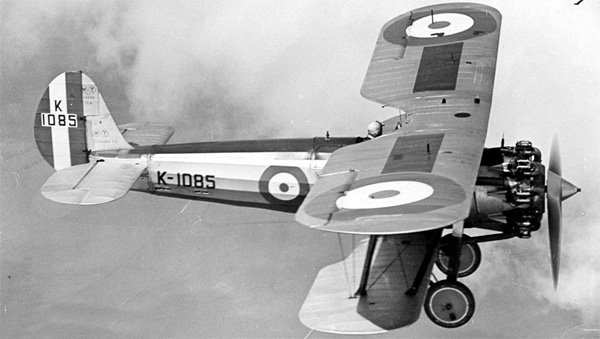
Designed under the leadership of chief designer Frank Sowter Barnwell, the Bristol Bulldog was a single-seat, single-bay biplane fighter characterized by unequal-span wings and a fixed tailskid undercarriage. The aircraft's development began with the Prototype Type 105, which first flew on May 17, 1927. This was followed by the improved Bulldog Mk.II (Type 105A), which first flew on January 21, 1928, and subsequently became the primary production standard. The Bulldog was technologically significant for its all-metal duralumin airframe covered in fabric, moving away from the wood-and-fabric constructions of the First World War.
Production took place at the Bristol Aeroplane Company's Filton works near Bristol, England. A total of 443 aircraft were produced across all versions between 1928 and the mid-1930s. The aircraft was powered by the Bristol Jupiter VII F, a supercharged 9-cylinder air-cooled radial piston engine produced by Bristol's own engine department. This powerplant delivered approximately 490 hp, allowing the Bulldog II to reach a maximum speed of about 178 mph and a service ceiling between 29,000 and 30,000 feet.
Entering RAF service in 1929, the Bulldog became the mainstay of the British fighter force until its withdrawal from front-line service in July 1937, when it was replaced by the Gloster Gauntlet and later monoplanes like the Hawker Hurricane. While the RAF utilized the type for air defense and training—including deployments to Sudan by No. 3 Squadron during the 1935–36 Abyssinian Crisis—it did not see combat with the RAF. However, export versions saw active service elsewhere. The Finnish Air Force employed Bulldogs during the Winter War, where they achieved two confirmed aerial victories against Soviet aircraft, and later used them for advanced training during the Continuation War. Additionally, the type served with the Spanish Republican Air Force during the Spanish Civil War, including the Battle of Santander in 1937.
Standard armament consisted of two fixed .303-in Vickers machine guns and racks for four 20-lb bombs. Today, the legacy of the Bulldog is preserved through museum exhibits, including examples in Finland and displays at Aerospace Bristol in Filton.