
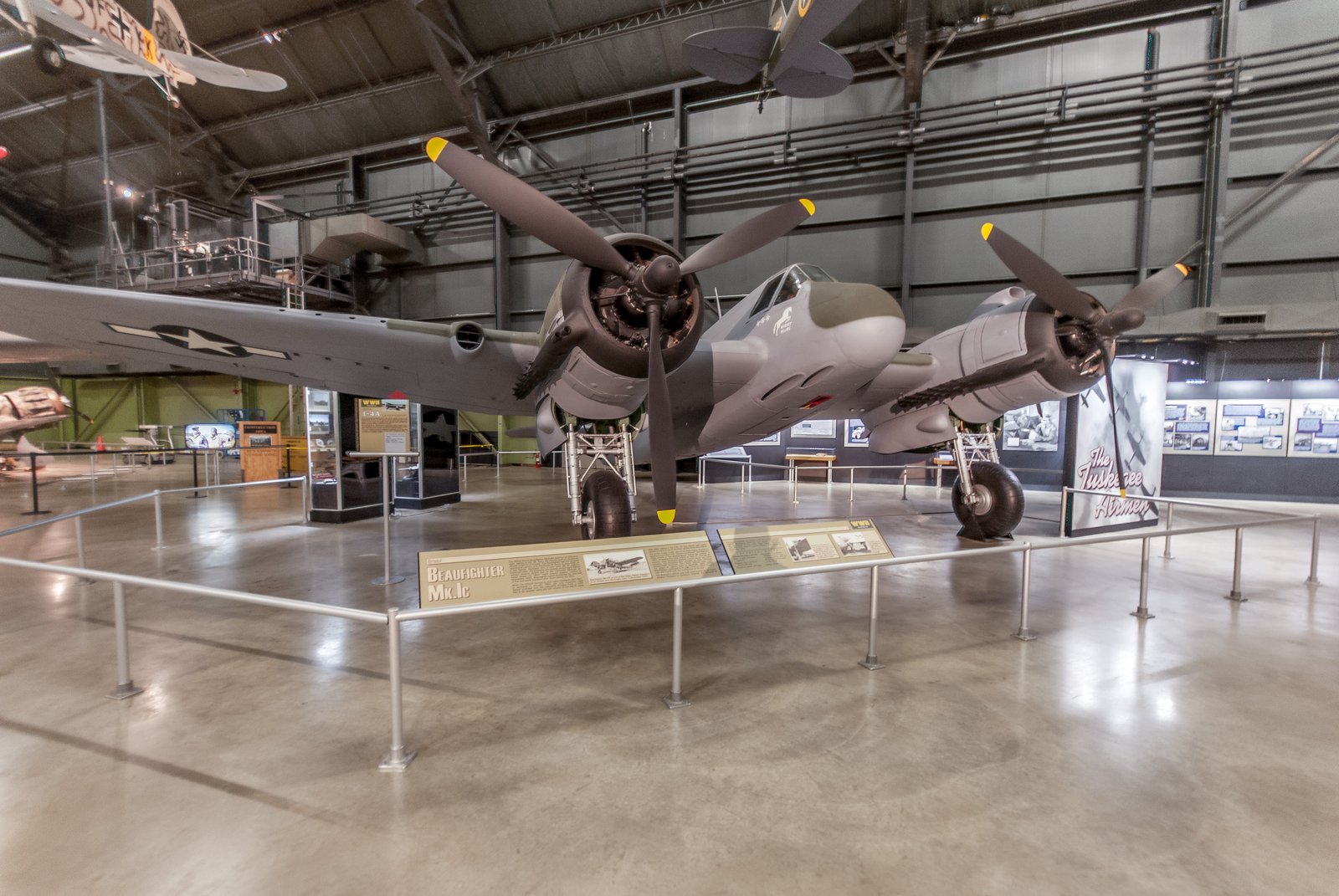
The Bristol Type 156 Beaufighter was a British twin-engine heavy fighter developed as a private-venture project to meet Air Ministry Specification F.37/35. Conceived during the tensions of the 1938 Munich Crisis, the aircraft was designed to provide a long-range, heavily armed fighter. The design team was led by L. G. Frise, who utilized the existing airframe of the Bristol Beaufort torpedo bomber to accelerate development. The first prototype, R2052, flew unarmed on July 17, 1939, and the aircraft officially entered RAF service on July 27, 1940.
Production of the Beaufighter ran from May 1940 to 1946, with a total of 5,928 units built across the United Kingdom and Australia. In the UK, 5,564 aircraft were produced, including 4,804 by the Bristol Aeroplane Company at Filton and Weston-super-Mare, 500 by Fairey Aviation Company in Stockport, and 260 by Rootes Securities in Speke. Australia's Government Aircraft Factory (GAF) produced 364 Beaufighter Mk.21 aircraft at Fishermans Bend, Victoria. Major variants included the Mk.I (915 built), Mk.II (448), Mk.VI (1,831), and the late-war Mk.X (2,205).
Technically, the Beaufighter was renowned for its massive firepower, typically featuring four 20 mm Hispano cannons in the lower nose and six 0.303 in Browning machine guns in the wings. Most variants were powered by Bristol Hercules radial engines, though the Mk.II utilized Rolls-Royce Merlin XX liquid-cooled V-12 engines to mitigate early-war Hercules shortages. The Mk.X, the primary late-war strike version, utilized the Hercules XVII engine, producing approximately 1,735 hp. Performance figures for the Mk.X included a maximum speed of 320–330 mph, a service ceiling of 26,000 ft, and a range of roughly 1,500 miles with external tanks.
During the Second World War, the Beaufighter operated in diverse roles, including night interception, ground attack, and maritime strike. It was a critical asset for the RAF's Fighter and Coastal Commands, as well as the Royal Australian Air Force (RAAF), Royal Canadian Air Force (RCAF), and Royal New Zealand Air Force (RNZAF). Group Captain John “Cats-Eyes” Cunningham became a notable figure, achieving the highest number of night kills in the type. Post-war, some Mk.X aircraft were converted to TT Mk.10A target tugs, with the final RAF sortie occurring on May 12, 1960. The legacy of the Bristol Aeroplane Company continues today through BAE Systems and Rolls-Royce.