
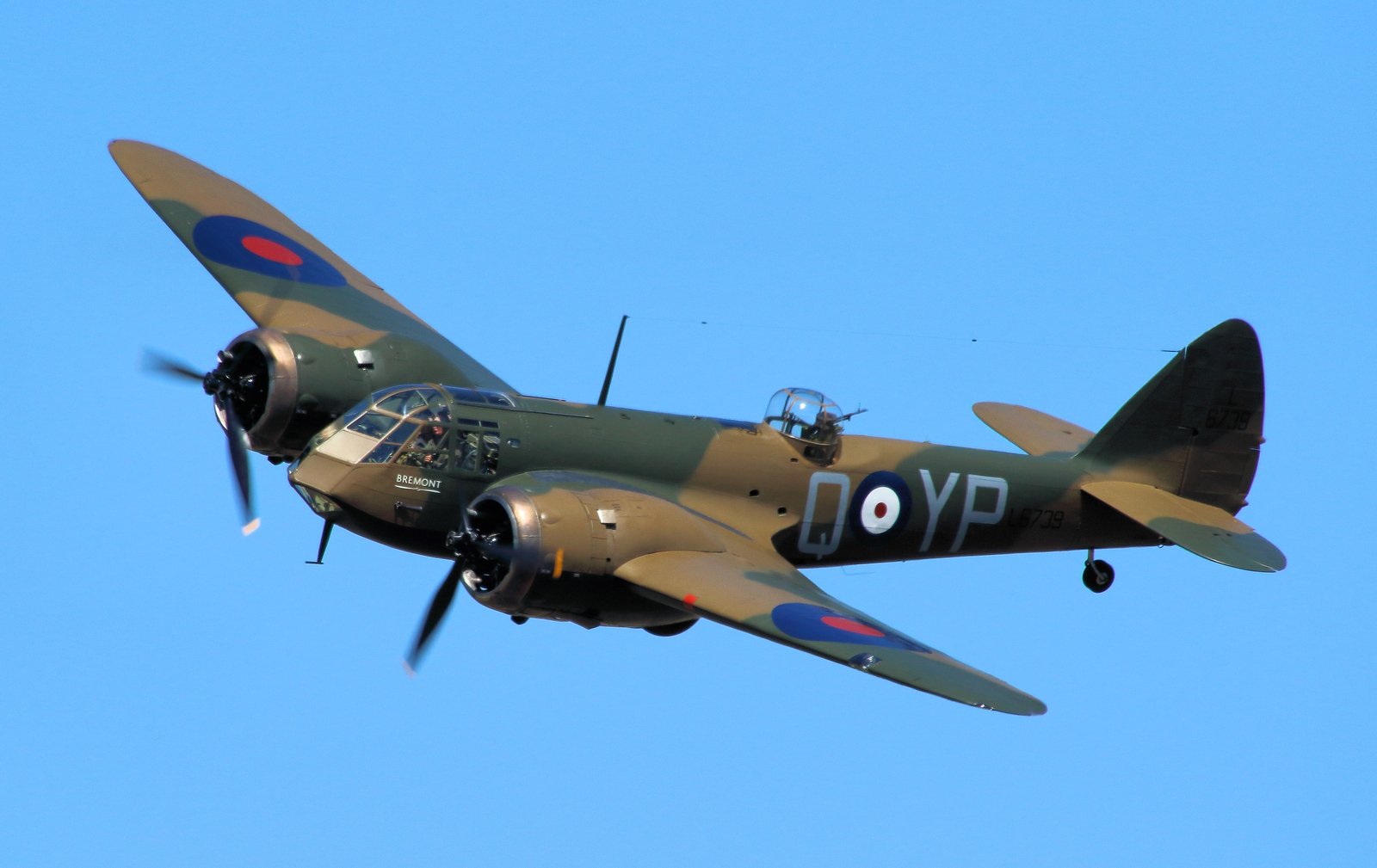
The Bristol Blenheim was a cornerstone of the Royal Air Force's early-war offensive capabilities, representing a significant leap in aviation technology. Designed by the Bristol Aeroplane Company, the aircraft originated as the Type 142, a high-speed civil transport developed by chief designer Frank Barnwell and engine designer Roy Fedden. The Type 142 first flew in April 1935 as an eight-seat executive aircraft; its speed exceeded that of any fighter then in RAF service, prompting the Air Ministry to request a military derivative. The first military prototype, the Type 142M, flew from Filton in June 1936, leading to the delivery of production Mk I bombers starting in March 1937.
Technologically, the Blenheim was advanced for the mid-1930s, featuring an all-metal stressed-skin monocoque construction, retractable landing gear, flaps, and a powered dorsal gun turret. It was powered by Bristol Mercury nine-cylinder, air-cooled radial piston engines. The Mk I utilized the Mercury VIII (approximately 840–860 hp), while the later Mk V "Bisley" employed the Mercury XXV, which produced roughly 950 hp. Early models achieved maximum speeds of approximately 266 mph and could carry an internal bomb load of up to 1,000 lb.
Production was extensive, with estimates ranging from 4,400 to over 6,200 aircraft. While primarily built at Filton and a shadow factory at Weston-super-Mare, the type was also produced under licence in Canada by Fairchild (designated as the Bolingbroke), as well as in Finland and Yugoslavia. By September 1939, the RAF operated two home-based and eleven overseas Blenheim squadrons. The aircraft served in every WWII theatre, including the Mediterranean, where No. 18 Squadron operated from Malta. Its roles evolved from light bombing to night fighting—with 200 Mk I aircraft converted to the radar-equipped Mk IF—and low-level ground attack in the Middle and Far East via the Mk V.
Despite being outclassed as the war progressed, the Blenheim's crews were praised for their courage, with Winston Churchill famously likening their efforts to the "Charge of the Light Brigade." Today, the legacy of the type survives through the world's last airworthy example, L6739 (G-BPIV), operated by the Aircraft Restoration Company. This aircraft, which served with No. 23 Squadron during the Battle of Britain, incorporates components from Canadian-built Bolingbrokes.