
Production and Manufacturer History
The Bristol Bombay was developed by the Bristol Aeroplane Company, an entity founded on February 19, 1910, as the British and Colonial Aeroplane Company by Sir George White. The aircraft were manufactured at the company's primary works in Filton, near Bristol, England. Production was limited, with a total of 51 aircraft built, consisting of one prototype and 50 production machines. While the prototype first flew in June 1935, a prolonged development and re-engining process delayed the first production aircraft until March 1939. Deliveries to frontline units began in September 1939, and the type was withdrawn from operational use by 1944.
Design and Technical Specifications
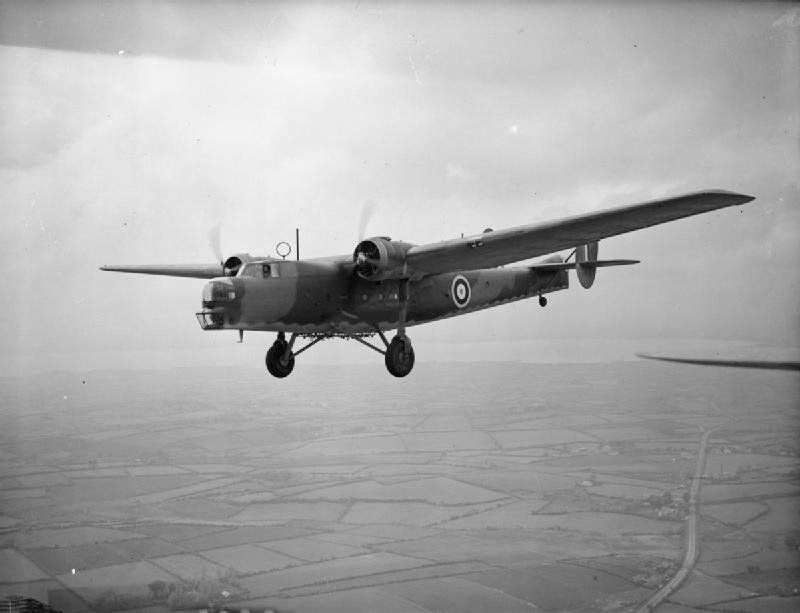
Designed to meet Air Ministry Specification C.26/31, the Bombay was intended to replace the Vickers Valentia in India and the Middle East. It featured an all-metal cantilever high-wing monoplane configuration, representing a significant technological advancement over the fabric-covered biplanes of the era. The aircraft was designed for a dual role as a medium bomber and troop transport; it could carry up to 24 soldiers or equivalent cargo, and its internal space was adaptable for use as an air ambulance for wounded personnel. For defensive capabilities, it was equipped with two 0.303 in Vickers K machine guns located in manually-operated nose and tail turrets. In its bombing role, it could carry up to eight 250-lb bombs on racks situated under the fuselage.
Engine and Performance
Production Bombays were powered by two Bristol Pegasus XXII nine-cylinder, single-row, air-cooled radial piston engines. Each engine produced approximately 1,010 horsepower and drove a three-blade variable-pitch propeller. The aircraft had a maximum speed of approximately 310 km/h and a cruising speed of about 260 km/h. With a wingspan of roughly 29 meters and a length of about 21 meters, the Bombay had an empty weight of approximately 6,260 kg.
Military Service
The Bombay served extensively during the Second World War, primarily in North Africa, the Mediterranean, and the Middle East. No. 216 Squadron RAF, based in Egypt, operated the type from October 1939 to May 1943, utilizing them for transport and improvised night bombing missions. No. 271 Squadron RAF used the aircraft from May 1940 to February 1941 to ferry supplies to the British Expeditionary Force in France. Additionally, No. 117 Squadron RAF operated the type in 1941, and the No. 1 Air Ambulance Unit of the Royal Australian Air Force utilized Bombays for casualty evacuation under RAF control.
Notable operations included the evacuation of the Greek royal family to Egypt and intensive medical evacuations during the 1943 invasion of Sicily, where the type is credited with transporting over 2,000 wounded. The aircraft was also involved in a high-profile tragedy when a Bombay carrying Major General William Gott was attacked by German fighters, resulting in the death of the senior commander.
Legacy
By the time it entered full service, the Bombay was already considered obsolescent as a bomber due to its low performance. However, it remained a vital workhorse for medical and transport duties until it was replaced by more capable aircraft like the Douglas Dakota. No complete airframes are known to have survived in museums or airworthy condition today.