
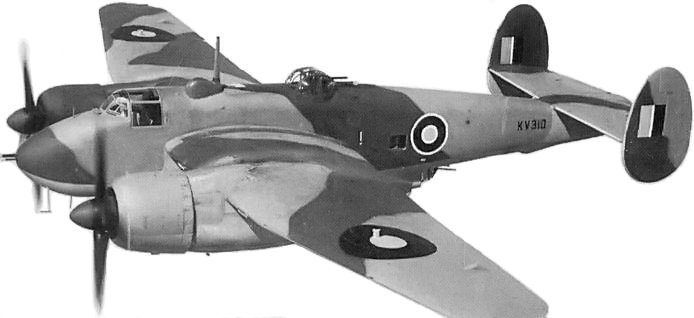
The Bristol Type 163 Buckingham was a British twin-engined medium bomber developed during the Second World War. Its design origins date back to 1939, when the Bristol Aeroplane Company proposed a medium bomber based on the Bristol Beaufighter. However, after various design and specification revisions, the resulting Buckingham shared very little external resemblance to its predecessor, emerging as an entirely new aircraft design.
Production was carried out by the Bristol Aeroplane Company at their Filton facility near Bristol, England. The first prototype flew on 4 February 1943. Production spanned approximately 1943 to 1944, resulting in a total of 123 airframes, comprising four prototypes, 54 bombers (B.I), and 65 transports (C.1). Some sources suggest a total of 119 aircraft, noting that 65 bomber airframes on the production line were rebuilt as Bristol Buckmaster advanced trainers for the Bristol Brigand torpedo bomber.
Technically, the Buckingham was powered by two Bristol Centaurus sleeve-valve radial piston engines, each producing approximately 2,520 horsepower. This powerplant enabled a maximum speed of around 330 mph and a range of approximately 3,180 miles. The bomber variant featured a robust all-metal, stressed-skin structure capable of carrying a 4,000 lb bomb load. It was heavily armed for its class, equipped with four forward-firing 0.303 in machine guns in the nose, four in a dorsal power turret, and two in a ventral gun cupola.
Despite its performance, the Buckingham never saw combat. By the time production aircraft were delivered in 1944, the type was considered obsolete compared to the faster and more versatile de Havilland Mosquito. Consequently, the 54 B.I bombers were placed in storage. The 65 C.1 transport versions, which removed all defensive armament to accommodate a crew of three and four passengers, served with the RAF Transport Command as high-speed couriers between the United Kingdom and the Mediterranean.
Following the war, the Bristol Aeroplane Company's airframe division merged in 1959 with Vickers-Armstrongs, English Electric, and Hunting Aircraft to form the British Aircraft Corporation (BAC), which eventually became part of BAE Systems. No surviving Buckingham airframes are recorded in current museum collections.