
Service History
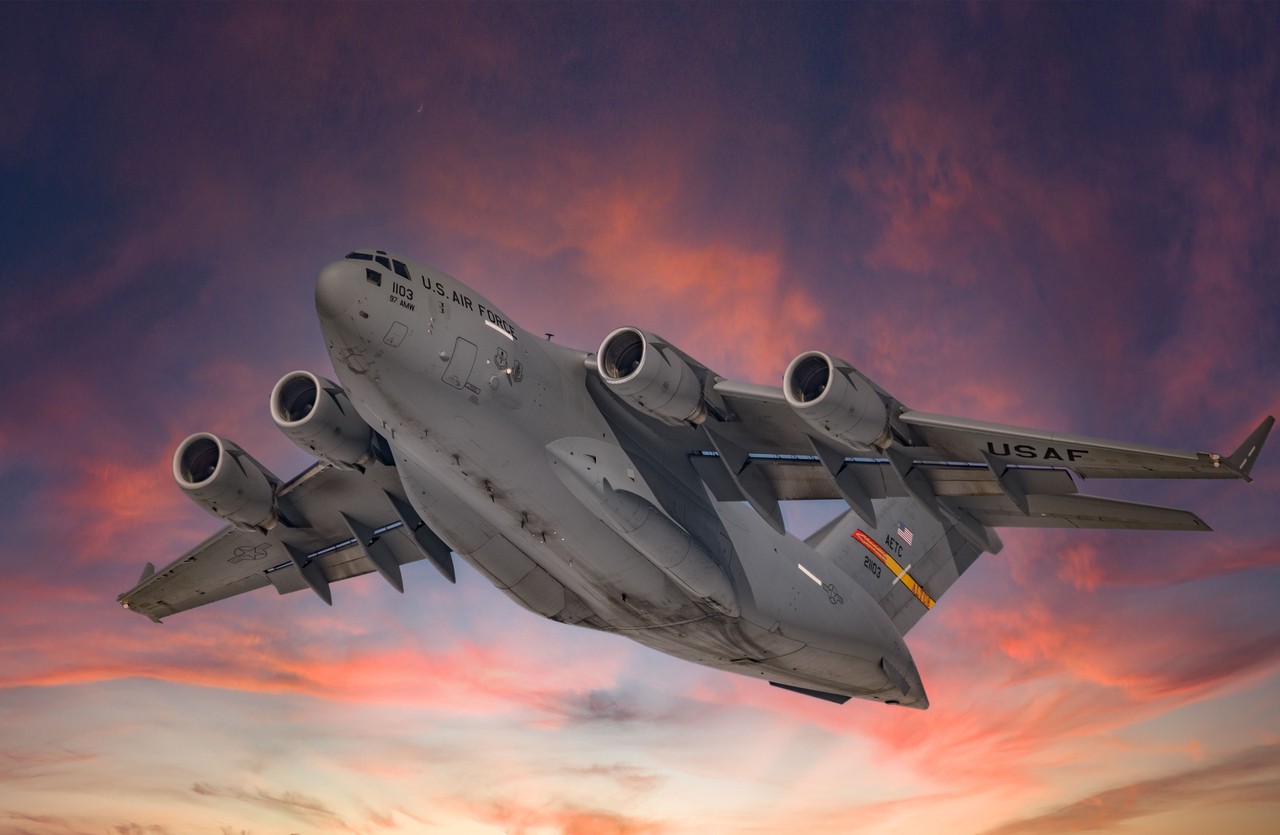
The C-17 Globemaster III has dominated strategic airlift operations for the United States Air Force and eight international partners since entering service in 1995. With 223 aircraft delivered to the USAF alone, the C-17 comprises the backbone of American strategic airlift capability, supplementing the larger but less versatile C-5 Galaxy. International operators include the Royal Australian Air Force, Royal Canadian Air Force, Indian Air Force, Hungarian Air Force, Kuwait Air Force, Qatar Emiri Air Force, NATO Heavy Airlift Wing, and the United Kingdom's Royal Air Force, bringing total global fleet strength to 279 aircraft.
Since achieving initial operational capability with the 17th Airlift Squadron at Charleston Air Force Base on January 17, 1995, the C-17 has participated in every major American military operation and humanitarian mission. The aircraft's unique combination of strategic range and tactical flexibility allows it to deliver outsized cargo directly to forward operating bases with runways as short as 3,000 feet, eliminating the need for intermediate staging areas that constrained previous airlift operations.
Operational History
The C-17's operational versatility has proven invaluable across three decades of continuous service. During combat operations, the aircraft can deliver main battle tanks, armored vehicles, and artillery systems directly to tactical airfields near the front lines. In humanitarian roles, it has provided disaster relief worldwide, capable of rapid deployment with medical supplies, food, and rescue equipment to areas with limited infrastructure.
The aircraft's defensive systems and robust construction enable operations in contested environments, while its advanced cargo handling systems allow rapid loading and unloading. A typical crew consists of two pilots and one loadmaster, though additional crew members may be carried for extended missions or specialized operations.
The Manufacturer
McDonnell Douglas originally developed the C-17 in response to the Air Force's C-X program, launched in 1981 to replace the aging Lockheed C-141 Starlifter fleet. The St. Louis-based aerospace giant had formed in 1967 through the merger of McDonnell Aircraft Corporation and Douglas Aircraft Company, inheriting Douglas's rich transport aircraft heritage that included the earlier C-74 and C-124 Globemaster transports.
Boeing acquired McDonnell Douglas in 1997, assuming responsibility for C-17 production at the Long Beach, California facility. This merger created the world's largest aerospace company and consolidated American military transport production under Boeing's umbrella. The final C-17 rolled off the Long Beach assembly line in 2015, ending 24 years of production as Boeing shifted focus to other defense programs.
Engine & Technical Innovation
Four Pratt & Whitney F117-PW-100 high-bypass turbofan engines power the C-17, each generating over 40,000 pounds of thrust. These engines, military variants of the proven PW2000 commercial powerplant, provide the enormous power required for short-field takeoffs with maximum cargo loads exceeding 80 tons.
The aircraft's innovative design features include prominent winglets that improve fuel efficiency during long-range cruise flight, advanced fly-by-wire flight controls that reduce pilot workload, and a sophisticated cargo handling system with a motorized cargo floor. The high-mounted wing configuration keeps the cargo compartment low to the ground while providing propeller and jet blast clearance over obstacles during tactical operations.
Performance Characteristics
Pilots praise the C-17's handling qualities, which combine the stability of a large transport with surprisingly agile performance characteristics. The aircraft can execute tactical approaches and steep descents that would challenge smaller transports, while maintaining the smooth ride quality expected of a strategic airlifter during transcontinental flights.
With a maximum cruise speed of Mach 0.77 and a service ceiling exceeding 45,000 feet, the C-17 can complete intercontinental missions while avoiding most weather systems. Its unrefueled range of 2,400 nautical miles with maximum payload extends to over 5,200 nautical miles when carrying lighter loads, providing global reach with minimal intermediate stops.
Production & Legacy
Total production of 279 aircraft represented a compromise between the Air Force's original requirement for over 200 aircraft and congressional budget constraints that threatened the program multiple times. Despite early development challenges that delayed initial delivery by nearly a decade from the original 1981 contract award, the C-17 ultimately proved its worth through reliable service across diverse mission profiles.
Today, virtually all 279 C-17s remain in active service with their original operators, testament to the aircraft's robust design and continued relevance. The Air Force has invested $23.8 billion in sustainment contracts to keep its fleet operational through 2040, while studies have shown that restarting production would cost over $2.1 billion due to the complexity of recreating the supply chain and tooling.