
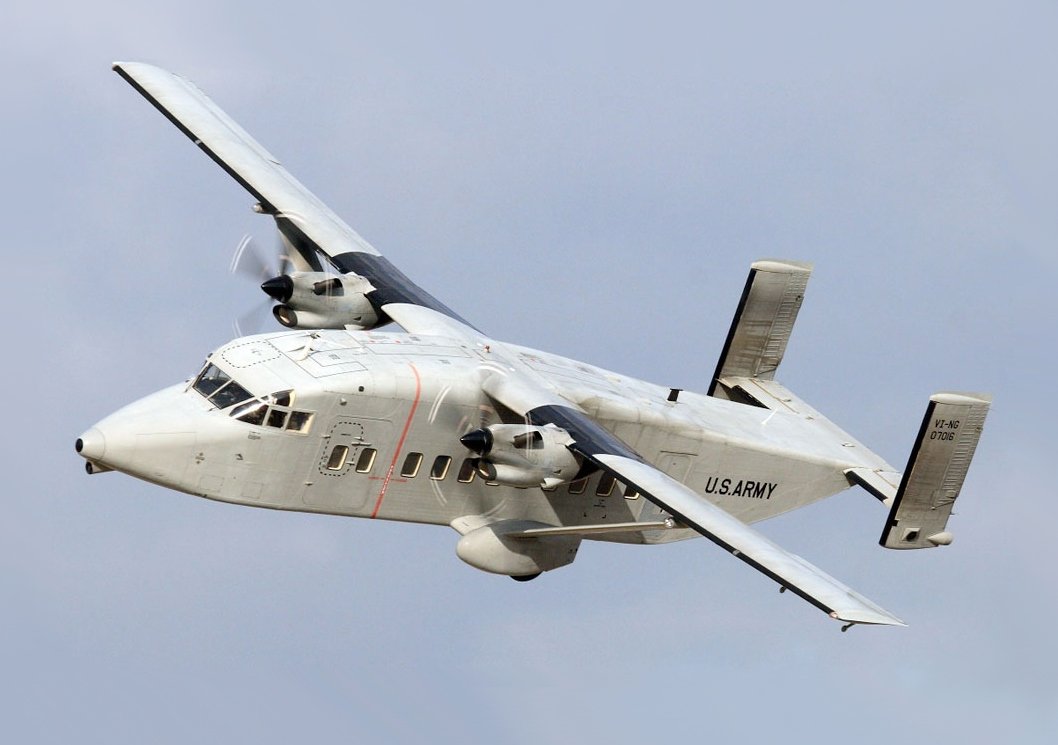
The Short C-23 Sherpa is a twin-turboprop, short takeoff and landing (STOL) military transport aircraft developed by Short Brothers in Belfast, Northern Ireland. Designed to provide cost-effective intra-theater logistics, the aircraft was derived from the Short 330 and Short 360 regional airliners, which themselves evolved from the Short SC.7 Skyvan. Production took place between 1984 and 1997, resulting in 60 aircraft delivered to U.S. military customers across three primary variants: the C-23A, the C-23B, and the C-23B+.
Development began in 1981 as Short Brothers sought to adapt the Short 330 for military utility. Key design modifications included a strengthened floor and a full-width rear cargo ramp, a feature uncommon for aircraft of its size. The C-23B variant further improved this capability by allowing the ramp to be operated in flight for paratroop and airdrop missions. The aircraft's "flying truck" aesthetic, characterized by a boxy fuselage, was intentionally maintained to maximize internal cargo volume. The interior was designed for flexibility, featuring side-facing seating for paratroops and dedicated tie-down points for heavy cargo.
Technical specifications vary by model. The C-23A utilized two Pratt & Whitney Canada PT6A-45R turboprops, each producing approximately 1,198 to 1,200 hp. The C-23B was upgraded with more powerful PT6A-65AR engines. Performance data for the PT6A-45R variant indicates a maximum cruise speed of 221 knots, an operational range of 670 nautical miles, and a service ceiling of 27,000 feet. It possesses a maximum takeoff weight of 25,600 lb and a maximum payload capacity of 7,280 lb.
Operational history began in 1985 when the C-23A entered service with the United States Air Force in Europe at Zweibrücken Air Base in West Germany. Following the USAF's retirement of the type in 1990, the U.S. Army and Army National Guard became the primary operators. The National Guard ordered 14 C-23B aircraft in 1989, with deliveries coinciding with Operations Desert Shield and Desert Storm in 1990–1991. The Sherpa continued to serve U.S. Army intra-theater needs during the Iraq War from 2003 to 2011. The U.S. Army officially retired the fleet in January 2014.
Beyond U.S. military service, the C-23 has seen significant government and international use. In 2014, over a dozen aircraft were transferred to the U.S. Forestry Service, and others were provided to the State of Alaska. NASA also operates a single C-23 for atmospheric research. Internationally, the aircraft remains in service in Djibouti and the Philippines. Today, the legacy of the Sherpa is maintained by De Havilland Canada, which provides support for the family and operates an ex-U.S. Army SD3-60 C-23B+.