
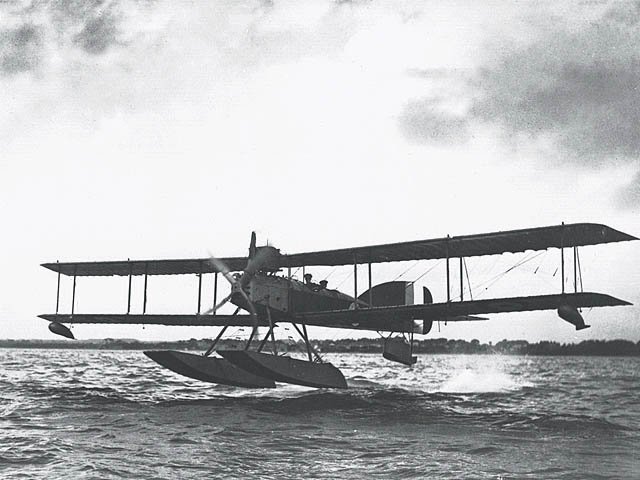
Design and Production
Designed by Horace Oswald Short to meet an Admiralty specification in 1914, the Short Type 184 (also known as the S.184) was a single-engine, two-bay biplane floatplane. The aircraft featured a wooden and fabric construction, utilizing twin main floats and smaller stabilizing floats under the wingtips. It was specifically engineered to carry a full-size 14-inch torpedo or a bomb load of up to 520 lb, proving that heavy naval ordnance could be effectively delivered via aircraft. Production began in 1915 at the Short Brothers works in Rochester, Kent. The type became the manufacturer's most successful pre-World War II aircraft, with production totals estimated at over 900 units, and some sources citing exactly 936. Due to high demand, production was expanded through at least ten British aero-industry contributors, including Westland Aircraft in Yeovil, Somerset.
Technical Specifications
The Type 184 was powered by a single liquid-cooled inline piston engine producing approximately 225 hp. The crew consisted of two members: a pilot and an observer/gunner. For defense, the rear observer's cockpit was equipped with a .303 in Lewis machine gun on a trainable mount. Various specialized versions were developed, including the Type D, a single-seat bomber capable of carrying nine 65 lb bombs, and the "Short Cut," a one-off experimental model with revised tailplanes and unequal-span wings designed to increase speed. A landplane derivative, known as the Short Bomber, was also produced for the Royal Flying Corps.
Military Service and Combat Firsts
Operating primarily with the Royal Naval Air Service (RNAS) and later the Royal Air Force (RAF), the Type 184 achieved several historic milestones during World War I. On August 12, 1915, Flight Commander C. H. K. Edmonds conducted the world's first successful combat aerial torpedo attack, striking a Turkish transport ship in the Sea of Marmara. This was followed by another attack on August 15, 1915, and the first sinking of a ship by an airborne torpedo on August 17, 1915, when a tug boat was destroyed. Many of these operations were conducted from seaplane tenders, such as HMS Ben-my-Chree. Additionally, the Type 184 is notable for being the only aircraft series present during the Battle of Jutland, where a single example served in a reconnaissance role to spot and report the enemy fleet.
Global Service and Legacy
Beyond British service, the Type 184 was operated by the Royal Canadian Naval Air Service, the French Navy, the Greek Navy, and the Dutch Naval Aviation Service. The Imperial Japanese Navy acquired one example for testing, designating it the "Short Reconnaissance Seaplane." Some aircraft remained in service with the Chilean and Estonian air arms until 1933. While primarily military, a limited number of aircraft entered civilian service post-war for passenger transport. The Type 184's legacy lies in pioneering the concept of the operational torpedo bomber, fundamentally altering naval warfare and cementing Short Brothers' reputation as a leading aerospace entity.