
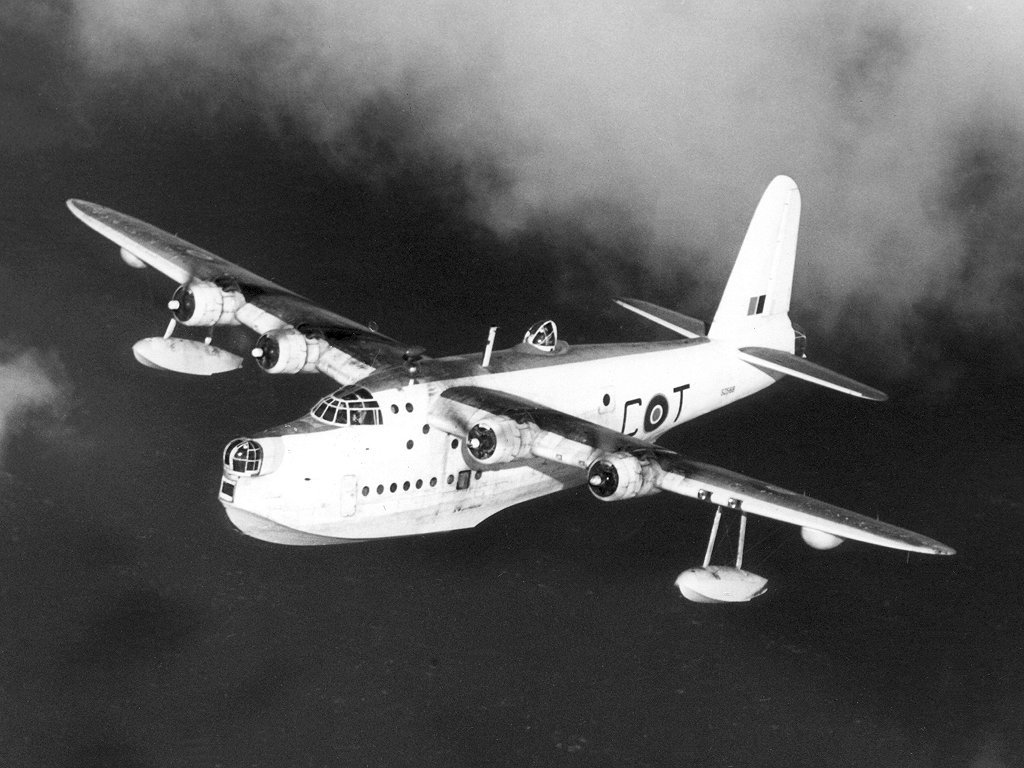
The Short S.25 Sunderland was a British four-engined military flying boat developed by Short Brothers to meet Air Ministry Specification R.2/33. Designed as a militarized derivative of the civil Short S.23 "Empire" flying boat, the Sunderland prototype first flew on October 16, 1937. The aircraft entered service with the RAF's Coastal Command in June 1938. Production took place between 1938 and 1946, with a total of 749 aircraft built. Manufacturing was primarily centered at Short Brothers in Rochester, Kent, and Short & Harland in Belfast, Northern Ireland.
Technically, the Sunderland was notable for being the first British flying boat to feature power-operated gun turrets as standard. Its extensive defensive armament earned it the German nickname "Fliegendes Stachelschwein" (Flying Porcupine). The aircraft was powered by four air-cooled radial piston engines; early marks used the Bristol Pegasus XXII (approximately 1,010 hp), while the Mk V utilized the Pratt & Whitney R-1830 Twin Wasp (approximately 1,200 hp). Designed for endurance, the aircraft included crew sleeping and catering facilities to support long-range maritime patrols over the Atlantic, Mediterranean, and Pacific.
During World War II, the Sunderland served as a long-range reconnaissance and anti-submarine warfare (ASW) asset. By September 1939, three RAF squadrons were operational, and the type is credited with damaging or destroying between 56 and 60 Axis submarines. Beyond the RAF, the aircraft was operated by the Royal Australian Air Force (RAAF)—including No. 10 and No. 461 Squadrons—the Royal Canadian Air Force (RCAF), and the Royal New Zealand Air Force (RNZAF). Post-war, the Sunderland continued to serve in the Berlin Airlift (1948–1949), transporting 4,920 tonnes of freight, and the Korean War, where it flew nearly 900 operational sorties. The RAF retired its last flying boats in 1959, while the RNZAF operated them until 1967.
In the civil sector, ex-military Sunderlands were converted into the Short Hythe and Short Sandringham passenger aircraft, with some remaining in commercial service until 1974. Today, the lineage of Short Brothers survives within the Belfast aircraft industry, though the original independent company was eventually absorbed into Bombardier Aerospace. A notable surviving example, the Sunderland MR5 (serial ML824), is preserved at the RAF Museum, Hendon.