
Design and Development
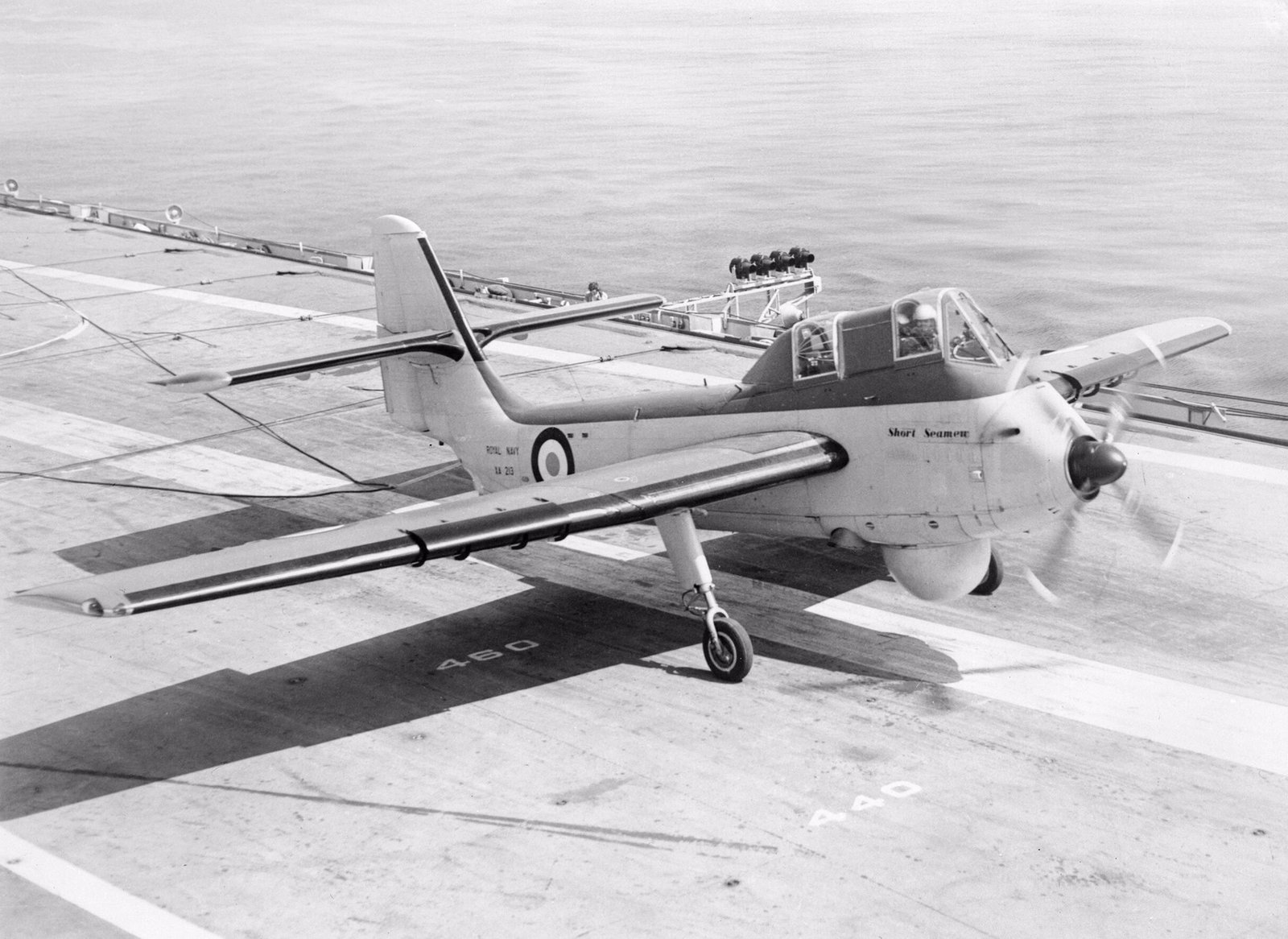
Designed in 1951 by David Keith-Lucas of Short Brothers, the SB.6 Seamew was developed to meet Admiralty Specification M.123D. The aircraft was intended as a simple, lightweight anti-submarine warfare (ASW) platform to replace the Grumman Avenger AS.4 within the Royal Naval Volunteer Reserve (RNVR) and the Royal Navy's Fleet Air Arm (FAA). To ensure the aircraft could operate unassisted from small escort carriers, Keith-Lucas incorporated a large wing area and high-lift devices to achieve low take-off and landing speeds. The design featured a high-mounted engine with a chin intake and a high-set cockpit to maximize forward and downward visibility for ASW operations. Notably, the aircraft utilized a fixed, spatted undercarriage with a tall stalk main gear and a tailwheel, a choice made to reduce maintenance costs and mechanical complexity, though it resulted in increased drag.
Production and Technical Specifications
The Seamew was produced by Short Brothers, primarily at their Belfast facilities in Northern Ireland (operating as Short & Harland). The prototype first flew on August 23, 1953. The aircraft was powered by a single Armstrong Siddeley Mamba turboprop engine. While designed for naval use with folding wings for carrier stowage, a land-based version was also planned for the Royal Air Force (RAF). Technical capabilities included a range of 750 miles (1,210 km). Its ASW armament suite was comprehensive, capable of carrying one torpedo, four depth charges, 275-lb ASW bombs, and up to twenty 28-lb sonobuoys.
Service History and Cancellation
In February 1955, an order for 60 aircraft was placed, split evenly between the RAF and the Fleet Air Arm. The prototype, serial XA213, underwent carrier trials aboard HMS Bulwark in July and December 1955. Despite these efforts, the aircraft suffered from marginal handling and performance, particularly at higher speeds. These technical shortcomings, combined with the sweeping military reforms of the 1957 Defence White Paper, led to the program's cancellation. In total, 26 airframes were built, though only 24 production aircraft actually flew; one airframe served as a static structural test rig. The program was effectively terminated by 1957 without the Seamew ever entering regular squadron service.
Legacy
The Short SB.6 Seamew remains a historical example of the early Cold War effort to create low-cost, specialized ASW platforms. It illustrates the challenges of balancing extreme cost-cutting and simplicity with the performance requirements of carrier aviation. No complete airframes survive today; reports indicate the final surviving example, used at a training school, was scrapped in 1967.