
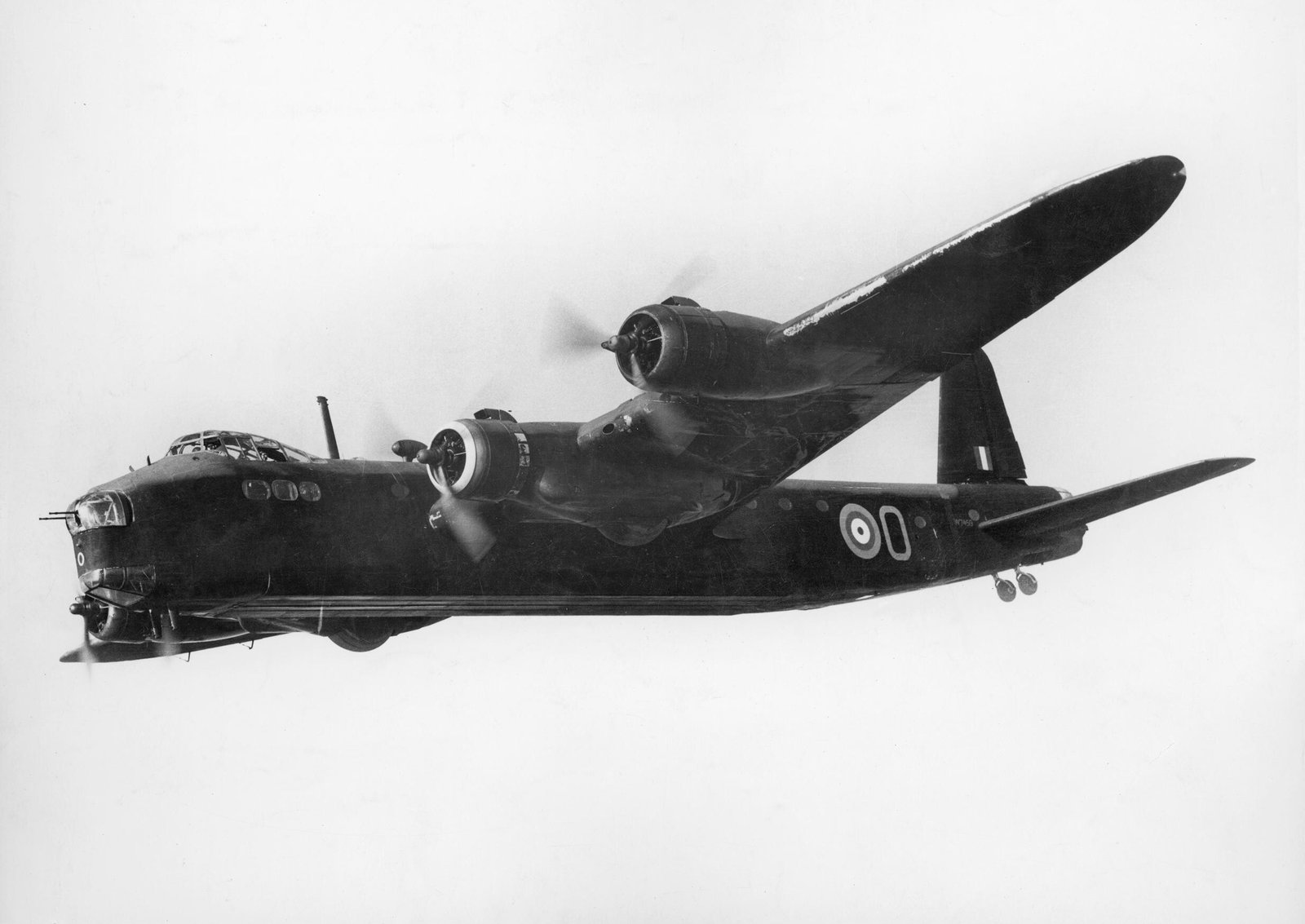
Production and Manufacturer History
Designed and built by Short Brothers (often referred to as Shorts), the Short Stirling was produced between 1940 and 1945. A total of 2,383 aircraft were manufactured across several sites to meet wartime demands. Primary production took place at Short Brothers in Rochester, Kent, and Short & Harland in Belfast, Northern Ireland. Additionally, the Austin Motor Company at Longbridge provided further production under shadow-factory arrangements, with later assembly also occurring at South Marston near Swindon.
Design and Development
The Stirling was developed to satisfy Air Ministry Specification B.12/36, which called for a long-range "penetration bomber" capable of carrying 14,000 lb (6,350 kg) of bombs and transporting troops. The design was led by the Short Brothers design team. A scaled proof-of-concept prototype, the Short S.31, first flew on September 19, 1938. The full-scale production aircraft began leaving Rochester in July 1940. A defining characteristic of the design was a mandatory wingspan restriction of under 100 ft imposed by the Air Ministry, which resulted in high wing loading and limited the aircraft's high-altitude performance.
Technical Specifications and Powerplant
All major variants were powered by four Bristol Hercules air-cooled radial piston engines. The early Stirling Mk I typically utilized the Hercules XI (approximately 1,500 hp each), while the Mk III used the Hercules VI (approximately 1,635 hp each) to increase top speed. Other configurations included the Hercules XVI rated at 1,650 hp. The aircraft featured a crew of seven, including a pilot, co-pilot, navigator/bomb aimer, radio operator, and three gunners. Defensive armament consisted of eight 0.303-in Browning machine guns mounted in powered nose, dorsal, and tail turrets.
Military and Civil Service
The Stirling entered frontline service with No. 7 Squadron in August 1940 and made its combat debut on the night of February 10–11, 1941, attacking oil storage facilities near Rotterdam. Between 1941 and late 1943, it served as a primary night heavy bomber, participating in the "1000 bomber" raids of 1942 and strikes on Berlin. Operational statistics vary by source, with reports indicating between 14,500 and 18,440 sorties and the delivery of approximately 27,000 tons of bombs.
By 1944, the Stirling was largely withdrawn from bombing duties in favor of the Lancaster and Halifax, transitioning to roles as a glider tug and paratroop carrier. It played a vital role in the Normandy invasion (Operation Glimmer) and Operation Market Garden. Specialized variants included the Mk IV glider tug and the Mk V transport, the latter of which could carry up to 40 troops or two jeeps with trailers. Post-war, the Belgian carrier Trans-Air operated ex-RAF Stirlings starting in 1947, and the Egyptian Air Force later acquired eight of these aircraft.
Legacy
As the RAF's first four-engined heavy bomber, the Stirling pioneered the shift toward large-scale strategic bombing in the UK. While its service ceiling was inferior to later heavy bombers, it remained a robust platform for transport and special operations. No complete original aircraft are known to survive today, though various reconstruction projects using recovered components continue.