
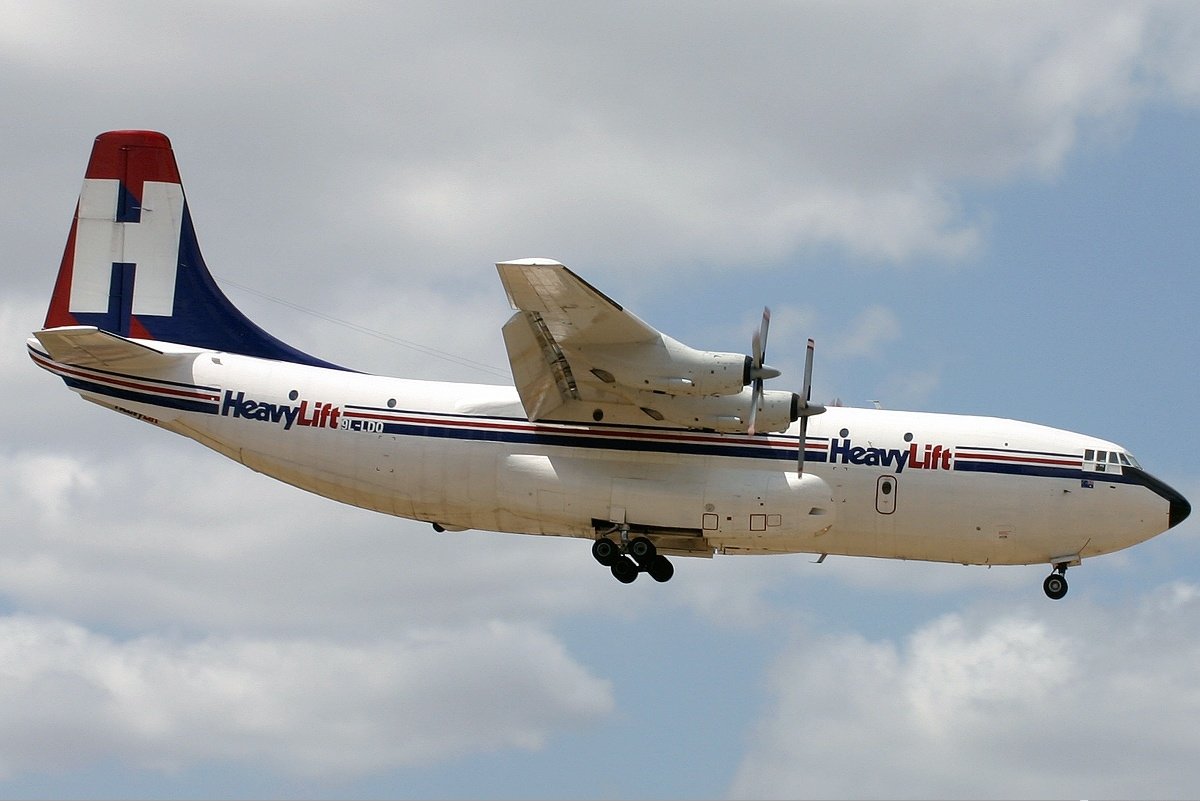
Production and Manufacturer History
Designed and built by Short Brothers at their plant in Belfast, Northern Ireland, the Short Belfast was a heavy military transport developed in the 1960s. Short Brothers, founded in London in 1908 by Oswald, Eustace, and Horace Short, is recognized as the world's first aircraft manufacturing company. By 1960, the firm operated as Short Brothers and Harland in Belfast. While the Royal Air Force (RAF) originally ordered 30 aircraft, only 10 were ultimately completed. The organization continues to exist today as a leading aerospace manufacturer based in Belfast.
Design and Technical Specifications
Formal design work for the strategic transport began in February 1959. The aircraft evolved from an earlier March 1957 concept known as the Britannic, which was intended to use Bristol Orion engines. Following the cancellation of the Orion program, the design was adapted to utilize Rolls-Royce Tyne turboprops. The first flight of the resulting Belfast occurred in January 1964.
Technically, the aircraft was distinguished by its massive capacity and advanced avionics. It was designed from the outset with a full automatic "blind landing" system and featured an EKCO E190 weather radar. The cargo hold measured 23 meters (75 ft 6 in) in length and provided approximately 11,001 cubic feet of volume. This allowed the Belfast to transport 150 fully equipped troops, two Wessex helicopters, two single-deck buses, or a single Chieftain main battle tank. The airframe measured 41.58 meters in length with a wingspan of approximately 48.4 meters.
Engine and Performance
The Belfast was powered by four Rolls-Royce Tyne turboprop engines, each producing 5,730 shaft horsepower. These engines enabled a maximum cruise speed of 292 knots (336 mph) and a service ceiling of 30,000 feet. The aircraft had a maximum take-off weight of approximately 104,500 kg (230,000 lb) and a maximum payload capacity of 75,000 lb. While its range with maximum payload was roughly 1,000 miles, it could reach 4,609 nautical miles when carrying maximum fuel.
Service History and Legacy
The aircraft entered RAF service on 20 January 1966, with aircraft XR367 delivered to No. 53 Squadron at RAF Brize Norton. Designated as the Belfast C.1, the fleet performed long-range strategic transport missions worldwide until the RAF phased the type out of service in 1976. Following military retirement, five of the ten aircraft transitioned to civilian cargo operations, where they performed charter freight work, some of which continued to support RAF operations during various conflicts.
Today, the legacy of the Belfast is preserved through aircraft XR371, named "Enceladus." After its retirement, it was flown to the Royal Air Force Museum Cosford in the autumn of 1978, where it remains as a museum exhibit.