
Production and Design
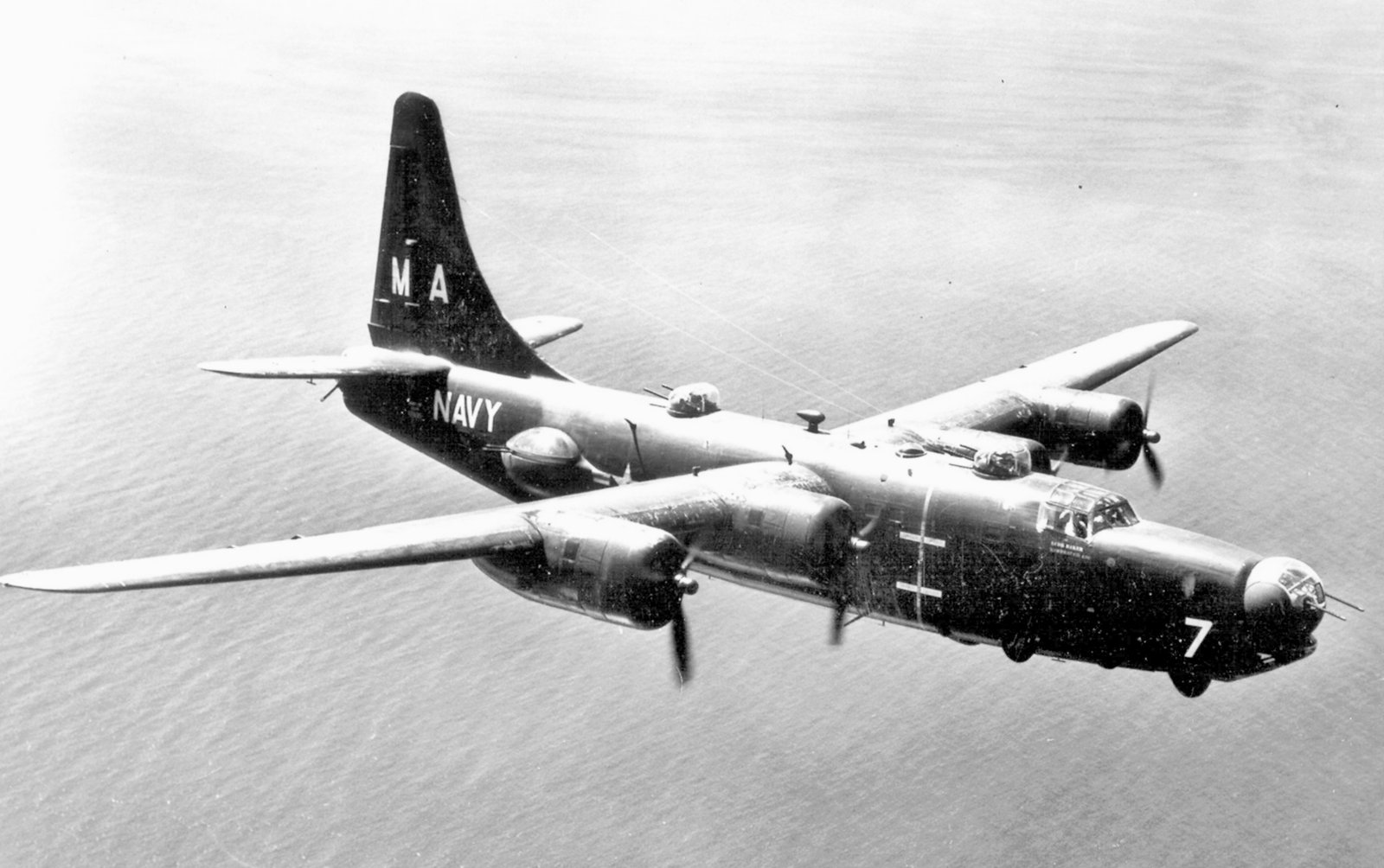
Developed as a specialized maritime evolution of the B-24 Liberator, the Consolidated PB4Y-2 Privateer was designed to meet U.S. Navy requirements for long-range patrol. In May 1943, the Navy ordered the conversion of three B-24D bombers into XPB4Y-2 prototypes, the first of which flew on September 20, 1943. Following a production order in October 1943, the aircraft were manufactured primarily at Consolidated Aircraft's San Diego, California plant. Total production figures are slightly varied across records, with estimates placing the number of delivered aircraft between 739 and 740. Deliveries to the fleet occurred from March 1944 through October 1945.
To optimize the aircraft for low-altitude maritime operations, Consolidated implemented several significant structural changes. The B-24's twin tail was replaced by a single tall vertical stabilizer to improve directional stability. The fuselage was extended by seven feet forward of the wing to accommodate additional operators and electronic equipment. Power was provided by four Pratt & Whitney R-1830-94 radial engines, each producing 1,350 hp. Unlike the high-altitude B-24, these engines lacked turbo-superchargers to better suit low-level patrol work.
Military Service
During World War II, the Privateer operated extensively in the Pacific theater from the Philippines to the Aleutian Islands, performing reconnaissance, search and rescue, and anti-shipping missions. It featured a heavy defensive armament of twelve .50-caliber Browning M2 machine guns in powered turrets, and some units were equipped with 20 mm nose cannons. Notably, the PB4Y-2B variant carried the ASM-N-2 "Bat" radar-guided anti-ship glide bomb, which saw successful combat use in April 1945 at Balikpapan Harbor, Borneo.
Post-war, the aircraft continued service through the Korean War. Active and reserve squadrons, including VP-28, VP-772, and VP-871, conducted "Lamp Lighter" night illumination missions starting in June 1951, dropping up to 250 high-intensity flares. In the early Cold War, modified PB4Y-2s performed electronic intelligence (ELINT) missions along the Soviet bloc, leading to a confrontation with Soviet fighters over the Baltic Sea on April 8, 1950. Additionally, the U.S. Coast Guard operated nine PB4Y-2G aircraft for weather reconnaissance and search-and-rescue until 1960.
Civil Service and Legacy
Following military retirement, several airframes were converted into civilian fire-bombers, often designated as "Super Privateers." These air tankers were frequently re-engined with more powerful 1,700-hp plants and remained active in forest fire suppression until 2002. Today, the aircraft is preserved in museums such as the Pima Air & Space Museum and the Yanks Air Museum, representing a critical bridge between WWII heavy bombers and modern maritime patrol aircraft.