
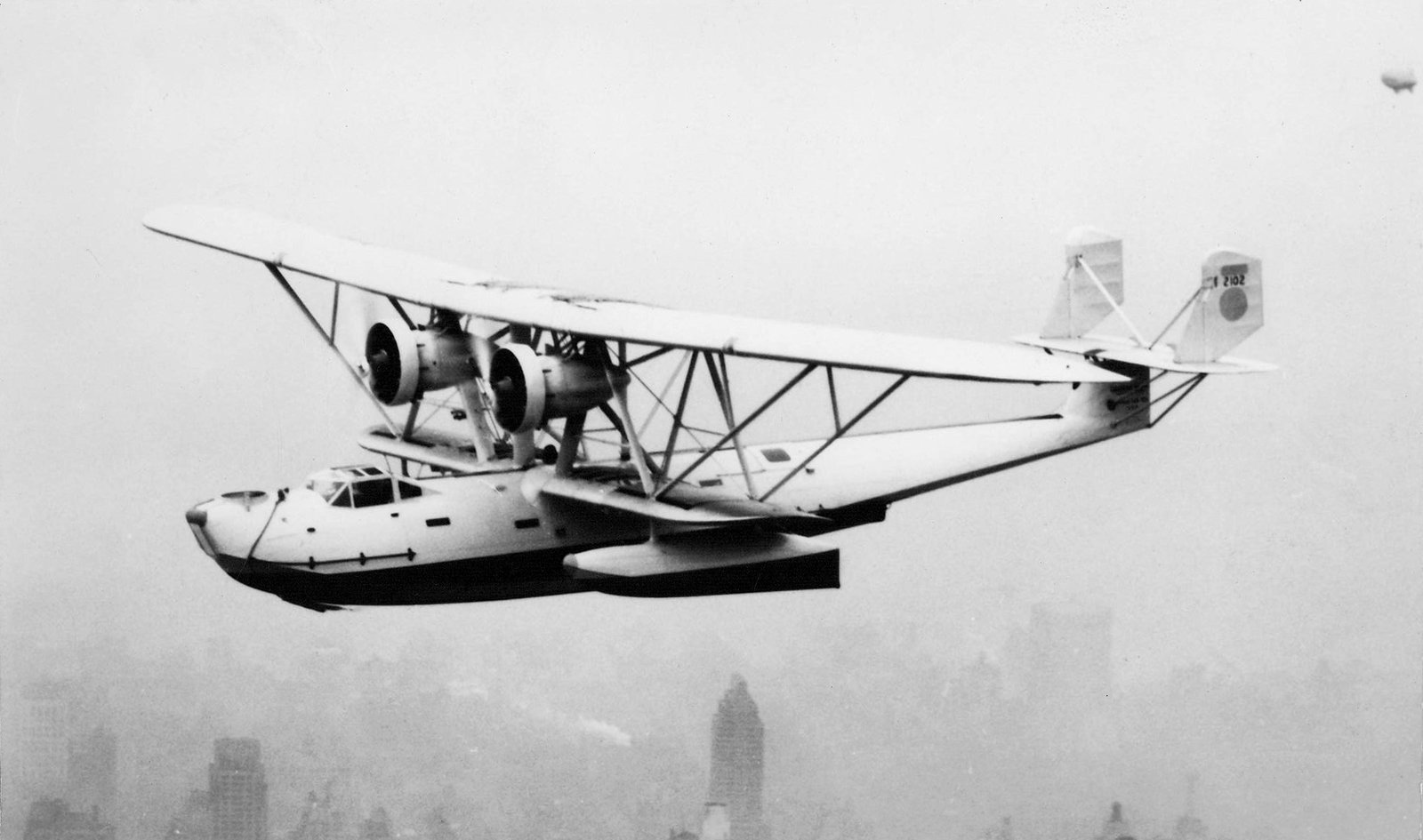
The Consolidated P2Y was a twin-engine maritime patrol flying boat developed by Consolidated Aircraft in the early 1930s. It is historically significant as the progenitor of the PBY Catalina, as the later aircraft retained the P2Y's general hull design and several other key features. The aircraft's lineage began with the Model 9 XPY-1 prototype, which first flew on January 10, 1929, piloted by Lieutenant A. W. Gorton at NAS Anacostia.
Production of the P2Y series spanned from 1931 to 1937, with a total of 78 aircraft built. This included approximately 70 units for the U.S. Navy and eight export aircraft. The U.S. Navy ordered the main production batch on July 7, 1931, and the first P2Y-1s were delivered to squadron VP-10F in February 1933. The P2Y was designed as a sesquiplane with fabric-covered wings and an all-metal aluminum hull, marking a transition away from the wood-hull boats previously used by the Navy.
Technical specifications varied by model, but the P2Y-3 was powered by two Wright R-1820-90 Cyclone nine-cylinder air-cooled radial piston engines, each producing 750 hp. The P2Y-3 featured a crew of five, a wingspan of 30.48 meters, and a maximum speed of 240 km/h. For armament, the P2Y-3 carried three 0.30 inch M1919 Browning machine guns in flexible bow and dorsal positions, and it could carry a bomb load of up to 2,000 lb.
In U.S. service, the P2Y was used for long-range formation flights, most notably a record-setting flight from Norfolk, Virginia, to Coco Solo, Panama Canal Zone, on September 7–8, 1933, covering 2,058 miles in 25 hours and 19 minutes. By the end of 1941, all U.S. Navy P2Y-2 and P2Y-3 aircraft were withdrawn from frontline service and relegated to training roles at NAS Pensacola and NAS Jacksonville.
Internationally, the P2Y saw limited combat use; a single P2Y-1C operated by the Colombian Air Force served as a bomber during the Colombia–Peru War of 1932–1933. Argentina operated six P2Y-3A aircraft from 1936 to 1949, while the Imperial Japanese Navy used one P2Y-1J (designated HXC) for evaluation tests and later as a transport during World War II. No intact airframes are known to survive in museums today.