
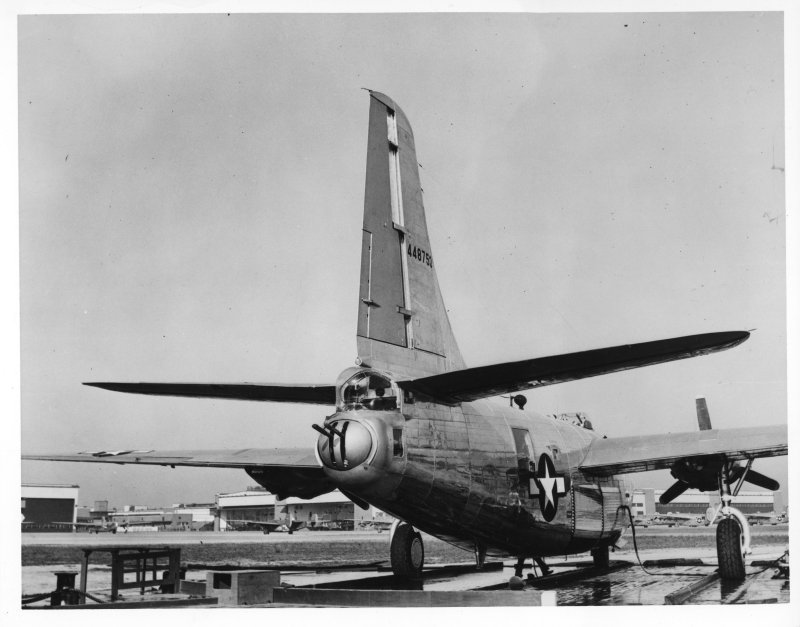
The Consolidated XB-24 served as the original prototype for the B-24 Liberator, a heavy bomber that would eventually become the most-produced American heavy bomber of the Second World War. Developed by the design team at Consolidated Aircraft in San Diego, California, the XB-24 first took to the skies on December 29, 1939. The aircraft was characterized by its high-wing configuration and a distinctive twin-tail design. A central feature of its engineering was the high-aspect-ratio Davis Wing, which provided the bomber with superior speed and range compared to its contemporary, the Boeing B-17.
Technical specifications for the XB-24 included four Pratt & Whitney Twin Wasp S3C4-G (R-1830-33) air-cooled, supercharged radial piston engines. Each engine produced 1,200 hp of takeoff or military power at 2,700 rpm up to an altitude of 5,000 feet. These powerplants enabled the prototype to reach a maximum speed of 273 mph at 15,000 feet, with a cruise speed of 186 mph. The aircraft possessed a service ceiling of 31,500 feet and a maximum range of 4,700 miles, though it could achieve 3,000 miles while carrying a 2,500 lb bomb load.
While the XB-24 was a prototype, the resulting B-24 family saw massive production between 1940 and 1945, with total production figures cited at 18,188 units. Manufacturing was spread across several key locations, including San Diego, California; Fort Worth, Texas; Dallas, Texas; Tulsa, Oklahoma; and Willow Run, Michigan. The aircraft saw extensive service during World War II in nearly every major theater, including the Pacific, Southwest Pacific, China-Burma-India, Mediterranean, African, and European theaters. Operators included the Royal Air Force, the Royal Australian Air Force, the United States Navy (which utilized the PB4Y-1 Privateer derivative), and the United States Army Air Forces. The B-24 was employed in diverse roles such as maritime patrol, anti-submarine warfare, long-range transport, and strategic bombing, most notably during Operation Tidal Wave against the Ploesti oil refineries.
Beyond military use, the aircraft found a place in civil service with BOAC as a long-range transport, and in specialized roles as the C-87 Liberator Express and the C-109 fuel transport. The Indian Air Force continued to operate the type until 1968. Despite its success in mass production and range, wartime experience indicated the B-24 was less damage-tolerant in combat than other heavy bombers. Today, the aircraft is remembered as a cornerstone of Allied aerial strategy, though only a small number of examples remain in existence.