
Service History
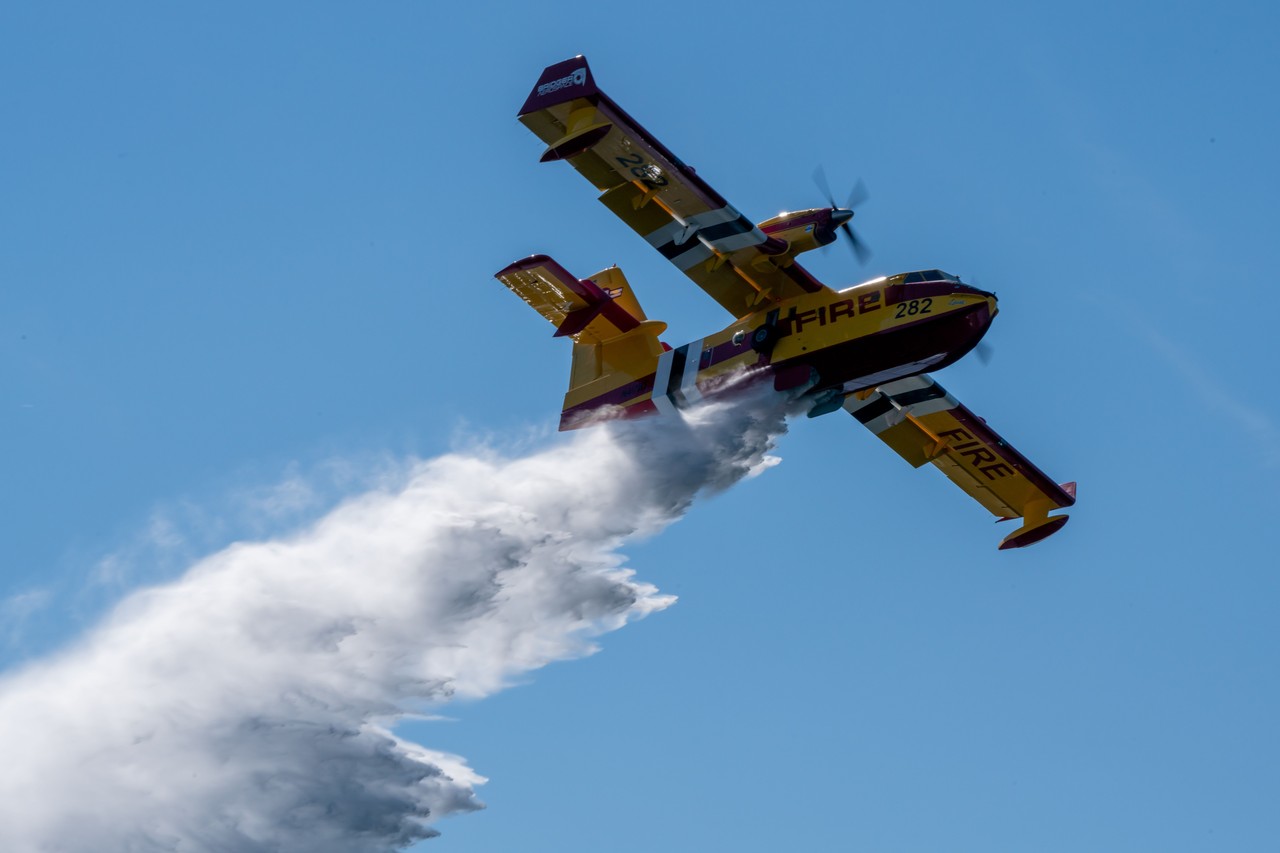
The CL-415 achieved dominance in aerial firefighting operations worldwide, with 95 aircraft serving government agencies and private contractors across multiple continents. By July 1996, just three years after first flight, 37 examples were already operational with fire services in Canada, France, Italy, and Spain. The aircraft's unique amphibious capabilities allowed operators to reload water directly from lakes, rivers, or coastal waters in under 12 seconds, then deliver precise drops on forest fires in remote locations inaccessible to ground-based equipment.
Sales expanded significantly in the early 2000s when Croatia acquired multiple aircraft and private aerial firefighting companies in North America began incorporating the type into their fleets. A comprehensive 180-day demonstration tour launched in 1995, using a CL-415 owned by the Quebec Government, showcased the aircraft's capabilities across 21 countries and generated substantial international interest.
The Manufacturer
Canadair, founded in 1944 in Montreal, Quebec, established itself as a pioneer in amphibious aircraft design with the original piston-powered CL-215 in 1967. The company's expertise in water-based aviation made it the natural choice to develop the world's first purpose-built aerial firefighting aircraft. In 1996, Bombardier Aerospace acquired Canadair and continued CL-415 production at facilities in Cartierville, Quebec, before relocating final assembly to North Bay, Ontario in 1998.
The aircraft's development history took another turn on June 20, 2016, when Viking Air purchased the CL-415 type certificate from Bombardier. Viking Air, through its De Havilland Canada subsidiary, announced plans for an upgraded successor model designated DHC-515, with production scheduled to move to Calgary, Alberta.
Engine & Technical Details
The CL-415's twin Pratt & Whitney Canada PW123AF turboprops delivered a 15 percent power increase over the original CL-215's piston engines, providing 2,380 shaft horsepower per engine. This powerplant combination enabled the aircraft to achieve short takeoff and landing performance essential for operations in confined spaces near fire zones. The engines drove four-blade Hamilton Standard propellers and incorporated full authority digital engine control systems for precise power management during critical water-scooping maneuvers.
Significant technological advances over the CL-215 included powered flight controls, cockpit air conditioning, and comprehensively upgraded electrical and avionics systems. The aircraft featured a modern glass cockpit design that reduced pilot workload during high-stress firefighting missions. The water tank system incorporated foam injection capability, allowing the aircraft to mix fire retardant chemicals for enhanced suppression effectiveness.
Pilot Perspective
Pilots praised the CL-415 for its exceptional low-speed handling characteristics and ability to operate safely in turbulent conditions common near active wildfires. The aircraft's high-wing configuration provided excellent stability during water scooping runs, while the turboprop engines offered reliable power and quick throttle response. With a typical crew of two, the CL-415 could cruise at 230 miles per hour, reach a service ceiling of 20,000 feet, and operate with a range of approximately 1,240 nautical miles.
The aircraft's amphibious design allowed pilots to land on water surfaces as short as 4,000 feet long and 150 feet wide, dramatically expanding operational flexibility compared to land-based firefighting aircraft. Pilots particularly appreciated the aircraft's ability to perform multiple water drops during a single mission without returning to base for refueling.
Production & Legacy
Canadair and Bombardier produced exactly 95 CL-415 aircraft between 1993 and 2015, when production officially ended due to declining sales. Each aircraft carried a unit cost of approximately 37 million Canadian dollars. The type received certification from Transport Canada on June 24, 1994, and Federal Aviation Administration approval in March 1993.
During the 2010s, reduced global demand for specialized firefighting aircraft led to production challenges, prompting Bombardier's decision to close the line in October 2015. However, Viking Air's acquisition of the program brought renewed development energy, culminating in the CL-415EAF Enhanced Aerial Firefighter conversion program announced on May 7, 2018.
The CL-415's legacy continues through Viking Air's DHC-515 development program, which secured 22 letters of intent from European customers. Indonesia's Ministry of Defense announced a significant order on June 21, 2019, purchasing six CL-515s and one CL-415EAF for delivery in 2024, demonstrating continued international confidence in the design's capabilities.
Today, all 95 CL-415 aircraft remain in active service worldwide, testament to the type's robust design and continued operational relevance. The aircraft represents the pinnacle of aerial firefighting technology, building upon the CL-215's legacy as the most successful amphibious aircraft since World War II.