
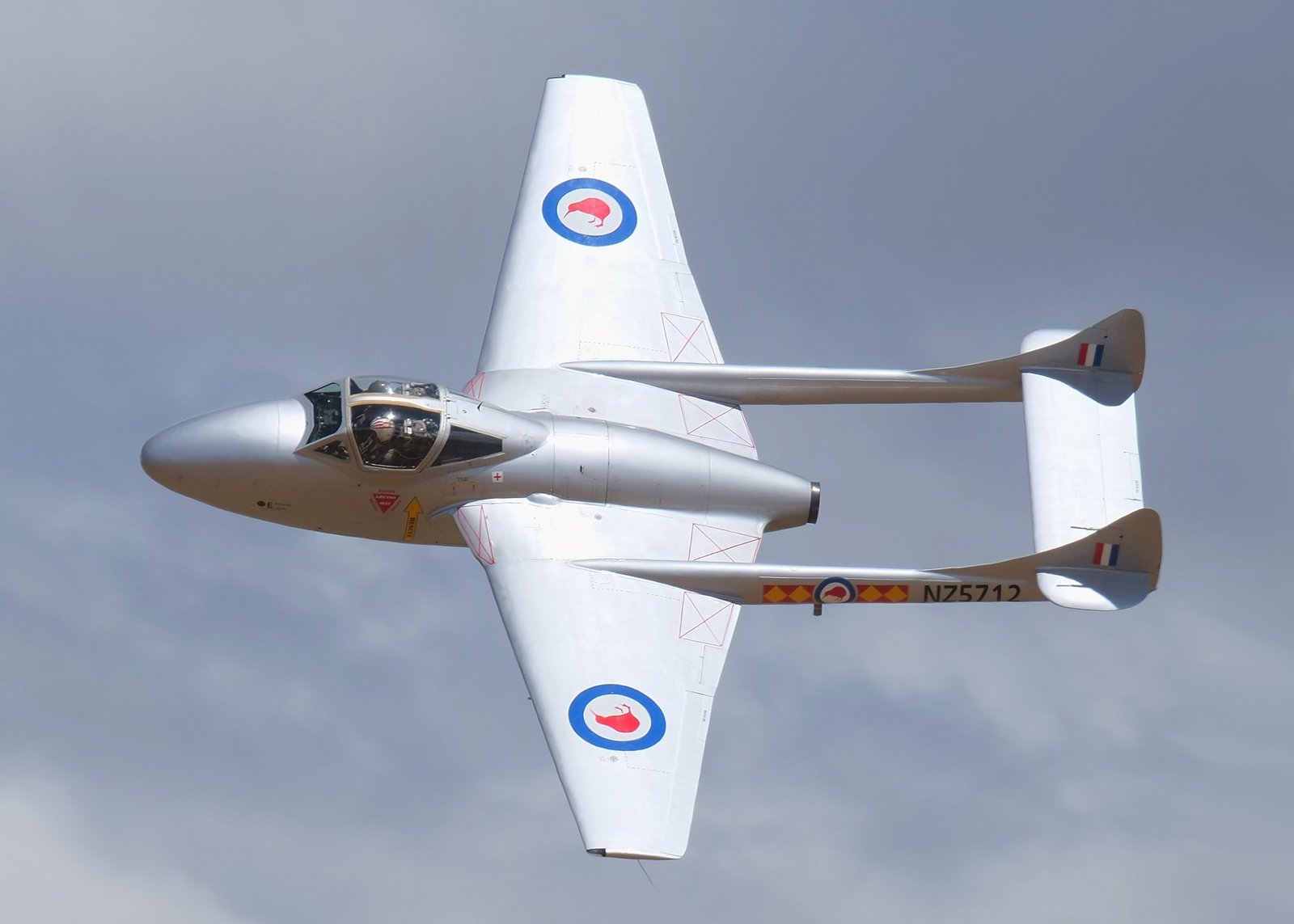
Designed by the de Havilland Aircraft Company under the leadership of Sir Geoffrey de Havilland, the DH.100 Vampire began development in May 1942. The prototype, originally designated the "Spider Crab," first took flight on September 20, 1943. The aircraft's design was characterized by a central fuselage pod and twin tail booms, a layout specifically chosen to ensure the short jet exhaust remained clear of the tailplane. It was among the earliest fighter aircraft to incorporate tricycle landing gear and standard cockpit pressurization.
Power was provided by the Halford H.1 centrifugal-flow turbojet, designed by Frank Halford. This engine was later refined and produced by de Havilland as the Goblin. While the prototype flew in 1943, the first production Vampire Mk I did not fly until April 1945. Worldwide production of the Vampire family, including single-seat fighters and two-seat trainers like the DH.115, continued from 1943 until approximately 1961. Production figures vary by source, with estimates ranging from 3,300 DH.100-series aircraft to a total of 3,987 aircraft across six countries, including Australia, where de Havilland Aircraft Pty built 80 units.
The Vampire entered operational service with the RAF in April 1946, with No. 247 Squadron being the first unit to receive the F.1 variant. It served as a day fighter and interceptor before transitioning into fighter-bomber and training roles. The aircraft achieved several historic milestones: on December 3, 1945, a Sea Vampire piloted by Captain Eric "Winkle" Brown became the first pure-jet aircraft to take off from and land on an aircraft carrier. Additionally, on July 14, 1948, six Vampire 3s from No. 54 Squadron completed the first trans-Atlantic jet crossing, arriving at Goose Bay, Labrador.
Beyond the UK, the Vampire was exported to over 15 countries, including Canada, where it was the RCAF's first jet fighter starting in 1948. It saw combat in the Suez Crisis, the Malayan Emergency, and the Rhodesian Bush War, with the Rhodesian Air Force operating the type until 1979. The Swiss Air Force maintained the Vampire in service until 1990, the latest operational retirement of the type. Today, the aircraft is preserved in museums such as the RAF Museum and the Canada Aviation and Space Museum, while a small number remain airworthy through private operators and the RAAF Temora Historic Flight.