
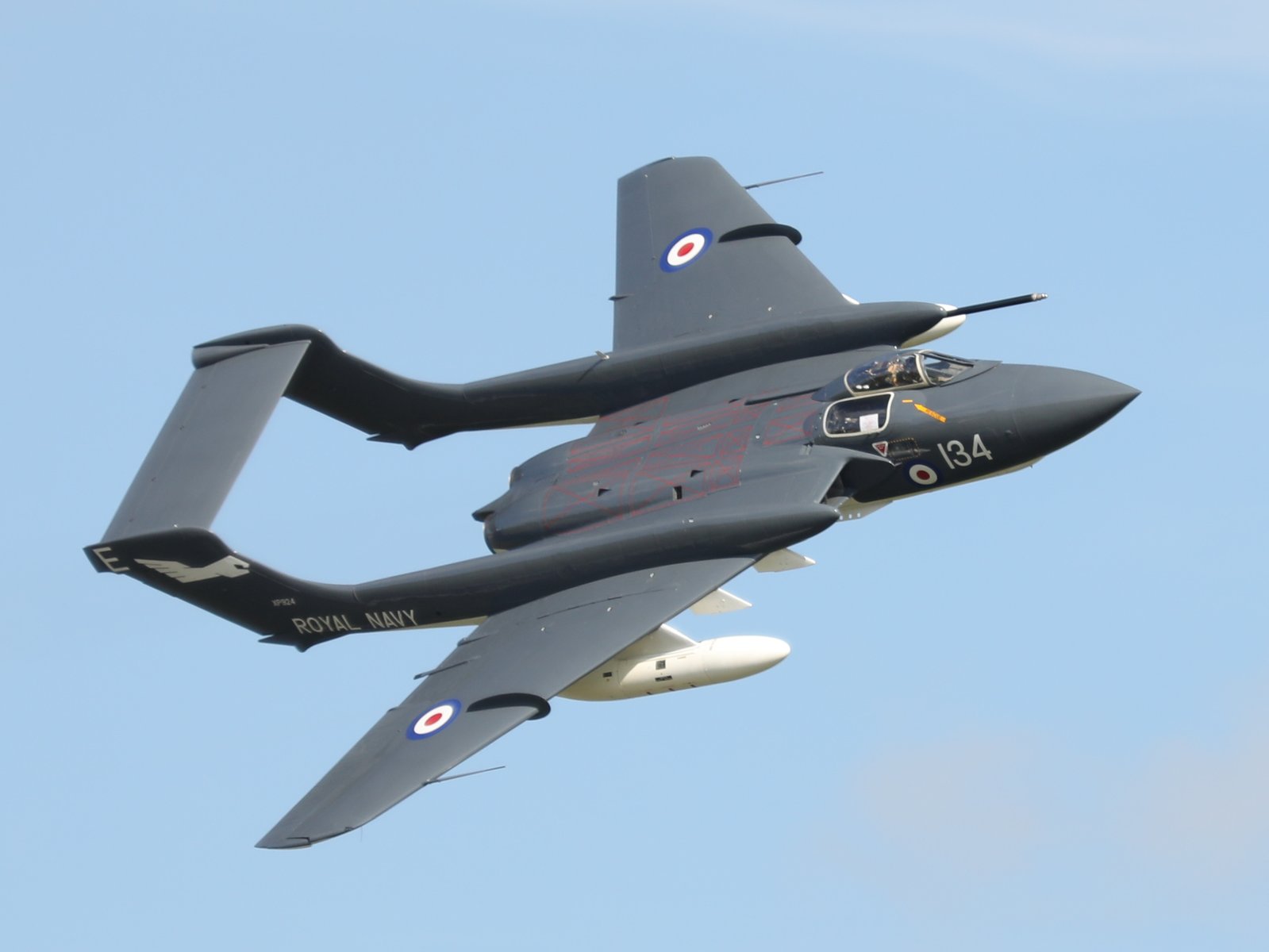
Design and Development
Conceived in the late 1940s as the de Havilland DH.110, the Sea Vixen was developed to succeed earlier first-generation jet fighters, such as the Sea Venom, in the fleet air defence role for the Royal Navy’s Fleet Air Arm. The aircraft featured a distinctive twin-boom tail and an unconventional offset cockpit layout; the pilot was positioned under a canopy offset to one side, while the radar observer sat lower and offset, lacking a conventional forward view. Notably, the Sea Vixen was the first British two-seat combat aircraft to achieve supersonic speed, although this was accomplished in a dive rather than in level flight.
Production and Manufacturer
The aircraft was designed by the de Havilland team at the Hatfield aircraft factory in Hertfordshire, UK. While the original builder was the de Havilland Aircraft Company, the aircraft later became known as the Hawker Siddeley Sea Vixen after de Havilland was absorbed into the Hawker Siddeley Group in 1960. Total production is estimated at fewer than 150 airframes across all variants, including the FAW.1 and FAW.2. The corporate lineage of the manufacturer eventually transitioned into British Aerospace in 1977 and subsequently into BAE Systems.
Technical Specifications
The Sea Vixen FAW.2 was powered by two Rolls-Royce Avon Mk 208 axial-flow turbojet engines, each producing 50 kN (11,000 lbf) of thrust, for a combined total of 100 kN. The aircraft had a maximum take-off weight of 46,750 lb and a service ceiling of 48,000 ft. In terms of performance, it reached a maximum speed of Mach 0.91 at sea level and possessed a range of 790 miles using internal fuel. A defining technical characteristic was its armament; it was the first British fighter designed without a built-in gun, relying instead on four Red Top or Firestreak air-to-air missiles, four Matra rocket pods (containing 18 SNEB 68 mm rockets each), and the capability to carry two 500 lb bombs.
Service History and Legacy
Operating exclusively with the Royal Navy's Fleet Air Arm, the first Sea Vixen-equipped squadron became operational at the end of the 1950s. Despite participating in various operations, the aircraft never engaged in direct combat during its service. The fleet began to wind down with the disbandment of 892 Naval Air Squadron in October 1968, and the final unit, 899 Naval Air Squadron, was disbanded on 23 January 1972. Following their retirement, some airframes were converted into pilotless target drones. The type's service record was marked by tragedy, with 30 fatal accidents reported. While some aircraft continued to fly in heritage roles, there have been no flying Sea Vixens since 2017.