
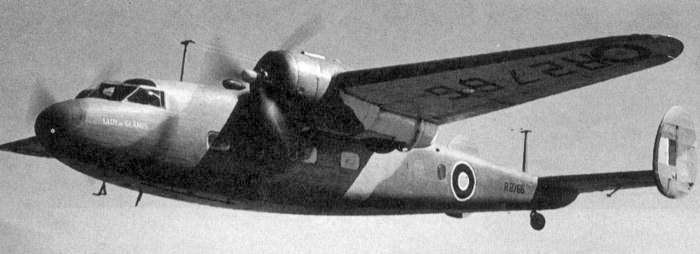
The de Havilland DH.95 Flamingo represented a significant technological shift for the de Havilland Aircraft Company, marking its transition from traditional wood-and-fabric construction to a modern all-metal, stressed-skin structure. Designed for short- to medium-range passenger services, the aircraft first took flight in December 1938, with sources citing the date as either December 22 or December 28. Early flight testing was associated with the company's chief test pilot, Geoffrey de Havilland Jr., though the aircraft was a broader company project rather than the work of a single designer.
Production took place at Hatfield, Hertfordshire, England, beginning in 1939. A total of eleven aircraft were manufactured, with the final delivery occurring in April 1941. The Flamingo was powered by two Bristol Perseus radial piston engines, manufactured by the Bristol Aeroplane Company, which provided 930 hp each. Technically, the aircraft featured a wingspan of 66 ft 0 in, a length of 45 ft 4 in, and a height of 14 ft 6 in. It achieved a maximum speed of approximately 243 mph and a cruising speed of 204 mph, with a range of roughly 1,400 miles when carrying lighter passenger loads.
In civil service, the Flamingo was utilized by several operators, including BOAC, British Air Transport, and the Egyptian government. Jersey Airways provided the first customer order, purchasing three aircraft configured for 17 passengers. Depending on the layout, the aircraft typically accommodated between 8 and 17 passengers, though some planning sources mentioned a maximum capacity of 20. BOAC utilized the type for managed services, including routes to the Middle East.
During the Second World War, the Flamingo was pressed into military service for the Royal Air Force, the Fleet Air Arm (specifically 782 Naval Air Squadron), and the King’s Flight. It performed general communications and transport duties, including a flight to Paris for Winston Churchill and royal evacuation planning in 1940. A military derivative known as the DH.95 Hertfordshire was proposed under Specification 19/39 to carry 22 soldiers, but the Air Ministry cancelled the order following unsatisfactory trials. Today, no complete examples of the Flamingo survive.