
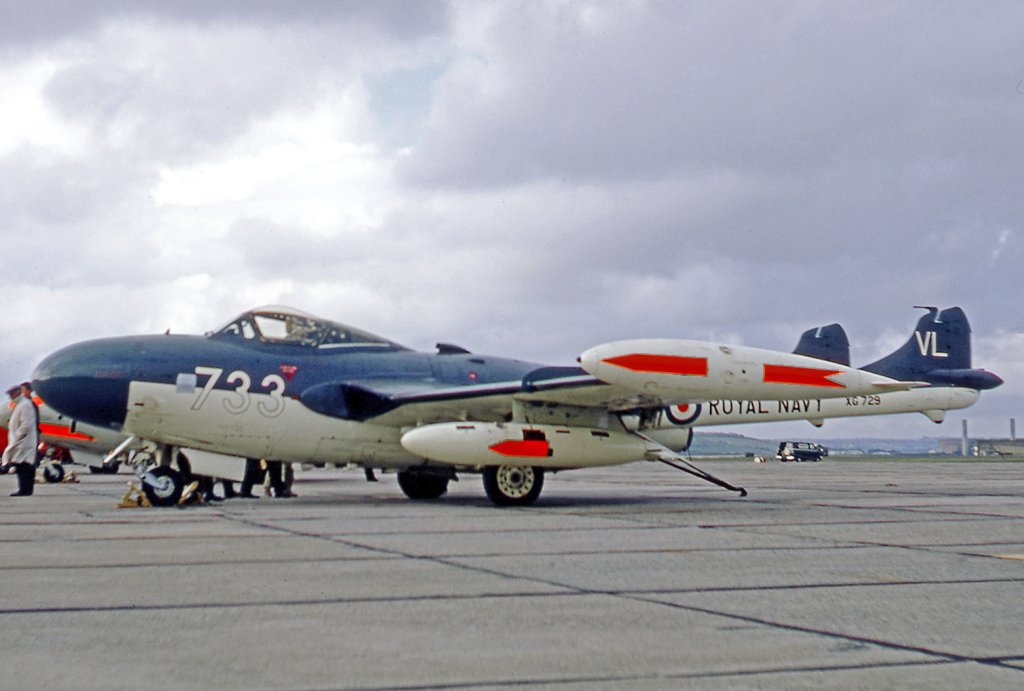
The de Havilland DH.112 Sea Venom was developed as a navalized adaptation of the RAF's two-seat Venom NF.3 night fighter. Designed and built at Hatfield, the aircraft was specifically tailored for the Fleet Air Arm, featuring a strengthened airframe, a long-stroke undercarriage, and an arrester hook to facilitate carrier operations. The Sea Venom prototype first flew on April 19, 1951. Its design was notable for incorporating a twin-boom tail layout and swept wings, powered by the de Havilland Ghost turbojet engine.
Production was centered in the United Kingdom, where 295 aircraft were built for the Royal Navy and the Royal Australian Navy. Additionally, France produced a derivative known as the Aquilon under license through SNCASE (Sud-Est) and Sud-Ouest Aviation; 75 two-seater Aquilon 202s were manufactured, with the first French-built example flying on March 25, 1954. The original manufacturer, de Havilland Aircraft Company Ltd., was founded in 1920 by Sir Geoffrey de Havilland. The company was later acquired by the Hawker Siddeley Group in 1959, eventually becoming part of British Aerospace in 1977, and now exists as BAE Systems plc.
Technically, the Sea Venom FAW.22 variant utilized a de Havilland Ghost 105 single-spool turbojet producing 5,300 lbf of static thrust. This allowed for a maximum speed of 575 mph and a service ceiling of 40,000 feet. To enable all-weather interception, the aircraft was equipped with AI Mk.21 radar, operated by an observer in the rear cockpit. Armament consisted of four 20 mm Hispano cannons in the fuselage, with the capability to carry under-wing bombs or unguided rockets.
Militarily, the Sea Venom saw extensive service. During the 1956 Suez Crisis (Operation Musketeer), squadrons including 809, 891, 892, 893, 894, and 895 NAS operated from HMS Albion and HMS Eagle to bomb targets in Egypt. The Royal Australian Navy operated 39 FAW.53 variants from 1956 to 1966, providing fleet protection and escorting HMAS Sydney to Vung Tau Harbour, Vietnam, in 1965 and 1966. French Aquilons were utilized in counter-insurgency operations in Algeria between 1957 and 1961. While the Royal Navy began replacing the type with the Sea Vixen in 1959, some remained in second-line service until 1970. In Australia, 724 Squadron used the aircraft for target towing until June 1973.