
Service History
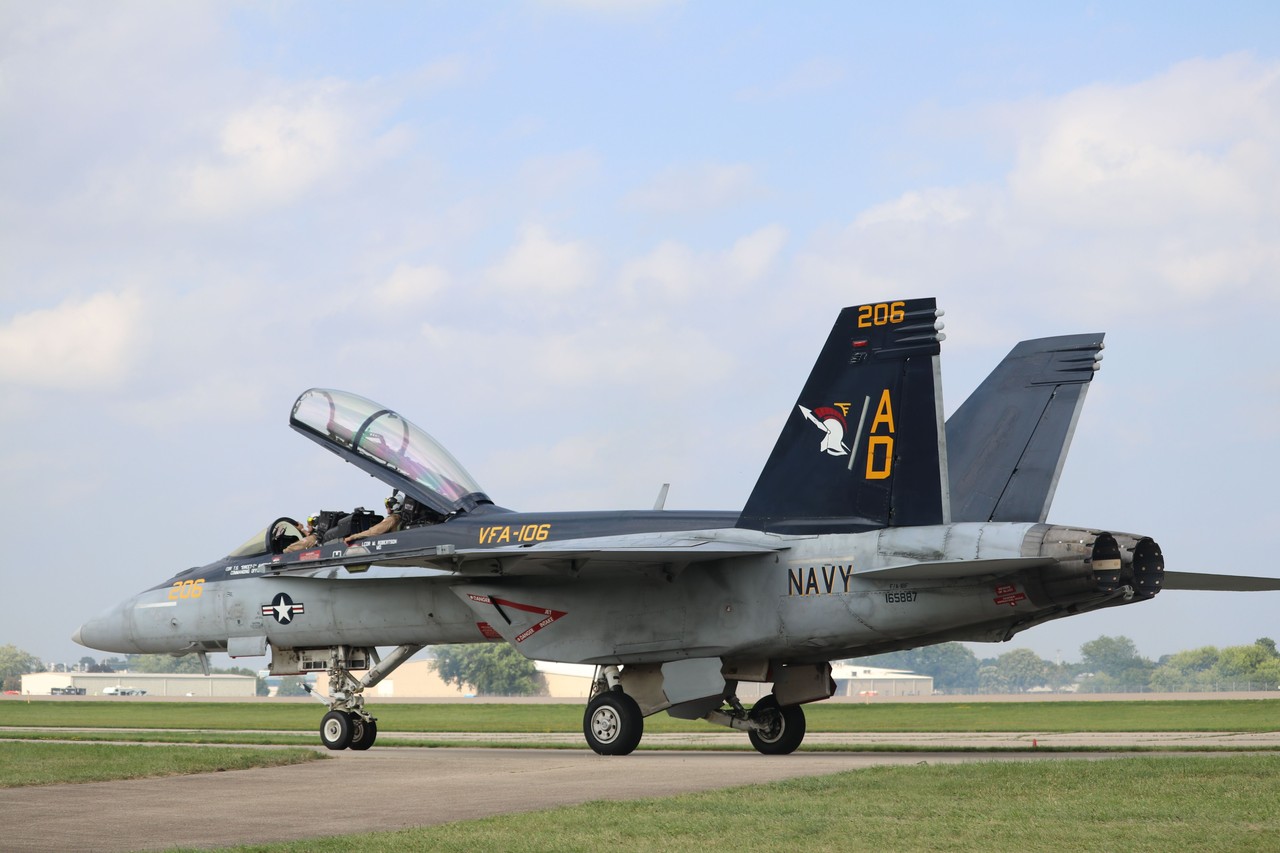
The Super Hornet entered U.S. Navy fleet service in 1999, achieving initial operating capability in 2001 as the service's premier carrier-based strike fighter. Within two decades, the aircraft became the backbone of naval aviation, designed to replace multiple legacy platforms including the Douglas A-4 Skyhawk, A-7 Corsair II, and remaining F-4 Phantom IIs while complementing the F-14 Tomcat. The Super Hornet's multirole capabilities allowed the Navy to consolidate its carrier air wings around fewer aircraft types, significantly reducing maintenance complexity and training requirements.
Production commenced in 1997 following the aircraft's successful development program, with full-rate production beginning in September of that year. The program is scheduled to conclude in 2027, representing three decades of continuous manufacturing and improvement.
Combat Operations
The Super Hornet proved its combat effectiveness on November 6, 2002, when two F/A-18Es from Strike Fighter Squadron 115 (VFA-115) conducted precision strikes against Iraqi surface-to-air missile launchers at Al Kut and an air defense bunker at Tallil Airbase during Operation Southern Watch. This marked the aircraft's operational debut in hostile territory, demonstrating the enhanced strike capabilities that distinguished it from the original Hornet.
The aircraft subsequently saw extensive combat action throughout Middle Eastern operations, building upon the combat legacy established by its predecessor. The original F/A-18 Hornet had already proven itself in the 1986 bombing of Libya, the 1991 Gulf War, operations over Bosnia and Kosovo during the 1990s, and the 2003 Iraq War.
The Manufacturer
McDonnell Douglas developed the Super Hornet as an evolutionary improvement over their successful F/A-18 Hornet design. The company had originally won the naval fighter competition in 1976, defeating a competing design from Vought and General Dynamics. McDonnell Douglas itself had been formed through the acquisition of the established Douglas Company in the late 1970s, combining two storied aviation manufacturers.
Boeing acquired McDonnell Douglas in 1997, coinciding with the Super Hornet's entry into production. Under Boeing's stewardship, the program continued to evolve with ongoing improvements and modernization efforts. The transition maintained continuity in the aircraft's development while leveraging Boeing's extensive aerospace capabilities.
Engine & Technical Innovations
The Super Hornet is powered by two General Electric F414 turbofan engines, representing a significant advancement over the F404 engines used in the original Hornet. The F414 provides substantially increased thrust and improved fuel efficiency, directly contributing to the aircraft's enhanced combat radius and payload capacity.
The aircraft features a two-variant configuration: the single-seat E model optimized for strike missions, and the two-seat F variant that serves dual roles as a trainer and operational aircraft. The F model's second crew station allows for shared workload distribution during complex missions, enhancing operational effectiveness during deployments.
Design improvements over the original Hornet include enlarged wing surfaces, increased fuel capacity, and enhanced avionics systems. These modifications resulted in superior carrier suitability and expanded mission flexibility compared to earlier naval fighters.
Operational Characteristics
Naval aviators praise the Super Hornet for its forgiving handling characteristics and exceptional carrier landing qualities. The aircraft's stable flight envelope and predictable responses make it particularly well-suited for the demanding environment of carrier operations, where precision and reliability are paramount.
The Super Hornet's multirole capabilities allow a single aircraft to perform air-to-air intercept, close air support, and precision strike missions within the same sortie. This versatility proved crucial as carrier air wings reduced their overall aircraft complement while maintaining mission effectiveness.
Production & Legacy
While exact production totals for the Super Hornet remain classified, the program represents one of the most successful naval aviation acquisitions of the modern era. The aircraft continues serving as the U.S. Navy's primary strike fighter, with ongoing modernization programs ensuring its relevance through the 2040s.
The Super Hornet's success validated the evolutionary approach to fighter development, demonstrating that systematic improvements to proven designs could achieve capabilities comparable to entirely new aircraft at reduced cost and risk. This development philosophy influenced subsequent naval aviation programs and established Boeing as a major military aircraft manufacturer following the McDonnell Douglas acquisition.
Today, Super Hornets operate from all U.S. Navy aircraft carriers, forming the core of America's sea-based air power projection capability. The aircraft's combination of reliability, versatility, and combat effectiveness ensures its continued importance in naval operations worldwide.