
Design and Development
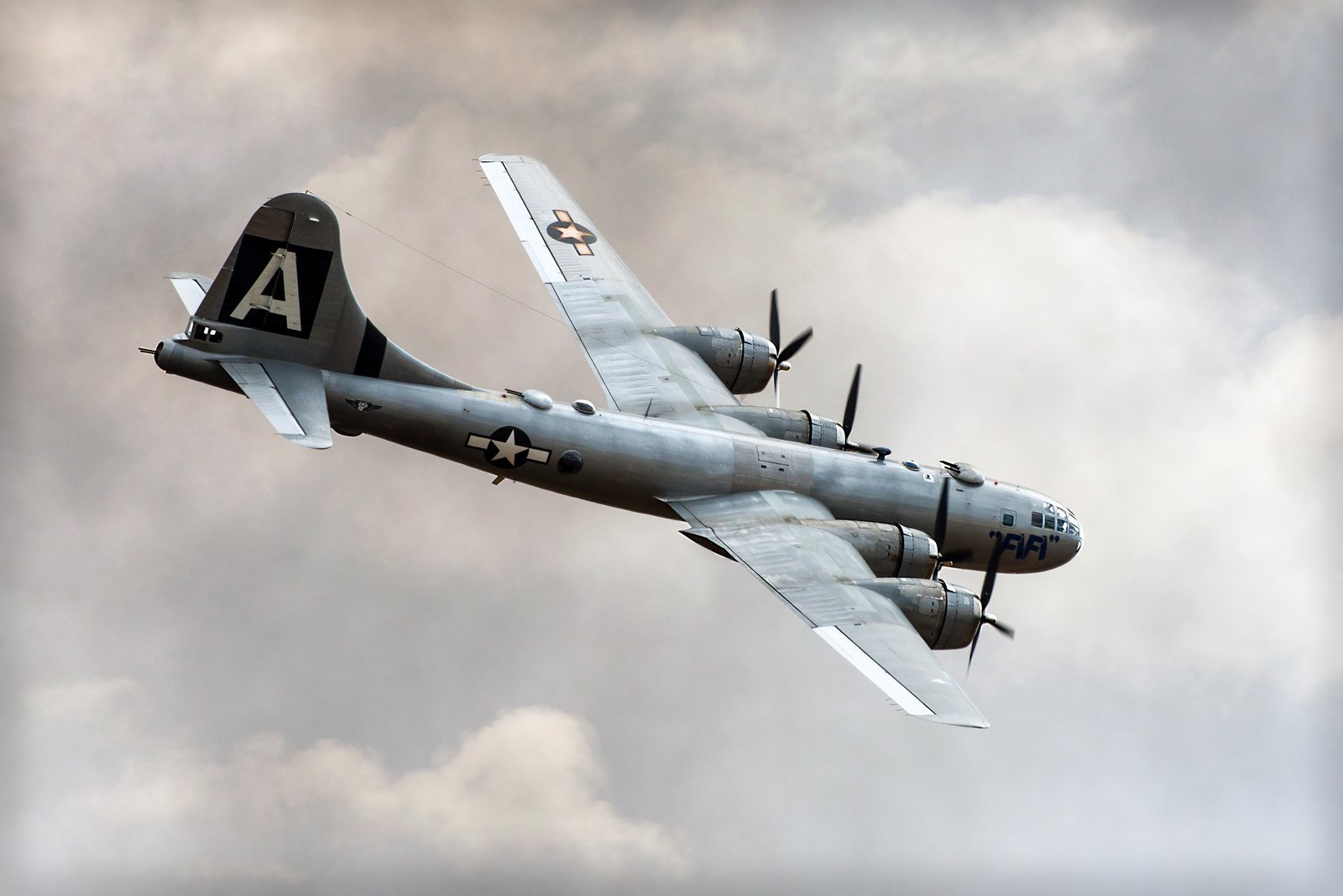
Designed by Boeing, the B-29 Superfortress was developed as a large, high-altitude strategic bomber intended to replace the B-17 Flying Fortress. The aircraft incorporated several cutting-edge technologies for its era, most notably a pressurized cabin to allow crews to operate at high altitudes and tricycle landing gear. To enhance defensive capabilities, Boeing integrated a remote, computer-controlled fire-control system to manage the aircraft's turrets.
Production and Technical Specifications
The B-29 was produced between 1943 and 1946, with production centered at Boeing's Wichita, Kansas plant and other company sites. The airframe measures 99 feet in length with a wingspan of 141 feet 3 inches and a height of 27 feet 9 inches. It is powered by four Wright R-3350 radial piston engines (specifically the -23 or -57 models), each capable of producing 2,200 hp. These powerplants enable the bomber to achieve a range of 4,100 miles.
Military Service
Primarily operated by the United States, the B-29 served as a strategic bomber during both World War II and the Korean War. The type is historically significant as the only aircraft to have dropped nuclear weapons during wartime, specifically targeting the cities of Hiroshima and Nagasaki. While the B-29 program saw extensive combat, the specific airframe known as FIFI was built in Kansas in 1945 and did not see combat service, instead serving in non-combat roles.
Civil Service and Restoration
Following its military tenure, FIFI served as an administrative aircraft and was later placed in storage before returning to duty in 1953. By the early 1970s, the aircraft was located at the U.S. Navy Proving Ground at China Lake, California, where it had been utilized as a missile target. The Commemorative Air Force acquired the airframe and began a comprehensive restoration process. This effort culminated in 2010 when the aircraft returned to flight, featuring four new custom-built hybrid engines. Today, FIFI is based at the Victor N. Agather Hangar at Dallas Executive Airport in Texas and conducts annual tours across the United States and Canada. Along with an aircraft named Doc, FIFI is one of only two B-29s currently flying worldwide.