
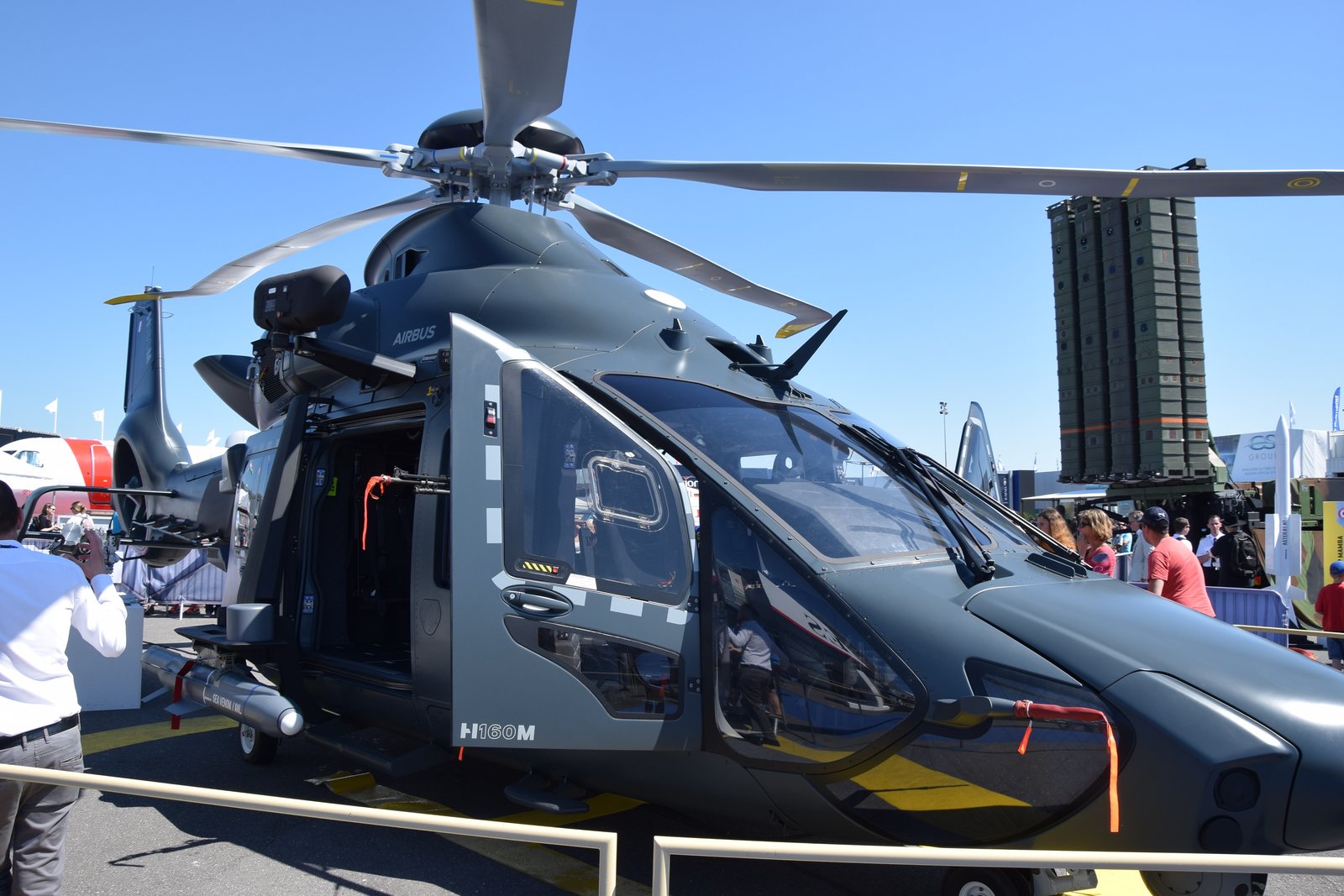
The Airbus Helicopters H160M Guépard is a military derivative of the civil H160, developed to serve as a common platform for the French Army, Navy, and Air & Space Force. The program is part of the Hélicoptère Interarmées Léger (HIL) initiative launched in 2017 by the French Ministry of the Armed Forces. The H160M is intended to replace five legacy helicopter types: the SA 342M Gazelle, AS555 Fennec, AS365/AS565 Dauphin/Panther, and the Alouette III.
Developed at Airbus Helicopters' headquarters in Marignane, France, the H160M incorporates 68 patented technologies to enhance safety and efficiency. Its design is characterized by a five-blade Spheriflex main rotor and an enclosed, canted Fenestron tail rotor. The aircraft's first flight took place in July 2025 at Marignane, with a crew consisting of one test pilot and three flight-test engineers. While serial production has not yet begun, deliveries to the French Armed Forces are scheduled to start in late 2028 under the French Military Programming Law 2024–2030.
Technically, the H160M is powered by two Safran Arrano turboshaft engines, each providing approximately 1,100 shaft horsepower. The aircraft is equipped with Thales FlytX avionics, a Thales AirMaster C AESA radar, and a Safran Euroflir 410 EO/IR turret. For combat capabilities, it utilizes the HForce modular weapon system, which supports 7.62 mm door guns, 12.7 mm gun pods, and guided rockets. Its performance includes a top speed of approximately 330 km/h.
Planned procurement totals 169 aircraft for the armed forces: 80 for the Aviation légère de l’Armée de terre (ALAT), 49 for the Marine nationale, and 40 for the Armée de l’Air et de l’Espace. The ALAT will utilize the H160M for armed reconnaissance and special forces infiltration, while the Navy will employ it for maritime patrol and anti-ship warfare. The Air & Space Force will use the platform for air policing and search and rescue. The H160M is notably the first Airbus helicopter designed for native manned-unmanned teaming, allowing it to cooperate directly with drones.