
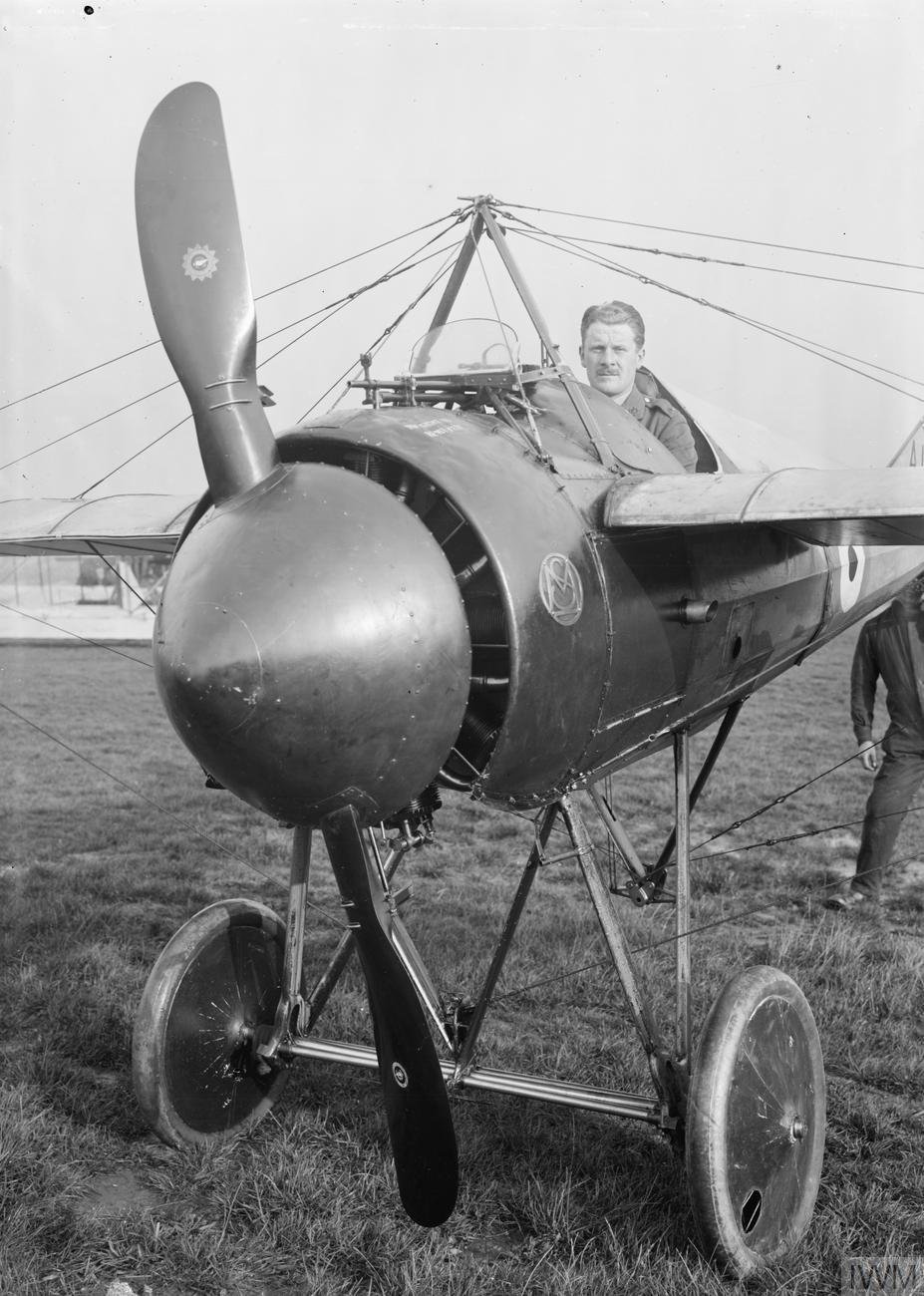
The Morane-Saulnier N was a French single-seat fighter developed during the early stages of the First World War. Introduced in 1914 and entering active service in April 1915, the aircraft represented a critical evolution in aerial combat. It was specifically designed as a streamlined tractor monoplane, a configuration that helped define the trajectory of fighter development. The aircraft is most significant for its early implementation of a forward-firing weapon system; rather than using a mechanical synchronization gear, it utilized deflector wedges to allow a machine gun to fire through the propeller arc. This innovative concept was famously utilized by Roland Garros, contributing heavily to the aircraft's reputation.
Production of the Morane-Saulnier N took place in France between 1914 and 1915, with a total of 49 aircraft built. The aircraft was powered by a Le Rhône 9C engine, a 9-cylinder air-cooled rotary piston engine capable of producing 80 hp (approximately 60 kW). In terms of armament, the fighter was equipped with a single unsynchronized forward-firing gun, which varied between a 7.9 mm Hotchkiss or a .303 in Vickers machine gun depending on the specific variant.
Technically, the aircraft featured a wingspan of 8.15 m and a length of 5.83 m, with a wing area of 11 m². It had an empty weight of 288 kg and a loaded weight of 444 kg. These specifications allowed the Morane-Saulnier N to reach a maximum speed of 144 km/h and operate at a service ceiling of 4,000 m. Its operational range was 225 km, with a flight endurance of 1 hour and 30 minutes.
During its military service, the aircraft was operated by several nations. The French Aéronautique Militaire utilized the type, as did the British Royal Flying Corps, which operated the aircraft across four squadrons. Additionally, the Imperial Russian Air Force employed the fighter in limited numbers, including the 19th Squadron, and three aircraft were operated by the Ukrainian People's Republic Air Fleet. While no original wartime aircraft are known to survive, the legacy of the Morane-Saulnier N is preserved through reproductions. The Old Rhinebeck Aerodrome maintains a reproduction built from a Morane-Saulnier A.I fuselage, and the Western North Carolina Air Museum displays a full-scale replica of an N1 “Bullet.”